

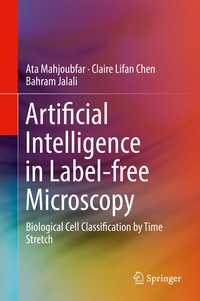
Artificial Intelligence in Label-free Microscopy
Description

This book introduces time-stretch quantitative phase imaging (TS-QPI), a high-throughput label-free imaging flow cytometer developed for big data acquisition and analysis in phenotypic screening. TS-QPI is able to capture quantitative optical phase and intensity images simultaneously, enabling high-content cell analysis, cancer diagnostics, personalized genomics, and drug development. The authors also demonstrate a complete machine learning pipeline that performs optical phase measurement, image processing, feature extraction, and classification, enabling high-throughput quantitative imaging that achieves record high accuracy in label -free cellular phenotypic screening and opens up a new path to data-driven diagnosis.
More details
Other editions
Additional editions
Persons
Claire Lifan Chen is a senior application engineer at Lumentum Operations LLC. She received her Ph.D. degree in Electrical Engineering and M.Sc. degree in Bioengineering at University of California, Los Angeles in 2015 and 2012, respectively. She received her B.Sc. degree in Optics Science and Engineering from Fudan University, China in 2010. Dr. Chen was a member of California NanoSystems Institute from 2013 to 2015 and the president of OSA/SPIE student chapter at UCLA in 2015. She has authored and co-authored 14 peer-reviewed publications and 2 patents. Her research interests include machine learning, data acquisition and analytics, image processing, and high-throughput imaging with applications in biomedical and information technologies.
Bahram Jalali is the Northrop-Grumman Endowed Chair and Professor of Electrical Engineering at UCLA with joint appointments in Biomedical Engineering, California NanoSystems Institute (CNSI) and Department of Surgery at the UCLA School of Medicine. He is the inventor of the Photonic Time Stretch, a measurement technique that has led to discoveries of new scientific phenomena and to technological inventions. He received his Ph.D. in Applied Physics from Columbia University in 1989 and was with Bell Laboratories in Murray Hill, New Jersey until 2002 before joining UCLA. He is a Fellow of IEEE, the Optical Society of America (OSA), the American Physical Society (APS) and SPIE. He is the recipient of the R.W. Wood Prize from Optical Society of America for the invention and demonstration of the first Silicon Laser, the Aron Kressel Award of the IEEE Photonics Society, the Achievement Medal from IET for his contributions to field of instrumentation for cancer detection, and the Distinguished Engineering Achievement Award from the Engineers Council. He was the founder and CEO of Cognet, a CMOS fiber optics company that was acquired by Intel in 2001. In 2005 he was elected into the Scientific American Top 50, and received the BrideGate 20 Award in 2001 for his entrepreneurial accomplishments and contributions to Southern California economy.
