

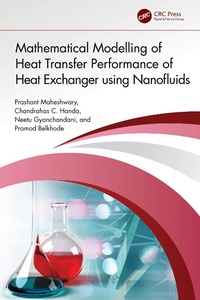
Mathematical Modelling of Heat Transfer Performance of Heat Exchanger using Nanofluids
1st Edition
Published on 19. September 2023
148 pages
978-1-000-93714-5 (ISBN)
Description

The book presents a detailed discussion of nanomaterials, nanofluids and application of nanofluids as a coolant to reduce heat transfer. It presents a detailed approach to the formulation of mathematical modelling applicable to any type of case study with a validation approach and sensitivity and optimization.
Covers the aspects of formulation of mathematical modelling with optimization and sensitivity analysis
Presents a case study based on heat transfer improvement and performs operations using nanofluids
Examines the analysis of experimental data by the formulation of a mathematical model and correlation between input data and output data
Illustrates heat transfer improvement of heat exchangers using nanofluids through the mathematical modelling approach
Discusses applications of nanofluids in cooling systems
This book discusses the aspect of formulation of mathematical modelling with optimization and sensitivity analysis. It further presents a case study based on the heat transfer improvement and performing operations using nanofluids. The text covers sensitivity analysis and analysis from the indices of the model. It also discusses important concepts such as nanomaterials, applications of nanomaterials, and nanofluids. It will serve as an ideal reference text for senior undergraduate, and graduate students in fields including mechanical engineering, chemical engineering, aerospace engineering, industrial engineering, and manufacturing engineering.
Covers the aspects of formulation of mathematical modelling with optimization and sensitivity analysis
Presents a case study based on heat transfer improvement and performs operations using nanofluids
Examines the analysis of experimental data by the formulation of a mathematical model and correlation between input data and output data
Illustrates heat transfer improvement of heat exchangers using nanofluids through the mathematical modelling approach
Discusses applications of nanofluids in cooling systems
This book discusses the aspect of formulation of mathematical modelling with optimization and sensitivity analysis. It further presents a case study based on the heat transfer improvement and performing operations using nanofluids. The text covers sensitivity analysis and analysis from the indices of the model. It also discusses important concepts such as nanomaterials, applications of nanomaterials, and nanofluids. It will serve as an ideal reference text for senior undergraduate, and graduate students in fields including mechanical engineering, chemical engineering, aerospace engineering, industrial engineering, and manufacturing engineering.
More details
Edition
1. Auflage
Language
English
Place of publication
London
United Kingdom
Publishing group
Taylor & Francis Ltd
Target group
College/higher education
Product notice
Reflowable
Illustrations
45 Tables, black and white; 53 Line drawings, black and white; 3 Halftones, black and white; 50 Illustrations, color; 6 Illustrations, black and white
ISBN-13
978-1-000-93714-5 (9781000937145)
Copyright in bibliographic data and cover images is held by Nielsen Book Services Limited or by the publishers or by their respective licensors: all rights reserved.
Schweitzer Classification
Other editions
Additional editions
Prashant Maheshwary | Chandrahas C. Handa | Neetu Gyanchandani
Mathematical Modelling of Heat Transfer Performance of Heat Exchanger using Nanofluids
Book
01/2025
1st Edition
CRC Press
€70.50
Shipment within 10-20 days
Prashant Maheshwary | Chandrahas C. Handa | Neetu Gyanchandani
Mathematical Modelling of Heat Transfer Performance of Heat Exchanger using Nanofluids
Book
09/2023
1st Edition
CRC Press
€139.90
Shipment within 10-20 days
Persons
Dr. P. B. Maheshwary is Dean, Faculty of Science and Technology, Rashtrasant Tukadoji Maharaj Nagpur University, Nagpur. He did his double doctoral research degree in two different specialization (Machine Design and Thermal Engineering) of Mechanical Engineering. His area of research is nanomaterials and nanoscience, Thermal Engineering and Mechanism and Machines. Subject taught earlier are heat transfer, thermodynamics, characterization of nanomaterials, application of nanomaterials at UG and PG level. An accomplished Teaching Professional with more than 3 decades of teaching experience and 10 years of research experience. Published more than twenty research papers in SCI and Scopus (A+) indexed international journals. In-depth administrative experience gained being the Director of an Educational Institute since 2008. A self-driven, result oriented person with flexibility and ability to connect to all levels in an organization. Continuous self-development and continuous learning have added to his knowledge and is an asset to the Institution he is associated with.
Dr. Chandrahas C. Handa is a Professor and Head of Department of Mechanical Engineering at Karmaveer Dadasaheb Kannamwar College of Engineering (KDKCE), Rashtrasant Tukadoji Maharaj Nagpur University (RTMNU), Nagpur, India. His area of research includes photovoltaic cells and nano sensors. He is teaching subject such as machine design, optimization techniques and genetic logarithm. He obtained his PhD in Mechanical Engineering from RTMNU, Nagpur. He has more than 33 years of teaching, administrative and 25 years of research experience. He has published 124 research papers in international/national journals and presented 99 papers in international/national conferences. He has guided 12 PhD students at RTMNU, Nagpur. He is recipient of five Best Teacher Awards including award given by RTMNU, Nagpur. He got many research, development and training grants of more than 20 million from various Central Ministries of Government of India. He has published 4 Patents and 5 Copyrights. He is Ex Treasurer ISTE, New Delhi. He has Worked as Principal, Vice Principal, Dean of Engineering College in the past. He has developed more than 50 machines. He has received Research Grants from AICTE and Industries.
Dr. (Mrs) Neetu Gyanchandani did her Doctoral research in the area of Electronics Engineering. She is currently Dean (R & D), S. B. Jain Institute of Technology, Management and Research, Nagpur, Maharashtra, India. Her area of research is application of nanospintronics, composite materials and image processing. She is teaching subject such as application of nanospintronics, computer materials and image processing at UG and PG level. She is capable, academician and an administrator with more than 18 years of teaching experience. She has been awarded as best women teacher of Engineering College by Indian Society of Technical Education, New Delhi. She is also single point contact (SPoC) for indigenous MOOCs platform Swayam NPTEL, since last five years. Under her leadership a centre of excellence in industrial robotics is started by IIT Mumbai in her department. She has published more than five patents and ten research papers.
Dr. Pramod Belkhode did his doctoral research degree in Mechanical Engineering from Rashtrasant Tukadoji Maharaj Nagpur University, Nagpur. He is working as Assistant Professor at Laxminarayan Institute of Technology since 2009. His area of research is mathematical modelling and simulation. He published more than fifty research papers in international Journals, four patents and delivered more than 30 guest lectures on various topics.
Dr. Chandrahas C. Handa is a Professor and Head of Department of Mechanical Engineering at Karmaveer Dadasaheb Kannamwar College of Engineering (KDKCE), Rashtrasant Tukadoji Maharaj Nagpur University (RTMNU), Nagpur, India. His area of research includes photovoltaic cells and nano sensors. He is teaching subject such as machine design, optimization techniques and genetic logarithm. He obtained his PhD in Mechanical Engineering from RTMNU, Nagpur. He has more than 33 years of teaching, administrative and 25 years of research experience. He has published 124 research papers in international/national journals and presented 99 papers in international/national conferences. He has guided 12 PhD students at RTMNU, Nagpur. He is recipient of five Best Teacher Awards including award given by RTMNU, Nagpur. He got many research, development and training grants of more than 20 million from various Central Ministries of Government of India. He has published 4 Patents and 5 Copyrights. He is Ex Treasurer ISTE, New Delhi. He has Worked as Principal, Vice Principal, Dean of Engineering College in the past. He has developed more than 50 machines. He has received Research Grants from AICTE and Industries.
Dr. (Mrs) Neetu Gyanchandani did her Doctoral research in the area of Electronics Engineering. She is currently Dean (R & D), S. B. Jain Institute of Technology, Management and Research, Nagpur, Maharashtra, India. Her area of research is application of nanospintronics, composite materials and image processing. She is teaching subject such as application of nanospintronics, computer materials and image processing at UG and PG level. She is capable, academician and an administrator with more than 18 years of teaching experience. She has been awarded as best women teacher of Engineering College by Indian Society of Technical Education, New Delhi. She is also single point contact (SPoC) for indigenous MOOCs platform Swayam NPTEL, since last five years. Under her leadership a centre of excellence in industrial robotics is started by IIT Mumbai in her department. She has published more than five patents and ten research papers.
Dr. Pramod Belkhode did his doctoral research degree in Mechanical Engineering from Rashtrasant Tukadoji Maharaj Nagpur University, Nagpur. He is working as Assistant Professor at Laxminarayan Institute of Technology since 2009. His area of research is mathematical modelling and simulation. He published more than fifty research papers in international Journals, four patents and delivered more than 30 guest lectures on various topics.
Content
Chapter 1
Nanofluids
1.1 Nanotechnology
1.2 Nanomaterials
1.3 Applications of Nanomaterials
1.4 Nanofluids
1.5 Compact Heat Exchangers
1.6 Heat Transfer Enhancement through Nanofluids
1.7 Improvement in Heat Exchanger Performance
1.8 Application of Nanofluid in Cooling Systems
1.9 Mathematical Modelling
Chapter 2
Concept of Experimental Data-Based Modelling
2.1 Introduction
2.2 Nanofluid for Heat Transfer
2.3 Brief Methodology of Theory of Experimentation
2.4 Methods of Experimentation
Chapter 3
Design of Experimentation
3.1 Introduction
3.2 Design of Experiment - Methodical Approach
3.3 Experimental Setup and Procedure
3.4 Two-Wire Method
3.5 Radiator as a Heat Exchanger: Experimental Procedure
3.6 Design of Instrumentation for Experimental Setup
3.7 Components of Instrumentation Systems
3.8 Identification of Variables in Phenomenon
3.9 Mathematical Relationship for Heat Transfer Phenomena
3.10 Formation of Pi Terms for Dependent & Independent
3.11 Reduction of Variables by Dimensional Analysis
3.12 Plan for Experimentation
3.13 Experimental Observations
3.14 Sample Selection
Chapter 4
Mathematical Models
4.1 Introduction
4.2 Model Classification
4.3 Formulation of Experimental Data-Based Models (Two-Wire Method)
4.4 Sample Calculations of Pi Terms
Chapter 5
Analysis using SPSS Statistical Packages Software
5.1 Introduction
5.2 Developing the SPSS Model for Individual Pi Terms
5.3 SPSS Output for Thermal Conductivity K? (Concentration)
5.4 SPSS Output for Thermal Conductivity Kt (Size)
5.5 SPSS Output for Thermal Conductivity Ks (Shape)
5.6 SPSS Output for ?D1 (Temperature Difference, ?T)
5.7 SPSS Output for ?D2 (Heat Flow, Q)
5.8 SPSS Output for ?D3 (Heat Transfer Coefficient, h)
Chapter 6
Analysis of Model using Artificial Neural Network Programming
6.1 Introduction
6.2 Procedure for Artificial Neural Network Phenomenon
6.3 Performance of Models by ANN
6.3.1 ANN using SPSS o/p for Thermal Conductivity K?
6.3.2 ANN using SPSS o/p for Thermal Conductivity Kt (Size)
6.3.3 ANN using SPSS o/p for Thermal Conduct. Ks (Shape)
6.3.4 ANN using MATLAB Program for ?D1 (Temp. Diffe., ?T)
6.3.5 Comparison of Various Model Values
Chapter 7
Analysis of the Indices of Model
7.1 Introduction
7.2 Analysis of the Model for Dependent Pi Term ?D1 (K?)
7.3 Analysis of the Model for Dependent Pi Term ?D2 (Kt)
7.4 Analysis of the Model for Dependent Pi Term ?D3 (Ks)
7.5 Analysis of the Model for Dependent Pi Term ?D1 (?T)
7.6 Analysis of the Model for Dependent Pi Term ?D2 (Q)
7.7 Analysis of the Model for Dependent Pi Term ?D3 (h)
Chapter 8
Optimization and Sensitivity Analysis
8.1 Introduction
8.2 Optimization of the Models
8.3 Sensitivity Analysis for Two-Wire Method
8.4 Estimation of Limiting Values of Response Variables
8.5 Performance of the Models
8.6 Reliability of Models
8.7 Coefficient of Determinants R2 for Two-Wire Method
Chapter 9
Interpretation of the Simulation
9.1 Interpretation of Independent Variables vs. Response Variables after Optimization
9.2 Interpretation of Temperature Difference against the Mass Flow Rate
9.3 Interpretation of Reliability and Coefficient of Determinant
9.4 Interpretation of Mean Error of Models Corresponding to Response Variables
Nanofluids
1.1 Nanotechnology
1.2 Nanomaterials
1.3 Applications of Nanomaterials
1.4 Nanofluids
1.5 Compact Heat Exchangers
1.6 Heat Transfer Enhancement through Nanofluids
1.7 Improvement in Heat Exchanger Performance
1.8 Application of Nanofluid in Cooling Systems
1.9 Mathematical Modelling
Chapter 2
Concept of Experimental Data-Based Modelling
2.1 Introduction
2.2 Nanofluid for Heat Transfer
2.3 Brief Methodology of Theory of Experimentation
2.4 Methods of Experimentation
Chapter 3
Design of Experimentation
3.1 Introduction
3.2 Design of Experiment - Methodical Approach
3.3 Experimental Setup and Procedure
3.4 Two-Wire Method
3.5 Radiator as a Heat Exchanger: Experimental Procedure
3.6 Design of Instrumentation for Experimental Setup
3.7 Components of Instrumentation Systems
3.8 Identification of Variables in Phenomenon
3.9 Mathematical Relationship for Heat Transfer Phenomena
3.10 Formation of Pi Terms for Dependent & Independent
3.11 Reduction of Variables by Dimensional Analysis
3.12 Plan for Experimentation
3.13 Experimental Observations
3.14 Sample Selection
Chapter 4
Mathematical Models
4.1 Introduction
4.2 Model Classification
4.3 Formulation of Experimental Data-Based Models (Two-Wire Method)
4.4 Sample Calculations of Pi Terms
Chapter 5
Analysis using SPSS Statistical Packages Software
5.1 Introduction
5.2 Developing the SPSS Model for Individual Pi Terms
5.3 SPSS Output for Thermal Conductivity K? (Concentration)
5.4 SPSS Output for Thermal Conductivity Kt (Size)
5.5 SPSS Output for Thermal Conductivity Ks (Shape)
5.6 SPSS Output for ?D1 (Temperature Difference, ?T)
5.7 SPSS Output for ?D2 (Heat Flow, Q)
5.8 SPSS Output for ?D3 (Heat Transfer Coefficient, h)
Chapter 6
Analysis of Model using Artificial Neural Network Programming
6.1 Introduction
6.2 Procedure for Artificial Neural Network Phenomenon
6.3 Performance of Models by ANN
6.3.1 ANN using SPSS o/p for Thermal Conductivity K?
6.3.2 ANN using SPSS o/p for Thermal Conductivity Kt (Size)
6.3.3 ANN using SPSS o/p for Thermal Conduct. Ks (Shape)
6.3.4 ANN using MATLAB Program for ?D1 (Temp. Diffe., ?T)
6.3.5 Comparison of Various Model Values
Chapter 7
Analysis of the Indices of Model
7.1 Introduction
7.2 Analysis of the Model for Dependent Pi Term ?D1 (K?)
7.3 Analysis of the Model for Dependent Pi Term ?D2 (Kt)
7.4 Analysis of the Model for Dependent Pi Term ?D3 (Ks)
7.5 Analysis of the Model for Dependent Pi Term ?D1 (?T)
7.6 Analysis of the Model for Dependent Pi Term ?D2 (Q)
7.7 Analysis of the Model for Dependent Pi Term ?D3 (h)
Chapter 8
Optimization and Sensitivity Analysis
8.1 Introduction
8.2 Optimization of the Models
8.3 Sensitivity Analysis for Two-Wire Method
8.4 Estimation of Limiting Values of Response Variables
8.5 Performance of the Models
8.6 Reliability of Models
8.7 Coefficient of Determinants R2 for Two-Wire Method
Chapter 9
Interpretation of the Simulation
9.1 Interpretation of Independent Variables vs. Response Variables after Optimization
9.2 Interpretation of Temperature Difference against the Mass Flow Rate
9.3 Interpretation of Reliability and Coefficient of Determinant
9.4 Interpretation of Mean Error of Models Corresponding to Response Variables
