

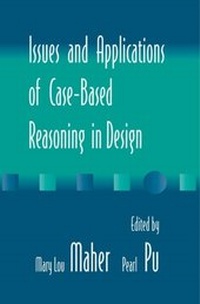
Issues and Applications of Case-Based Reasoning to Design
1st Edition
Published on 25. February 2014
360 pages
978-1-317-77891-2 (ISBN)
Description

Design is believed to be one of the most interesting and challenging problem-solving activities ever facing artificial intelligence (AI) researchers. Knowledge-based systems using rule-based and model-based reasoning techniques have been applied to build design automation and/or design decision support systems. Although such systems have met with some success, difficulties have been encountered in terms of formalizing such generalized design experiences as rules, logic, and domain models. Recently, researchers have been exploring the idea of using case-based reasoning (CBR) techniques to complement or replace other approaches to design support.
CBR can be considered as an alternative to paradigms such as rule-based and model-based reasoning. Rule-based expert systems capture knowledge in the form of if-then rules which are usually identified by a domain expert. Model-based reasoning aims at formulating knowledge in the form of principles to cover the various aspects of a problem domain. These principles, which are more general than if-then rules, comprise a model which an expert system may use to solve problems. Model-based reasoning (MBR) is sometimes called reasoning from first principles. Instead of generalizing knowledge into rules or models, CBR is an experience-based method. Thus, specific cases, corresponding to prior problem-solving experiences, comprise the main knowledge sources in a CBR system.
This volume includes a collection of chapters that describe specific projects in which case-based reasoning is the focus for the representation and reasoning in a particular design domain. The chapters provide a broad spectrum of applications and issues in applying and extending the concept of CBR to design. Each chapter provides its own introduction to CBR concepts and principles.
CBR can be considered as an alternative to paradigms such as rule-based and model-based reasoning. Rule-based expert systems capture knowledge in the form of if-then rules which are usually identified by a domain expert. Model-based reasoning aims at formulating knowledge in the form of principles to cover the various aspects of a problem domain. These principles, which are more general than if-then rules, comprise a model which an expert system may use to solve problems. Model-based reasoning (MBR) is sometimes called reasoning from first principles. Instead of generalizing knowledge into rules or models, CBR is an experience-based method. Thus, specific cases, corresponding to prior problem-solving experiences, comprise the main knowledge sources in a CBR system.
This volume includes a collection of chapters that describe specific projects in which case-based reasoning is the focus for the representation and reasoning in a particular design domain. The chapters provide a broad spectrum of applications and issues in applying and extending the concept of CBR to design. Each chapter provides its own introduction to CBR concepts and principles.
Reviews / Votes
"This book contains...very accessible essays which will interest anyone with a concern for design, design problems, or how poorly structured problems can be approached."-Journal of the American Society for Information Science
"The work has multidisciplinary appeal. Library and information science students will appreciate the issues and alternatives for case representation and indexing, students of computer science will be interested in the design models and implementation algorithms, and both engineers and designers in other domains may find value in the ways these systems enable the creation of something new out of past knowledge and experience."
-Library and Information Science Annual 1999
More details
Language
English
Place of publication
London
United Kingdom
Publishing group
Taylor & Francis Ltd
Target group
Professional and scholarly
File size
14,38 MB
ISBN-13
978-1-317-77891-2 (9781317778912)
Copyright in bibliographic data and cover images is held by Nielsen Book Services Limited or by the publishers or by their respective licensors: all rights reserved.
Schweitzer Classification
Other editions
Additional editions
Mary Lou Maher | Pearl Pu
Issues and Applications of Case-Based Reasoning to Design
Book
04/1997
Psychology Press
€215.41
Shipment within 10-20 days
Mary Lou Maher | Pearl Pu
Issues and Applications of Case-Based Reasoning to Design
Book
04/1997
Psychology Press
€77.20
Shipment within 10-20 days
Persons
Mary Lou Maher, Pearl Pu
Content
Contents: M.L. Maher, P. Pu, Introduction to the Issues and Applications of Case-Based Reasoning in Design. E.A. Domeshek, J.L. Kolodner, The Designers' Muse. B. Faltings, Case Reuse by Model-Based Interpretation. U. Flemming, Z. Aygen, R. Coyne, J. Snyder, Case-Based Design in a Software Environment that Supports the Early Phases in Building Design. A.K. Goel, S.R. Bhatta, E. Stroulia, KRITIK: An Early Case-Based Design System. T.R. Hinrichs, Plausible Design Advice Through Case-Based Reasoning. M.L. Maher, CASECAD and CADSYN. S. Narasimhan, K.P. Sycara, D. Navin-Chandra, Representation and Synthesis of Non-Monotonic Mechanical Devices. P. Pu, L. Purvis, Formalizing the Adaptation Process for Case-Based Design. G. Schmitt, B. Dave, S-G. Shih, Case-Based Architectural Design. C. Tsatsoulis, P. Alexander, Integrating Cases, Sub-Cases, and Generic Prototypes for Design. A. Voss, Case Design Specialists in FABEL.
