

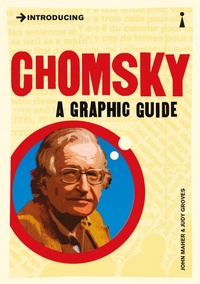
Introducing Chomsky Introducing Chomsky
A Graphic Guide
Published on 14. March 2015
176 pages
978-1-84831-967-7 (ISBN)
Description

Can it be that the human brain possesses an in-built faculty for language?
Noam Chomsky, one of the most brilliant linguists of the 20th century, believes that it does- that there exists a 'universal grammar' common to all languages. Around the world children learn, in very similar ways, languages that seem entirely different. This is possible, Chomsky argues, because all human languages and their grammatical structures are linked in the human brain.
Chomsky is controversial and yet highly influential, both in his pioneering work in linguistics and in his unrelenting critique of international power and his commitment to freedom and justice. These two 'Chomskys' are heirs to the Enlightenment tradition, and this book is the ideal introduction to them both.
More details
Other editions
Additional editions
Persons
John Maher studied philosophy and linguistics in London, Michigan and Edinburgh. He has published ten books on: bilingualism, Ainu, language rights, and the languages of Japan.
Judy Groves is an artist, illustrator and designer. She has also illustrated introductory guides to Jesus, Lacan, Wittgenstein, Levi-Strauss and Philosophy.
Content
- Intro
- Title Page
- Copyright
- Contents
- Introducing Chomsky
- Being and Language
- The Language Bell
- Language Use
- How Do We Know Language?
- The Diversity Diversion
- Getting to the Core of Language
- How Do We Explain Language?
- Language and Communication
- Two Common Uses of Language
- Structure Dependence
- The Knowledge of Language
- E-Language and I-Language
- Grammar or Politics?
- American Structuralism
- What About Saussure?
- Galileo's Method
- Abstraction
- Idealization
- Ideal-Type
- Violating the Rose
- The Idealized Model
- Language as a Mental Organ
- Descartes' Theory of Body
- A New Theory of Body
- Skinner's Behaviourist Theory
- The Refutation of Behaviourism
- Plato's Problem
- Language Is Not Learned, It Grows
- Innateness
- Growth and Constraints on Learning
- Language is Not Imitation
- What is Knowledge of Language?
- Non-Inductive Ability
- "Motherese"
- The Attack From the Social
- The Reply
- So What is Linguistics?
- Creative vs. Recursive
- The Tale of Two Grammars
- Traditional Grammar vs. Generative Grammar
- The Break with Structuralism
- I'm Okay, *You're Okay But Not
- Deep Structure, Surface Structure
- Universal Grammar
- Can We "Map" a Universal Grammar?
- How Does it Sound?
- Empiricist Critics
- The Rule for Making Questions
- The Rule for Reciprocal Expression
- A Theory of Scientific Theories?
- Other Competing Models
- Chomsky's Reply to Piaget
- Other Linguistic Schools
- 1980s Minimalism
- Principles and Parameters
- The UG Principles and Parameters
- Principles, Parameters and Language-Learning
- Limited Variation
- Objection
- Accounting for Language
- Dispensable Technology
- A Fairy Tale
- The Simplest Possible System?
- The Perfect Design
- The Origins of a Social Conscience
- A Chomsky File
- Chomsky the Social Critic
- "Is What You Say True?"
- The Tower of Babel
- Chomsky's Libertarian Inheritance
- Adam Smith's "Vile Maxim"
- Enlightenment Values
- Anarchism
- And Liberalism?
- Action Intellectuals
- The American Paradox
- The Manufacture of Consent
- Smash the Unions!
- Class and Poverty
- Who Do You Blame?
- The Fall of the Soviet Empire
- Who Should Apologize?
- Remembering Vietnam
- Overcoming the "Vietnam Syndrome"
- The Indonesia-East Timor File
- East Timor
- The Nicaragua File
- The Rotten Apple Theory
- Who's the Criminal?
- Commissars and the Speciality Game
- Bibliography
- Acknowledgements
- About the authors
- Index
