

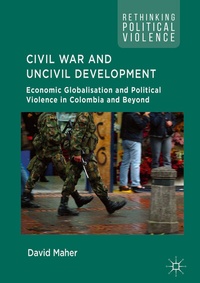
Civil War and Uncivil Development
Description

This book challenges the conventional wisdom that civil war inevitably stymies economic development and that 'civil war represents development in reverse'. While some civil wars may have adverse economic effects, Civil War and Uncivil Development posits that not all conflicts have negative economic consequences and, under certain conditions, civil war violence can bolster processes of economic development. Using Colombia as a case study, this book provides evidence that violence perpetrated by key actors of the conflict - the public armed forces and paramilitaries - has facilitated economic growth and processes of economic globalisation in Colombia (namely, international trade and foreign direct investment), with profoundly negative consequences for large swathes of civilians. The analysis also discusses the 'development in reverse' logic in the context of other conflicts across the globe.
This book will be an invaluable resource for scholars, practitioners and students in the fields of security and development, civil war studies, peace studies, the political economy of conflict and international relations.Reviews / Votes
"The book speaks to students, scholars, practitioners and human rights activists interested in the relationship between political violence, development and globalization. . Scholars and students of civil war will find the book a theoretically sound and empirically rich source as it advances knowledge on a particularly relevant yet overlooked area in civil war studies through the lenses of critical theory and historical materialism." (Ervjola Selenica, Interdisciplinary Political Studies, Vol. 5 (1), 2019)More details
Other editions
Additional editions
Person
David Maher is Lecturer in International Relations at the University of Salford, UK. His research employs a political economy framework to analyse the links between political violence (particularly civil war and terrorism) and processes of economic development, including processes of economic globalisation such as international trade and foreign direct investment.
Content
Chapter 1: Civil War, Development and Economic Globalisation.- Chapter 2: Civil War as Development in Reverse or a Case of Historical Amnesia.- Chapter 3: Colombia: Globalisation, Economic Growth and Civil War.- Chapter 4: The Fatal Attraction of Civil War: Violence and the Oil Sector in Arauca.- Chapter 5: Rooted in Violence: The Expansion of Palm Oil in Meta.- Chapter 6: Conflict, Development and the Fluidity of Violence: Colombia and Beyond.- Chapter 7: Conclusion.
