

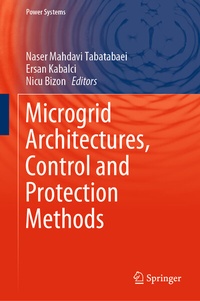
Microgrid Architectures, Control and Protection Methods
Description

This book presents intuitive explanations of the principles of microgrids, including their structure and operation and their applications. It also discusses the latest research on microgrid control and protection technologies and the essentials of microgrids as well as enhanced communication systems.
The book provides solutions to microgrid operation and planning issues using various methodologies including
- planning and modelling;
- AC and DC hybrid microgrids;
- energy storage systems in microgrids; and
- optimal microgrid operational planning.
Written by specialists, it is filled in innovative solutions and research related to microgrid operation, making it a valuable resource for those interested in developing updated approaches in electric power analysis, design and operational strategies. Thanks to its in-depth explanations and clear, three-part structure, it is useful for electrical engineering students, researchersand technicians.
More details
Other editions
Additional editions
Persons
Naser Mahdavi Tabatabaei holds B.Sc. and M.Sc. degrees from the University of Tabriz (Iran) and a Ph.D. degree from Iran University of Science and Technology (Tehran), all in Power Electrical Engineering. He is a Professor at the IOTPE and an academic at the Power Electrical Engineering department at Seraj Higher Education Institute (Tabriz, Iran). He is General Chair and Secretary of ICTPE, Editor-in-Chief of IJTPE and Chairman of IETPE, all supported by the IOTPE. He has authored and co-authored 9 books and book chapters, and 170 papers in international journals and conference proceedings. His research interests are in the area of power system analysis and control, energy management systems, microgrids and smart grids. He is a member of the Iranian Association of Electrical and Electronic Engineers (IAEEE).
Ersan Kabalci received his B.S. and M.S. degrees in Electronics and Computer Education from Gazi University, Ankara, Turkey, in 2003 and 2006, respectively.He received his Ph.D. degree from the same university in 2010, with a thesis on implementing an enhanced modulation scheme for multilevel inverters, and from 2005 to 2007, he was a lecturer there. He is currently Head of the Department of Electrical and Electronics Engineering, Nevsehir HBV University, where he became an Assistant Professor in 2011; an Associate Professor in 2013, and Full Professor in 2019. His research interests include power electronic applications and drives for renewable energy sources, microgrids, distributed generation, power line communication, and smart grid applications.
Nicu Bizon received his B.S. ('85) M.S. ('86) and Ph.D. ('96) degrees in Electronics, and Automatic and Control Systems from the University "Polytechnic" of Bucharest. Currently, he is a Professor at the University of Pitesti, Romania. He was the Dean ('12-'17) of the Faculty of Electronics, Communication and Computers, Director of the research center "Modeling and simulation processes and systems" ('08-'12), and Head of university research department ('04-'08). He has edited or authored 13 books in the field of renewable/fuel cell hybrid power systems. His current research interests include the broad area of nonlinear systems, and dynamics and control applied in hybrid systems. He has published over 150 journal papers, and is the General Chair of the "ECAI" Conference and a member of the editorial boards of several journals.
