

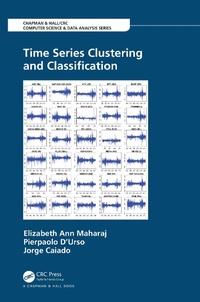
Time Series Clustering and Classification
1st Edition
Published on 19. March 2019
244 pages
978-0-429-60330-3 (ISBN)
Description

The beginning of the age of artificial intelligence and machine learning has created new challenges and opportunities for data analysts, statisticians, mathematicians, econometricians, computer scientists and many others. At the root of these techniques are algorithms and methods for clustering and classifying different types of large datasets, including time series data.
Time Series Clustering and Classification includes relevant developments on observation-based, feature-based and model-based traditional and fuzzy clustering methods, feature-based and model-based classification methods, and machine learning methods. It presents a broad and self-contained overview of techniques for both researchers and students.
Features
Provides an overview of the methods and applications of pattern recognition of time series
Covers a wide range of techniques, including unsupervised and supervised approaches
Includes a range of real examples from medicine, finance, environmental science, and more
R and MATLAB code, and relevant data sets are available on a supplementary website
Time Series Clustering and Classification includes relevant developments on observation-based, feature-based and model-based traditional and fuzzy clustering methods, feature-based and model-based classification methods, and machine learning methods. It presents a broad and self-contained overview of techniques for both researchers and students.
Features
Provides an overview of the methods and applications of pattern recognition of time series
Covers a wide range of techniques, including unsupervised and supervised approaches
Includes a range of real examples from medicine, finance, environmental science, and more
R and MATLAB code, and relevant data sets are available on a supplementary website
Reviews / Votes
"The book represents 20 years of research by the authors. They have achieved the goal of gathering in one place a broad spectrum of clustering and classification techniques for time series, which have attracted substantial attention for the last few decades...The book contains a number of examples of clustering, which are intended to highlight the main theoretical models on real data...The book contains a large amount of theoretical information and practical examples and may be recommended as a desk book for young scientists and applied mathematicians."- Maria Ivanchuk, ISCB News, July 2020
"The authors of this book have more than 20 years of experience on the topic of time series clustering and classification. They consolidate many important methods and algorithms commonly used in time series clustering and classification practices published by various scientific journals. In addition, they provide Matlab and R code and corresponding datasets to reproduce the examples in the book...This book covers most classical and common techniques for time series clustering and classification. It consolidates different methods into an extensive coherent framework. This makes the book a good reference for students and researchers."
- Ming Chen, JASA, August 2020
More details
Series
Edition
1. Auflage
Language
English
Place of publication
London
United Kingdom
Publishing group
Taylor & Francis Ltd
Target group
College/higher education
Product notice
Reflowable
Illustrations
42 Tables, black and white; 46 Line drawings, black and white; 46 Illustrations, black and white
File size
6,38 MB
ISBN-13
978-0-429-60330-3 (9780429603303)
Copyright in bibliographic data and cover images is held by Nielsen Book Services Limited or by the publishers or by their respective licensors: all rights reserved.
Schweitzer Classification
Other editions
Additional editions
Elizabeth Ann Maharaj | Pierpaolo D'Urso | Jorge Caiado
Time Series Clustering and Classification
Book
06/2021
1st Edition
Chapman & Hall/CRC
€74.30
Shipment within 10-20 days
Elizabeth Ann Maharaj | Pierpaolo D'Urso | Jorge Caiado
Time Series Clustering and Classification
Book
04/2019
1st Edition
Chapman & Hall/CRC
€241.90
Shipment within 15-20 days
Persons
Elizabeth Ann Maharaj is an Associate Professor in the Department of Econometrics and Business Statistics at Monash University, Australia. She has a Ph.D. from Monash University on the Pattern Recognition of Time Series. Ann is an elected member of the International Statistical Institute (ISI), a member of the International Association of Statistical Computing (IASC) and of the Statistical Society of Australia (SSA). She is also an accredited statistician with the SSA. Ann's main research interests are in time series classification, wavelets analysis, fuzzy classification and interval time series analysis. She has also worked on research projects in climatology, environmental science, labour markets, human mobility and finance.
Pierpaolo D'Urso is a Full Professor of Statistics at Sapienza - University of Rome. He is the chair of the Department of Social and Economic Sciences, Sapienza - University of Rome. He received his Ph.D. in Statistics and his bachelor's degree in Statistics both from Sapienza. He is an associate editor and a member of the editorial board of several journals. He has been member of several program committees of international conferences and guest editor of special issues. His recent research activity is focus on fuzzy clustering, clustering and classification of time series, clustering of complex structures of data, and statistical methods for marketing, local labour systems, electoral studies and environmental monitoring.
Jorge Caiado has a Ph.D. in Applied Mathematics to Economics and Management. He is a Professor of Econometrics and Forecasting Methods at the Lisbon School of Economics and Management (ISEG) and a Researcher at the Centre for Applied Mathematics and Economics. His research in econometrics, finance, time series analysis, forecasting methods and statistical software has led to numerous publications in scientific journals and books. He serves as an econometric and statistical consultant and trainer for numerous companies and organizations including central banks, commercial and investment banks, bureau of statistics, bureau of economic analysis, transportation and logistics companies, health companies and insurance companies. He is also a co-founder and partner of GlobalSolver.
Pierpaolo D'Urso is a Full Professor of Statistics at Sapienza - University of Rome. He is the chair of the Department of Social and Economic Sciences, Sapienza - University of Rome. He received his Ph.D. in Statistics and his bachelor's degree in Statistics both from Sapienza. He is an associate editor and a member of the editorial board of several journals. He has been member of several program committees of international conferences and guest editor of special issues. His recent research activity is focus on fuzzy clustering, clustering and classification of time series, clustering of complex structures of data, and statistical methods for marketing, local labour systems, electoral studies and environmental monitoring.
Jorge Caiado has a Ph.D. in Applied Mathematics to Economics and Management. He is a Professor of Econometrics and Forecasting Methods at the Lisbon School of Economics and Management (ISEG) and a Researcher at the Centre for Applied Mathematics and Economics. His research in econometrics, finance, time series analysis, forecasting methods and statistical software has led to numerous publications in scientific journals and books. He serves as an econometric and statistical consultant and trainer for numerous companies and organizations including central banks, commercial and investment banks, bureau of statistics, bureau of economic analysis, transportation and logistics companies, health companies and insurance companies. He is also a co-founder and partner of GlobalSolver.
Content
1. Introduction 2. Time Series Features and Models 3. Traditional cluster analysis 4. Fuzzy clustering 5. Observation-based clustering 6. Feature-based clustering 7. Model-based clustering 8. Other time series clustering approaches 9. Feature-based classification approaches 10. Other time series classification approaches 11.Software and Data Sets
