

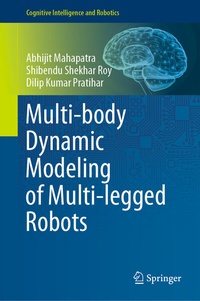
Multi-body Dynamic Modeling of Multi-legged Robots
Description

This book describes the development of an integrated approach for generating the path and gait of realistic hexapod robotic systems. It discusses in detail locomation with straight-ahead, crab and turning motion capabilities in varying terrains, like sloping surfaces, staircases, and various user-defined rough terrains. It also presents computer simulations and validation using Virtual Prototyping (VP) tools and real-world experiments.
The book also explores improving solutions by applying the developed nonlinear, constrained inverse dynamics model of the system formulated as a coupled dynamical problem based on the Newton-Euler (NE) approach and taking into account realistic environmental conditions. The approach is developed on the basis of rigid multi-body modelling and the concept that there is no change in the configuration of the system in the short time span of collisions.
More details
Other editions
Additional editions
Persons
Dr. Abhijit Mahapatra
received B.E. and M.Tech. degrees in Mechanical Engineering from B.E. College (now, BESU), Shibpur, India, and NIT Durgapur, India, in 2002 and 2008, respectively. He received his Ph.D. from NIT Durgapur, India, in 2018. He is currently working as a Senior Scientist in the Advanced Design and Analysis Group at CSIR- Central Mechanical Engineering Research Institute, Durgapur, India.
Dr. Mahapatra has published a number of research papers in national and international journals and conference proceedings and filed several patents in the area of product development. His current research interests include design & analysis, multi-body dynamics, and modelling and simulating legged robots.
Dr. Shibendu Shekhar Roy
received B.E. and M.Tech. degrees in Mechanical Engineering from NIT, Durgapur. He also holds a Ph.D. from IIT, Kharagpur, India. He is currently working as a Professor at the Department of Mechanical Engineering and Associate Dean (Alumni Affairs & Outreach) at the National Institute of Technology, Durgapur.
Dr. Roy has published more than 68 papers in national and international journals and conference proceedings, as well as 4 book chapters, and has filed a number of patents in the area of product development. His current research interests include modelling and simulating legged robots, soft robotics, rehabilitation robotics, additive manufacturing and 3D printing on macro- and micro-scales.
Dr. Dilip Kumar Pratihar
completed his B.E. and M. Tech. in Mechanical Engineering at NIT, Durgapur, India, in 1988 and 1995, respectively. He received his Ph.D. from IIT Kanpur in 2000. Dr. Pratihar pursued postdoctoral studies in Japan and then in Germany under the Alexander von Humboldt Fellowship Program. He is currently working as a Professor at IIT Kharagpur, India. His research areas include robotics, soft computing and manufacturing science.
He has made significant contributions in the development of intelligent autonomous systems in various fields, including robotics, and manufacturing science. He has published more than 230 papers, mostly in international journals, and is on the editorial board of 12 international journals. He is a member of the FIE, MASME and SMIEEE. He has completed a number of sponsored (funded by DST, DAE, MHRD, DBT) and consultancy projects and is a member of Expert Committee of Advanced Manufacturing Technology, DST, Government of India.
Content
Introduction.- Introduction to multi-legged robots.- Multi-legged robots- a Review.- Gait Planning of multi-legged robots.- Kinematic Modeling and Analysis of Six-Legged Robots.- Kinematic Modeling and Analysis of Six-Legged Robots.- Locomotion planning on various terrains.- Multi-body Inverse Dynamic Modeling and Analysis of Six-Legged Robots.- Analytical Framework.- Static Equilibrium Moment Equation.- Study of performance indices- power consumption and stability measure.- Validation using Virtual Prototyping tools and Experiments.- Modeling using Virtual prototyping tools.
