

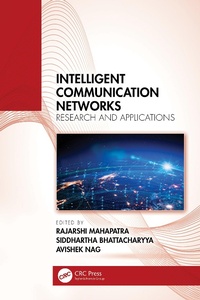
Intelligent Communication Networks
Research and Applications
1st Edition
Published on 6. June 2024
256 pages
978-1-040-03246-6 (ISBN)
Description

With the advent of Big Data, conventional communication networks are often limited in their inability to handle complex and voluminous data and information as far as effective processing, transmission, and reception are concerned. This book discusses the evolution of computational intelligence techniques in handling intelligent communication networks.
Provides a detailed theoretical foundation of machine learning and computational intelligence algorithms
Highlights the state of art machine learning-based solutions for communication networks
Presents video demonstrations and code snippets on each chapter for easy understanding of the concepts
Discusses applications including resource allocation, spectrum management, channel estimation, and physical layer of wireless networks
Demonstrates applications of machine learning techniques for optical networks
The text is primarily intended for senior undergraduate and graduate students and academic researchers in fields of electrical engineering, electronics and communication engineering, and computer engineering.
Provides a detailed theoretical foundation of machine learning and computational intelligence algorithms
Highlights the state of art machine learning-based solutions for communication networks
Presents video demonstrations and code snippets on each chapter for easy understanding of the concepts
Discusses applications including resource allocation, spectrum management, channel estimation, and physical layer of wireless networks
Demonstrates applications of machine learning techniques for optical networks
The text is primarily intended for senior undergraduate and graduate students and academic researchers in fields of electrical engineering, electronics and communication engineering, and computer engineering.
More details
Edition
1. Auflage
Language
English
Place of publication
London
United Kingdom
Publishing group
Taylor & Francis Ltd
Target group
College/higher education
Professional and scholarly
Product notice
Reflowable
Illustrations
37 Tables, black and white; 7 Line drawings, black and white; 60 Halftones, black and white; 67 Illustrations, black and white
ISBN-13
978-1-040-03246-6 (9781040032466)
Copyright in bibliographic data and cover images is held by Nielsen Book Services Limited or by the publishers or by their respective licensors: all rights reserved.
Schweitzer Classification
Other editions
Additional editions
Rajarshi Mahapatra | Siddhartha Bhattacharyya | Avishek Nag
Intelligent Communication Networks
Research and Applications
Book
05/2026
1st Edition
CRC Press
€66.00
Shipment within 10-20 days
Rajarshi Mahapatra | Siddhartha Bhattacharyya | Avishek Nag
Intelligent Communication Networks
Research and Applications
Book
06/2024
1st Edition
CRC Press
€186.20
Shipment within 10-20 days

Rajarshi Mahapatra | Siddhartha Bhattacharyya | Avishek Nag
Intelligent Communication Networks
Research and Applications
Book
05/2024
CRC Press
Unfortunately, price unknown
Article exhausted; check different version
Persons
Rajarshi Mahapatra earned a PhD in electronics and electrical communication engineering from the Indian Institute of Technology Kharagpur, Kharagpur, India, and a postdoctoral degree from the CEA-LETI, Grenoble, France. In his postdoctoral research, he was engaged in FP7 Call4 BeFEMTO and Greentouch projects. He is an Associate Professor with the Department of Electronics and Communication Engineering, Dr. SPM IIIT Naya Raipur. He also served as Dean (Academics) of IIITNR. He previously worked for Collins Aerospace, Hyderabad, on software-defined radio and electronic warfare. Dr. Mahapatra has worked extensively in the domain of physical layer design and analysis of a wireless communication system. He worked in the fields of cognitive radio, 5G & 6G communication, heterogeneous wireless communication, molecular communication, and energy-efficient communication. His team designed and developed software-defined radio and direction-finding systems for EW applications in Collins Aerospace. He has approximately 18 years of teaching, research, and industry experience. He has guided PhD scholars in the area of wireless communication and published several research papers in various refereed journals and IEEE journals. He is a regular reviewer of premier IEEE Transactions and other peer-reviewed journals and IEEE conferences. He has organized many workshops on 5G and also developed several high-value research labs, including the 5G test bed. He has successfully completed and undertaken high-value sponsored projects in the field of communication systems. He was awarded a National scholarship, an MHRD scholarship for research, and an EU-FP7 fellowship for a European project. He is a senior member of IEEE and a member of the Communication Society. His research interests include 5G and beyond communication, machine learning for communication, molecular communication, intelligent reflecting surfaces, and optical access networks.
Dr. Avishek Nag is an Assistant Professor in the School of Computer Science at University College Dublin in Ireland. Dr. Nag earned the BE (Honours) degree from Jadavpur University, Kolkata, India, in 2005; the MTech degree from the Indian Institute of Technology, Kharagpur, India, in 2007; and a PhD from the University of California, Davis, in 2012. He worked as a research associate at the CONNECT center for future networks and communication at Trinity College Dublin before joining University College Dublin. Dr. Nag received the Best Paper Award at the 2nd IEEE Advanced Networks and Telecommunication Symposium in 2008 and has published over 35 publications, including journals, conference proceedings, and book chapters with over 950 citations. His research interests include but are not limited to Cross-layer optimization in Wired and Wireless Networks, Network Reliability, Mathematics of Networks (Optimization, Graph Theory), Network Virtualization, Software-Defined Networks, Machine Learning, Data Analytics, Blockchain, and the Internet of Things. Dr. Nag is a senior member of the Institute of Electronics and electrical engineers (IEEE) and also the outreach lead for Ireland for the IEEE UK and Ireland Blockchain Group.
Dr. Siddhartha Bhattacharyya earned a Bachelors in Physics, Bachelors in Optics and Optoelectronics, and Masters in Optics and Optoelectronics from the University of Calcutta, India, in 1995, 1998, and 2000, respectively. He completed his PhD in Computer Science and Engineering from Jadavpur University, India, in 2008. He is the recipient of the University Gold Medal from the University of Calcutta for his Masters. He has received several coveted awards, including the Distinguished HoD Award and Distinguished Professor Award conferred by the Computer Society of India, Mumbai Chapter, India, in 2017, the Honorary Doctorate Award (D. Litt.) from the University of South America, and the Southeast Asian Regional Computing Confederation (SEARCC) International Digital Award ICT Educator of the Year in 2017. He was appointed as the ACM Distinguished Speaker for 2018-2020. He was inducted into the People of ACM Hall of Fame by ACM, USA, in 2020. He was appointed as the IEEE Computer Society Distinguished Visitor for 2021- 2023. He was elected as a full foreign member of the Russian Academy of Natural Sciences (RANS) and the Russian Academy of Engineering (REA). He was also elected a full fellow of the Royal Society for Arts, Manufactures and Commerce (RSA), London, UK. He currently serves as a Senior Researcher in the Faculty of Electrical Engineering and Computer Science of VSB Technical University of Ostrava, Czech Republic. He also serves as the Scientific Advisor of Algebra University College, Zagreb, Croatia. Prior to this, he served as the Principal of Rajnagar Mahavidyalaya, Rajnagar, Birbhum. He served as a Professor in the Department of Computer Science and Engineering of Christ University, Bangalore. He was the Principal of RCC Institute of Information Technology, Kolkata, India, from 2017 to 2019. He has also served as a Senior Research Scientist in the Faculty of Electrical Engineering and Computer Science of VSB Technical University of Ostrava, Czech Republic (2018-2019). Prior to this, he was the Professor of Information Technology at RCC Institute of Information Technology, Kolkata, India. He served as the Head of the Department from March 2014 to December 2016. Prior to this, he was an Associate Professor of Information Technology at RCC Institute of Information Technology, Kolkata, India, from 2011 to 2014. Before that, he served as an Assistant Professor in Computer Science and Information Technology at the University Institute of Technology, The University of Burdwan, India, from 2005 to 2011. He was a Lecturer in Information Technology at Kalyani Government Engineering College, India, 2001-2005. He is a co-author of six books and the co-editor of 100 books and has more than 400 research publications in international journals and conference proceedings to his credit. He has three PCTs and 20 patents to his credit. He has been a member of the organizing and technical program committees of several national and international conferences. He is the founding Chair of ICCICN 2014, ICRCICN (2015, 2016, 2017, 2018), and ISSIP (2017, 2018) (Kolkata, India). He was the General Chair of several international conferences such as WCNSSP 2016 (Chiang Mai, Thailand), ICACCP (2017, 2019) (Sikkim, India), ICICC 2018 (New Delhi, India), and ICICC 2019 (Ostrava, Czech Republic). His research interests include hybrid intelligence, pattern recognition, multimedia data processing, social networks, and quantum computing.
Dr. Avishek Nag is an Assistant Professor in the School of Computer Science at University College Dublin in Ireland. Dr. Nag earned the BE (Honours) degree from Jadavpur University, Kolkata, India, in 2005; the MTech degree from the Indian Institute of Technology, Kharagpur, India, in 2007; and a PhD from the University of California, Davis, in 2012. He worked as a research associate at the CONNECT center for future networks and communication at Trinity College Dublin before joining University College Dublin. Dr. Nag received the Best Paper Award at the 2nd IEEE Advanced Networks and Telecommunication Symposium in 2008 and has published over 35 publications, including journals, conference proceedings, and book chapters with over 950 citations. His research interests include but are not limited to Cross-layer optimization in Wired and Wireless Networks, Network Reliability, Mathematics of Networks (Optimization, Graph Theory), Network Virtualization, Software-Defined Networks, Machine Learning, Data Analytics, Blockchain, and the Internet of Things. Dr. Nag is a senior member of the Institute of Electronics and electrical engineers (IEEE) and also the outreach lead for Ireland for the IEEE UK and Ireland Blockchain Group.
Dr. Siddhartha Bhattacharyya earned a Bachelors in Physics, Bachelors in Optics and Optoelectronics, and Masters in Optics and Optoelectronics from the University of Calcutta, India, in 1995, 1998, and 2000, respectively. He completed his PhD in Computer Science and Engineering from Jadavpur University, India, in 2008. He is the recipient of the University Gold Medal from the University of Calcutta for his Masters. He has received several coveted awards, including the Distinguished HoD Award and Distinguished Professor Award conferred by the Computer Society of India, Mumbai Chapter, India, in 2017, the Honorary Doctorate Award (D. Litt.) from the University of South America, and the Southeast Asian Regional Computing Confederation (SEARCC) International Digital Award ICT Educator of the Year in 2017. He was appointed as the ACM Distinguished Speaker for 2018-2020. He was inducted into the People of ACM Hall of Fame by ACM, USA, in 2020. He was appointed as the IEEE Computer Society Distinguished Visitor for 2021- 2023. He was elected as a full foreign member of the Russian Academy of Natural Sciences (RANS) and the Russian Academy of Engineering (REA). He was also elected a full fellow of the Royal Society for Arts, Manufactures and Commerce (RSA), London, UK. He currently serves as a Senior Researcher in the Faculty of Electrical Engineering and Computer Science of VSB Technical University of Ostrava, Czech Republic. He also serves as the Scientific Advisor of Algebra University College, Zagreb, Croatia. Prior to this, he served as the Principal of Rajnagar Mahavidyalaya, Rajnagar, Birbhum. He served as a Professor in the Department of Computer Science and Engineering of Christ University, Bangalore. He was the Principal of RCC Institute of Information Technology, Kolkata, India, from 2017 to 2019. He has also served as a Senior Research Scientist in the Faculty of Electrical Engineering and Computer Science of VSB Technical University of Ostrava, Czech Republic (2018-2019). Prior to this, he was the Professor of Information Technology at RCC Institute of Information Technology, Kolkata, India. He served as the Head of the Department from March 2014 to December 2016. Prior to this, he was an Associate Professor of Information Technology at RCC Institute of Information Technology, Kolkata, India, from 2011 to 2014. Before that, he served as an Assistant Professor in Computer Science and Information Technology at the University Institute of Technology, The University of Burdwan, India, from 2005 to 2011. He was a Lecturer in Information Technology at Kalyani Government Engineering College, India, 2001-2005. He is a co-author of six books and the co-editor of 100 books and has more than 400 research publications in international journals and conference proceedings to his credit. He has three PCTs and 20 patents to his credit. He has been a member of the organizing and technical program committees of several national and international conferences. He is the founding Chair of ICCICN 2014, ICRCICN (2015, 2016, 2017, 2018), and ISSIP (2017, 2018) (Kolkata, India). He was the General Chair of several international conferences such as WCNSSP 2016 (Chiang Mai, Thailand), ICACCP (2017, 2019) (Sikkim, India), ICICC 2018 (New Delhi, India), and ICICC 2019 (Ostrava, Czech Republic). His research interests include hybrid intelligence, pattern recognition, multimedia data processing, social networks, and quantum computing.
Content
1. Various Deep Learning Based Resource Allocation Techniques in Wireless Communication System. 2. Federated Deep Reinforcement Learning-based Resource allocation in Heterogeneous Networks 3. A Comprehensive Overview of Internet of Nano Things (IoNT) in the Next Generation Heterogeneous Networks: Deployment Aspects, Applications, and Challenges 4. Emerging world of Metaverse: An Indian Perspective 5. Intelligent Optical Networks: Challenges, Opportunities, and Applications 6. Machine Learning for Non-Orthogonal Multiple Access 7. Compensating inbound signal strength for radio controlled mobile robots using ANFIS 8. Optimising Wireless Sensor Networks using Machine Learning 9. Machine Learning-Assisted Interference Management in the 6G UAV Networks with Soft Frequency Reuse 10. Computational Intelligence in Communication Networks: Classification, Clustering, Reinforcement Learning, Deep Learning
