

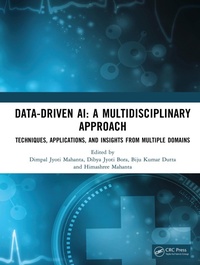
Data-Driven AI: A Multidisciplinary Approach
Techniques, Applications, and Insights from Multiple Domains
1st Edition
Published on 26. May 2026
366 pages
978-1-040-87579-7 (ISBN)
Description

The International Conference on Data-Driven AI (ICDDA 2025) is a global platform dedicated to advancing the transformative potential of Artificial Intelligence (AI) and its interdisciplinary applications. Scheduled from May 7 to May 9, 2025, in Jorhat, India, the conference aims to bring together researchers, academics, industry professionals, and policymakers to explore cutting-edge developments and their real-world impacts. ICDDA 2025 focuses on a broad spectrum of AI-related topics, including but not limited to Artificial Intelligence, Machine Learning, Data Structures and Algorithms, Data Mining, Image and Signal Processing, Natural Language Processing, Mathematical and Statistical Sciences, AI-Integrated Physical, Chemical, Biological, Environmental, Agricultural, Health and Social Sciences. By focusing on collaborative innovation, ICDDA 2025 aims to inspire progress in AI-driven technologies and their impact on science, industry, and society.
The conference emphasizes the integration of AI with diverse scientific and industrial domains, showcasing applications in areas such as healthcare, sustainability, robotics, and automation. Through keynote speeches, technical paper presentations, workshops, and panel discussions, ICDDA 2025 will explore how AI can solve real-world challenges and drive innovation across fields.
Unlike other conferences, ICDDA 2025 prioritizes an interdisciplinary approach, bridging the gap between theoretical research and practical applications. The event also emphasizes ethical AI practices and sustainability, making it relevant to a wide audience, including researchers, engineers, data scientists, students, and decision-makers.
The conference emphasizes the integration of AI with diverse scientific and industrial domains, showcasing applications in areas such as healthcare, sustainability, robotics, and automation. Through keynote speeches, technical paper presentations, workshops, and panel discussions, ICDDA 2025 will explore how AI can solve real-world challenges and drive innovation across fields.
Unlike other conferences, ICDDA 2025 prioritizes an interdisciplinary approach, bridging the gap between theoretical research and practical applications. The event also emphasizes ethical AI practices and sustainability, making it relevant to a wide audience, including researchers, engineers, data scientists, students, and decision-makers.
More details
Edition
1. Auflage
Language
English
Place of publication
London
United Kingdom
Publishing group
Taylor & Francis Ltd
Target group
College/higher education
Professional and scholarly
File size
36,64 MB
ISBN-13
978-1-040-87579-7 (9781040875797)
Copyright in bibliographic data and cover images is held by Nielsen Book Services Limited or by the publishers or by their respective licensors: all rights reserved.
Schweitzer Classification
Other editions
Additional editions
Dimpal Jyoti Mahanta | Dibya Jyoti Bora | Biju Kumar Dutta
Data-Driven AI: A Multidisciplinary Approach
Techniques, Applications, and Insights from Multiple Domains
Book
05/2026
1st Edition
CRC Press
€85.00
Shipment within 15-20 days
Persons
Dimpal Jyoti Mahanta is the Head and Associate Professor of Mathematics at The Assam Kaziranga University, Jorhat, India. He earned his Ph.D. in Mathematics from Tezpur University, specializing in parameter estimation for nonlinear growth models with applications in forestry. With over 11 years of teaching experience and serving as Head of the Department since 2019, he has significantly contributed to mathematical education and research.
Dibya Jyoti Bora is an accomplished academic and researcher specializing in Artificial Intelligence, Data Science, and Image Processing. He is an Associate Professor at The Assam Kaziranga University, serving as Vice President of the Institution's Innovation Council and Research Coordinator.
Biju Kumar Dutta is an Associate Professor in the Department of Mathematics at the School of Basic Sciences, The Assam Kaziranga University, Jorhat, Assam, India. He earned his Ph.D. in special functions and fractional calculus from NERIST, Arunachal Pradesh, in 2014. He completed his Master's and Bachelor's degrees in Mathematics from Gauhati University, Assam.
Himashree Mahanta is an expert in Computational Chemistry, is an Assistant Professor at The Assam Kaziranga University, Jorhat. She holds a Ph.D. in Theoretical Chemistry from NIT Meghalaya, with research focused on intramolecular interactions in aromatic complexes. She also earned her M.Sc. in Chemistry from NIT Meghalaya and a B.Sc. in Chemistry from Gauhati University. With over 2.5 years of teaching and 2 years of industrial experience, Dr. Mahanta guides postgraduate research projects in areas like chemical dynamics simulations, reaction dynamics, and intermolecular interactions. Her work is published in reputed SCI-indexed journals, complemented by contributions to books and conferences. Dr. Mahanta is proficient in software tools like VENUS96 and Gaussian09 and skilled in Fortran 77 programming. Her achievements include the SERB-DST fellowship and the Nanoscale Horizons Poster Prize, recognizing her dedication to research and education.
Dibya Jyoti Bora is an accomplished academic and researcher specializing in Artificial Intelligence, Data Science, and Image Processing. He is an Associate Professor at The Assam Kaziranga University, serving as Vice President of the Institution's Innovation Council and Research Coordinator.
Biju Kumar Dutta is an Associate Professor in the Department of Mathematics at the School of Basic Sciences, The Assam Kaziranga University, Jorhat, Assam, India. He earned his Ph.D. in special functions and fractional calculus from NERIST, Arunachal Pradesh, in 2014. He completed his Master's and Bachelor's degrees in Mathematics from Gauhati University, Assam.
Himashree Mahanta is an expert in Computational Chemistry, is an Assistant Professor at The Assam Kaziranga University, Jorhat. She holds a Ph.D. in Theoretical Chemistry from NIT Meghalaya, with research focused on intramolecular interactions in aromatic complexes. She also earned her M.Sc. in Chemistry from NIT Meghalaya and a B.Sc. in Chemistry from Gauhati University. With over 2.5 years of teaching and 2 years of industrial experience, Dr. Mahanta guides postgraduate research projects in areas like chemical dynamics simulations, reaction dynamics, and intermolecular interactions. Her work is published in reputed SCI-indexed journals, complemented by contributions to books and conferences. Dr. Mahanta is proficient in software tools like VENUS96 and Gaussian09 and skilled in Fortran 77 programming. Her achievements include the SERB-DST fellowship and the Nanoscale Horizons Poster Prize, recognizing her dedication to research and education.
Content
1 Optimising smart grid performance by integrating machine learning with PID control for sustainable energy management 2 AI-based software cost estimation using software metrics 3 A mathematical model for the application of induced magnetic field in blood flow through a bell-shaped stenosis artery 4 Enhancing time-series classification with autoencoder-driven feature and local attention in LSTM networks 5 Unravelling the functional role of PLRG-1 in development and lifespan in Caenorhabditis elegans 6 Artificial intelligence in education: Enhancing learning outcomes or replacing teachers 7 Steady state analysis of bi-criteria in queuing model comprising parallel servers with revisiting facility within stochastic environment 8 Spatial maps coupled vision transformers for skin cancer classification 9 Optimising rice leaf disease classification with ResNet50 and dense block integration 10 Utilising data-driven artificial intelligence to investigate plant-based compounds for neuroinflammation and inflammatory receptor modulation through polypharmacology 11 A deep learning-based technique for identifying the health of honeybee species 12 Supercapacitors in energy storage: Principles, materials, challenges, and applications 13 A comparative study on Fuzzy PERT with measures 14 Exploring the future of connectivity: A comprehensive review of wireless and optical communications 15 Proof-of-driving incentive mechanism for VANET to enhance traffic safety and efficiency 16 Agro automatic weather station 17 Optimisation of energy efficiency through prediction-based model of multiuser cognitive radio network 18 The paradox of AI and creativity: Enhancing or hindering innovation? 19 Human-AI interaction in language education: A comparative study of conversational chatbots 20 Implementation of Sukanya Samriddhi Yojana in incentivising development of girl child and women in Paradeep: An analytical approach 21 On algebraic properties of doubt bipolar ?-?-fuzzy order sub-groups and ?-?-fuzzy order normal sub-groups 22 A statistical investigation of ENSO 3.4 and rainfall trends in the Andaman and Nicobar islands using superposed epoch analysis 23 Social ecology of energy conservation: A social cognitive perspective on sustainable practices 24 Afraid to be happy: Understanding the predictors of subjective well-being among emerging adults concerning age and gender 25 Algebraic structures of anti-?-Q group acting on ?-sub-group and homomorphsim of ?-fuzzy sub-group 26 Empowering gig workers through digital banking: Revelation on drivers of adoption and pathways to sustainable digital financial inclusion 27 Artificial intelligence-driven health check and monitoring system for virtual machines 28 Bytes and barriers: Understanding digital divide in Kamrup metropolitan and Morigaon districts of Assam, India 29 A comparative study of mathematical growth models for Serratia marcescens D1 bacteria 30 Quantum tunnelling via quantum wormholes 31 Motion analysis and kinematic simulation of a land-based omni-directional mobile robot 32 A comprehensive survey on geometric deep learning 33 De-patterning the flower: Queering the "Twitterpat" in Walt Disney's Bambi (1942) 34 Effect of integrated nutrient management (INM) on forage crop under medium land situation 35 Soil microbes: Cornerstones of sustainability and ecological balance 36 Exploring the well-being of teacher trainees in Assam 37 AI in language learning: Ethical considerations of ChatGPT in Gujarat's second language classrooms 38 Exploring fixed point stability in series of functional equations from hotel-type models across classical and generalised Banach spaces 39 Vulnerabilities in IoT device clusters: Analysing security weaknesses and attack impacts 40 The AI revolution for climate mitigation: Optimising energy and enhancing conservation 41 Beyond words: The complexities in cross-language movie translations in the era of AI 42 Optimisation of complete awaiting duration of tasks in multi-stage flow shop scheduling model under fuzzy environment 43 Overcoming transgressive divides: Women, welfare and technology 44 Graphitic-based fillers in CFRP laminates: A study on milling method-dependent mechanical properties 45 Enhanced apple leaf disease classification using efficientNetB0 with green channel extraction and CLAHE-based pre-processing 46 Love under the microscope: Fractional differential equations in romantic behaviour 47 Revolutionising environmental monitoring: The role of AI in tracking biodiversity and deforestation 48 Smaller-sized aluminium-matrix composite components: Manufacturing and applications 49 Harnessing artificial intelligence for education: Innovations in communication and high school learning 50 UVSEGNET++: A synergised multipath architecture for concrete crack segmentation 51 A novel approach for development of anti-reflective coatings for next-gen immersion lithography 52 Advancing financial data privacy: A comprehensive review of differential privacy applications in financial systems 53 Hybrid deep learning for conjunctivitis disease identification and categorisation 54 Synthesis and application of TiO2 nanoparticles 55 Decoding bias: Data-driven AI and transgender representation 56 An analysis on the growth pattern of Escherichia coli using three non-linear growth models 57 Analysing decision-making approaches in identifying suspicious diabetes patients: Acomparative study of rough set, soft set, and rough set-based Bayesian decision theory
