

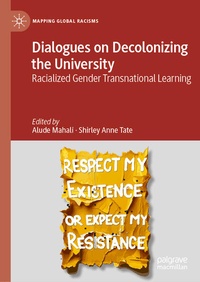
Dialogues on Decolonizing the University
Description

This book offers a transnational exploration of the role gender and race intersectionality plays in decolonization efforts within universities. Engaging with local contexts from across the globe, each chapter examines decolonization, racialization, and gender(ization) in relation to higher education, highlighting the complexities, contradictions, and contestations of these processes. Through interdisciplinary perspectives, the collection frames decolonization as a global project, emphasizing its ongoing intersections with race, gender, and coloniality. The book brings together early career and established scholars from diverse regions, including Latin America, Africa, Europe, and North America, alongside activist knowledge production. It explores how decolonization must account for racialized gender, addressing knowledge, policy, methodology, and practice interventions. The contributors challenge fixed notions of what decolonization and racialized gender mean, arguing that these concepts continue to evolve in both theory and practice.
This book will be of interest to scholars and activists working in the fields of decolonization, gender studies, race theory, higher education, and social justice, as well as anyone interested in how race and gender intersect in global movements for institutional change.
More details
Other editions
Additional editions
Persons
Dr Alude Mahali-Bhengu is a Research Director in the Equitable Education and Economies Unit at the Human Sciences Research Council, South Africa.
Shirley Anne Tate is Professor and Canada Research Chair Tier 1 in Feminism and Intersectionality in the Sociology Department, University of Alberta, Canada.
Content
- Introduction: Racialized gender dialogues in/on decolonizing the university.- 2. Affirmative action policies and the decolonization of the Brazilian university.- 3. Women that do not stay silent: Nahua experiences of decolonization of knowledge in Mexican architectural education.- 4. Duoethnography on the U.S. Gaze: Conversations about Mobility, Race, and Gender as International Scholars.- 5. Encampment Fever! Witnessing the revolutionary power of the Gaza solidarity student encampments in Britain through a racialized gendered lens.- 6. The Global Scholars Dilemma: An Imperfect Decolonial Intervention.- 7. 'University Aunties': Practices for Indigenous Scholars Navigating Academic Institutions.- 8. Women of Color Activists Fostering Relational Solidarity toward Decolonizing the University.- 9. The quandary of 'decoloniality' as an act and academic stance within a PhD: a retrospective narrative autoethnography.- 10. Decolonizing the curriculum in South Africa: Universities, decolonization competency and visibility for diverse sexualities and genders.
