

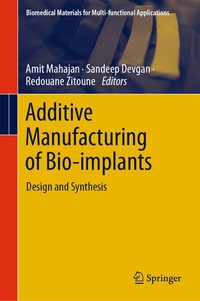
Additive Manufacturing of Bio-implants
Description

More details
Other editions
Additional editions
Persons
Dr. Amit Mahajan is Associate Professor at Khalsa College of Engineering & Technology, Amritsar, India. His research interests include additive manufacturing, surface modification of biomaterials, and electrical discharge machining. In his Ph.D., he profitably fabricated the nano-structured bio-favorable coatings on metallic biomaterials using powder mixed electrical discharge machining technique. His research aimed to design the carbon nanotubes (CNTs) and µ-hydroxyapatite (µHAp) mixed coatings on ß-type titanium alloy. He investigated the biological responses in terms of hydrophobicity and hydrophilicity tribological properties, corrosion inertness, bioactivity, etc. Currently, he works on the fabrication of alloys with proper fraction composition of carbon nanotubes (CNTs) and µ-hydroxyapatite (µHAp) via additive manufacturing. He has contributed 23 research papers and chapters to leading international journals, books, and conferences. He also serves as Reviewer for several national and international journals of repute.
Dr. Sandeep Devgan is Associate Professor at Khalsa College of Engineering & Technology, Amritsar, India. His research interests include CNTs-based nanotechnology, surface modification of biomaterials, and powder-mixed electrical discharge machining. In his Ph.D., he profitably fabricated the nano-structured bio-favorable coatings on the metallic biomaterials using powder mixed electrical discharge machining technique. His research was aimed to design the carbon nanotubes (CNTs) and µ-hydroxyapatite (µHAp) mixed coatings on ß-type titanium alloy. He investigated the biological responses in terms of hydrophobicity and hydrophilicity tribological properties, corrosion inertness, bioactivity, etc. Currently, he works on alloy fabrication with the proper fraction composition of carbon nanotubes (CNTs) and µ-hydroxyapatite (µHAp) via additive manufacturing. He has contributed 22 research papers and chapters to leading international journals, books, and conferences.
Dr. Redouane Zitoune is Full Professor in Mechanical Engineering at Clement Ader Institute (ICA UMR 5312) of Paul Sabatier University (Toulouse, France) and heads the composite research group since 2020. His research activities focus on the manufacturing and machining of aerospace materials. His current research interests include damage analysis during the manufacturing of composite materials. He is also interested in the thermal analysis of composite structures using numerical and experimental approaches with different techniques of instrumentation, such as optical fibers, infrared cameras, etc. He has published more than 160 technical papers in national and international journals and conferences. In the area of machining of composite materials, he has organized the first national conference and served as Guest Editor of several referenced international journals and Co-editor of three books.
