

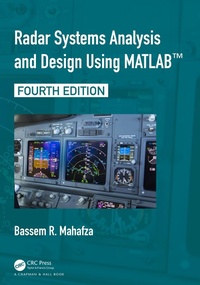
Radar Systems Analysis and Design Using MATLAB
4th Edition
Published on 28. March 2022
690 pages
978-1-000-52871-8 (ISBN)
Description

The first edition of this ground-breaking and widely used book introduced a comprehensive textbook on radar systems analysis and design providing hands-on experience facilitated by its companion MATLAB (R) software. The book very quickly turned into a bestseller. Based on feedback provided by several users and drawing from the author's own teaching experience, the 4th edition adopts a new approach.
The presentation in this edition takes the reader on a scientific journey whose major landmarks comprise the different radar sub-systems and components. Along the way, the different relevant radar subsystems are analyzed and discussed in great level of detail. Understanding the radar signal types and their associated radar signal processing techniques are key to understating how radar systems function.
Each chapter provides the necessary mathematical and analytical coverage required for a sound understanding of radar theory. Additionally, dedicated MATLAB (R) functions/programs enhance the understanding of the theory and establish a means to perform radar system analysis and design trades.
The software provides users with numerous varieties of graphical outputs. Additionally, a complete set of MATLAB (R) code that generates all plot and graphs found within the pages of this textbook are also available. All companion MATLAB (R) code can be downloaded from the book's web page.
The 4th Edition:
Takes advantage of the new features offered by MATLAB (R) 2021 release
Brings the text to a current state of the art
Incorporates much of the feedback received from users using this book as a text and from practicing engineers; accordingly, several chapters have been rewritten
Presents unique topics not found in other books
Maintains a comprehensive and exhaustive presentation
Restructures the presentation to be more convenient for course use
Provides a post-course reference for engineering students as they enter the field
Offers a companion solutions manual for instructors
The 4th edition will serve as a valuable tool to students and radar engineers by helping them better analyze and understand the many topics of radar systems. This book is written primarily as a graduate-level textbook, although parts of it can be used as a senior level course. A companion solutions manual has been developed for use by instructors.
The presentation in this edition takes the reader on a scientific journey whose major landmarks comprise the different radar sub-systems and components. Along the way, the different relevant radar subsystems are analyzed and discussed in great level of detail. Understanding the radar signal types and their associated radar signal processing techniques are key to understating how radar systems function.
Each chapter provides the necessary mathematical and analytical coverage required for a sound understanding of radar theory. Additionally, dedicated MATLAB (R) functions/programs enhance the understanding of the theory and establish a means to perform radar system analysis and design trades.
The software provides users with numerous varieties of graphical outputs. Additionally, a complete set of MATLAB (R) code that generates all plot and graphs found within the pages of this textbook are also available. All companion MATLAB (R) code can be downloaded from the book's web page.
The 4th Edition:
Takes advantage of the new features offered by MATLAB (R) 2021 release
Brings the text to a current state of the art
Incorporates much of the feedback received from users using this book as a text and from practicing engineers; accordingly, several chapters have been rewritten
Presents unique topics not found in other books
Maintains a comprehensive and exhaustive presentation
Restructures the presentation to be more convenient for course use
Provides a post-course reference for engineering students as they enter the field
Offers a companion solutions manual for instructors
The 4th edition will serve as a valuable tool to students and radar engineers by helping them better analyze and understand the many topics of radar systems. This book is written primarily as a graduate-level textbook, although parts of it can be used as a senior level course. A companion solutions manual has been developed for use by instructors.
More details
Edition
4th edition
Language
English
Place of publication
London
United Kingdom
Publishing group
Taylor & Francis Ltd
Target group
College/higher education
Professional and scholarly
Illustrations
71 Tables, black and white; 481 Line drawings, black and white; 7 Halftones, black and white; 488 Illustrations, black and white
ISBN-13
978-1-000-52871-8 (9781000528718)
Copyright in bibliographic data and cover images is held by Nielsen Book Services Limited or by the publishers or by their respective licensors: all rights reserved.
Schweitzer Classification
Other editions
Additional editions
Bassem R. Mahafza
Radar Systems Analysis and Design Using MATLAB
Book
03/2022
4th Edition
Chapman & Hall/CRC
€170.10
Shipment within 15-20 days
Person
Bassem R. Mahafza is the president and founder of Phased n Research. Dr. Mahafza is recognized as a radar subject matter expert and is widely known for authoring several leading reference and textbooks on radar systems. Dr. Mahafza has been a member of the IEEE (Institute of Electric and Electronic Engineers) since 1984, he was awarded a Senior IEEE member in 1994 and has been recently nominated for an IEEE Fellow. Dr. Mahafza's 30+ years' experience includes extensive work in radar technology, radar design and analysis (including all sensor subcomponents), radar simulation and model design, radar signatures and radar algorithm development. Through his industry career, he has supported numerous government organizations. Dr. Mahafza's academic experience includes developing and teaching several graduate and undergraduate level courses, such as random signal and noise, introduction to radar systems, advanced radar techniques, advanced signal processing. He supervised many masters students and several PhD candidates. During his academic tenure, his research was mainly focused on advancements in radar and sensor technology. Furthermore, Dr. Mahafza has conducted detailed research in Phased Array Radars, advanced Radar Signal Processing, Electronic Countermeasures, and Counter Countermeasure techniques.
Content
Preface........................................................................................................................................... xvii
Author Bio..................................................................................................................................... xxi
Companion: MATLABM (R) Code - Disclaimer........................................................................xxiii
1 Radar Definitions and Nomenclature.................................................................................1
2 Basic Radar Waveforms and Antenna............................................................................... 39
3 Radar Equation....................................................................................................................... 81
4 Radar Wave Propagation.................................................................................................... 149
5 Elements of Signal Processing of the Radar Receiver................................................. 185
6 Matched Filter...................................................................................................................... 221
7 Pulse Compression.............................................................................................................. 243
8 Radar Ambiguity Function................................................................................................277
9 Radar Clutter........................................................................................................................ 325
10 Moving Target Indicator and Pulsed Doppler Radars................................................347
11 Random Variables and Random Processes....................................................................385
12 Target Detection - Single Pulse Case.............................................................................. 401
13 Detection of Fluctuating Targets...................................................................................... 415
14 Radar Cross-Section............................................................................................................453
15 Phased Arrays...................................................................................................................... 491
16 Adaptive Signal Processing............................................................................................... 541
17 Target Tracking.................................................................................................................... 567
18 Synthetic Aperture Radar.................................................................................................. 623
Bibliography.................................................................................................................................653
Index..............................................................................................................................................659
Author Bio..................................................................................................................................... xxi
Companion: MATLABM (R) Code - Disclaimer........................................................................xxiii
1 Radar Definitions and Nomenclature.................................................................................1
2 Basic Radar Waveforms and Antenna............................................................................... 39
3 Radar Equation....................................................................................................................... 81
4 Radar Wave Propagation.................................................................................................... 149
5 Elements of Signal Processing of the Radar Receiver................................................. 185
6 Matched Filter...................................................................................................................... 221
7 Pulse Compression.............................................................................................................. 243
8 Radar Ambiguity Function................................................................................................277
9 Radar Clutter........................................................................................................................ 325
10 Moving Target Indicator and Pulsed Doppler Radars................................................347
11 Random Variables and Random Processes....................................................................385
12 Target Detection - Single Pulse Case.............................................................................. 401
13 Detection of Fluctuating Targets...................................................................................... 415
14 Radar Cross-Section............................................................................................................453
15 Phased Arrays...................................................................................................................... 491
16 Adaptive Signal Processing............................................................................................... 541
17 Target Tracking.................................................................................................................... 567
18 Synthetic Aperture Radar.................................................................................................. 623
Bibliography.................................................................................................................................653
Index..............................................................................................................................................659
