

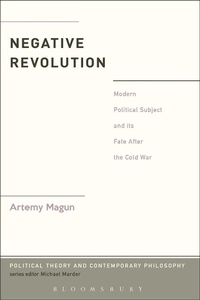
Negative Revolution
Modern Political Subject and its Fate After the Cold War
1st Edition
Published on 18. November 2013
336 pages
978-1-4411-2920-8 (ISBN)
Description

This thought-provoking work analyzes concrete political events and reinterprets key concepts in modern political science. Building on the works of Kant, Badiou, Adorno, Hegel, and more, it posits that the dynamics of revolution can be encapsulated in the concept of negation, since a revolution essentially negates "what is" by rejecting the power in place.
The work argues that revolution is the true ground of Western democracy and that the proof of a true democracy is the activity of protest movements. It discusses how modern philosophy conceives political truth as revolutionary or eventful, and that one aspect of revolution is negativity, which fluctuates between inertia and melancholia. It examines the problem of revolution in the context of modern philosophy, providing a diagnosis of the historical developments since the fall of the Soviet Union to the Arab Spring, setting forth an original theory of revolution while shedding light on the notion of negativity in contemporary thought. This innovative work will appeal to anyone interested in political theory and political philosophy.
The work argues that revolution is the true ground of Western democracy and that the proof of a true democracy is the activity of protest movements. It discusses how modern philosophy conceives political truth as revolutionary or eventful, and that one aspect of revolution is negativity, which fluctuates between inertia and melancholia. It examines the problem of revolution in the context of modern philosophy, providing a diagnosis of the historical developments since the fall of the Soviet Union to the Arab Spring, setting forth an original theory of revolution while shedding light on the notion of negativity in contemporary thought. This innovative work will appeal to anyone interested in political theory and political philosophy.
Reviews / Votes
The Negative Revolution convincingly diagnoses the melancholia of our present moment as a symptom of revolutionary negativity gone awry. From Kant to Badiou, weaving together philosophy, politics, and poetry, Artemy Magum confronts us with the demand to rehabilitate negativity to transform this melancholia into new revolutionary possibilities. * Benjamin Noys, author of The Persistence of the Negative (2010) * Artemy Magun's erudite and original philosophical reflection on revolution and negativity comes at an important critical historical juncture to illuminate the meaning and possibilities of emancipatory politics from South to North and from East to West. The Negative Revolution is a highly innovative account that offers new resources for understanding important contemporary popular practices of resistance and insurrection that escape standard conceptions and theories. Equally important, it has the virtue of historicizing these practices by situating them in relation to post-Cold War transnational forms of power and mobilization. Magun's splendid book is simply indispensable to those who wish to rethink revolutionary politics in a truly philosophical fashion that challenges both the normative idealization and the empirical cynicism built in all classical writings on the subject. * Andreas Kalyvas, Associate Professor of Politics, New School for Social Research, New York * Revolution comes to us from Russia, again. Artemy Magun, writing from Saint-Petersburg, calls it 'negative,' in order to show that it is open to a transgression, to a transcendence, and to a transvaluation of itself. This book works above all to hold in check the melancholia of today's 'developed' societies. Such a book is long awaited. It's a must read. * Jean-Luc Nancy, Emeritus Professor, University of Strasbourg, France * Magun's deep investigations of logical, linguistic, and philosophical negativity are an important corrective to theoretical over-emphasis on affirmation. Rather than celebrating multiple modes of becoming, Magun attends to multiple dimensions of negation: contradiction, contrariness, privation, foreclosure, repression, disavowal, and so on. ... Magun's theory of negativity provides a conceptual apparatus for theorizing modernity under the sign of climate change.More details
Series
Edition
1. Auflage
Language
English
Place of publication
New York
United States
Publishing group
Bloomsbury Publishing PLC (Digital)
ISBN-13
978-1-4411-2920-8 (9781441129208)
Copyright in bibliographic data and cover images is held by Nielsen Book Services Limited or by the publishers or by their respective licensors: all rights reserved.
Schweitzer Classification
Other editions
Additional editions
Book
12/2013
Bloomsbury Academic USA
€63.32
Shipment within 15-20 days
Book
12/2013
Bloomsbury Academic USA
€195.00
Shipment within 15-20 days
Person
Artemy Magun is Professor of Democratic Theory and Chair of the Department of Political Science and Sociology at the European University at Saint-Petersburg, Russia. He also teaches at the Smolny College of the Saint-Peterburg State University.
Content
Introduction
Chapter 1. Russian Anti-Communist Revolution (1985-1999) and the French Revolution (1789-1799)
Chapter 2. What does it mean to say "no"? Theories of negativity
Chapter 3. Theories of revolution
Conclusion
Index
Chapter 1. Russian Anti-Communist Revolution (1985-1999) and the French Revolution (1789-1799)
Chapter 2. What does it mean to say "no"? Theories of negativity
Chapter 3. Theories of revolution
Conclusion
Index
