

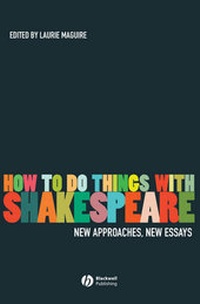
How To Do Things With Shakespeare
New Approaches, New Essays
Published on 8. May 2008
320 pages
978-0-470-69330-8 (ISBN)
Description

This collection of 12 essays uses the works of Shakespeare to showhow experts in their field formulate critical positions.
* * A helpful guidebook for anyone trying to think of a newapproach to Shakespeare
* Twelve experts take new critical positions in their field ofstudy using the writings and analysis of Shakespeare, to show howwriters (students and academics) find topics and develop theirideas
* Features autobiographical prefaces that explain how the expertschose their topics and why the editor commissioned these particularessays, topics, and authors
* Argues that literary research is a reaction to experiences,thoughts or feelings
* Essays are arranged in small dialogues of two or three, forminga debate
* Teaches students to respond individually to culturalpositions
Reviews / Votes
"The contributors to Laurie Maguire's book show by doing.... They are unusually present in what they write, speaking directly to their presumed student readers. This is in some ways the sort of writing we associate with school textbooks, and it is all the better for that." (Times Literary Supplement, October 2008)"Doing things with literature: scholarly articles are not the onlyway to go. Aristotle uses a lecture, Horace a letter, Sidney a mockoration. Laurie Maguire and the contributors to this book engage ina genial conversation that invites students in. Like all goodconversations, this one admits first-person candor, keeps thingslively by changing the subject five times, welcomes disagreements,and waits for what the reader-listener is going to do inresponse." -Bruce Smith, University of Southern California, LosAngeles "This collection of essays on How To Do Things withShakespeare, edited by Laurie Maguire, takes a wonderfullyfresh and unusual approach to its subject. The essays aboutindividual works center in some cases on texts too often neglected:Cymbeline, Henry VIII, Love's Labour's Lost,The Two Gentlemen of Verona,and The Winter's Tale,along with the more familiar A Midsummer Night's Dream,The Merchant of Venice, and the Sonnets. The topics areequally arresting in their freshness of approach: how to do thingswith sources, history, texts, animals, posterity. Animals! This isMaguire's splendid approach to the question she has put to herself,what the next stage in 'body' criticism might be. To provide ananswer, she calls on Erica Fudge to ask such questions as, Cananimals feel shame? Can they lose bladder control? as in the caseof Lance's fabulous dog in The Two Gentlemen. Paul Yachninaddresses such puzzles by thinking about Renaissance ideas of sheepand what they can tell us about personhood. The question, How to dothings with texts? is perhaps less off-beat, but it here producesno less innovative answers from Tiffany Stern: not the usualexplanation of how quartos differ from folios and all that, butinstead pioneering textual analysis of how the language of books isused to describe staging, and, conversely, how the language of thestage can be used to describe reading. Anthony Dawson asks in whatway our thinking about the nature of texts has changed in recentyears and how that change affects the actual process of editing.Source study is rescued from the low estate into which it hasfallen recently by three new and flexible ways of thinking aboutinfluence. Similar pairings of approaches offer delight andrevelation about every topic in this engaging and highly readablebook. The studies are admirably cross-disciplinary andcross-cultural. This is a companion to Shakespeare with adifference. Vive la différance!" -David Bevington, University of ChicagoMore details
Other editions
Additional editions

Book
10/2007
1st Edition
Wiley
€127.67
Shipment within 3-4 weeks
Book
09/2007
1st Edition
Wiley
€41.50
Shipment within 3-4 weeks
Person
Laurie Maguire is a Fellow of Magdalen College and Reader in English at Oxford University. Her books include Shakespearean Suspect Texts (1996), Studying Shakespeare (2004), Where There's a Will There's a Way (2006), and Shakespeare's Names (2007). Maguire has published widely on Renaissance drama, textual problems, performance, and women's studies.
Content
Notes on Contributors.
Introduction: Laurie E. Maguire (Magdalen College, University ofOxford).
Part I How To Do Things with Sources.
1. French Connections: The Je-Ne-Sais-Quoi in Montaigne andShakespeare: Richard Scholar (Oriel College, Oxford).
2. Romancing the Greeks: Cymbeline's Genres and Models:Tanya Pollard (Brooklyn College, City University of New York).
3. How the Renaissance (Mis)Used Sources: The Art ofMisquotation: Julie Maxwell (Lucy Cavendish College,Cambridge).
Part II How To Do Things with History.
4. Henry VIII, or All is True: Shakespeare's"Favorite" Play: Chris R. Kyle (SyracuseUniversity).
5. Catholicism and Conversion in Love's Labour'sLost: Gillian Woods (Wadham College, Oxford).
Part III How To Do Things with Texts.
6. Watching as Reading: The Audience and Written Text inShakespeare's Playhouse: Tiffany Stern (University College,Oxford).
7. What Do Editors Do and Why Does It Matter?: Anthony B. Dawson(University of British Columbia).
Part IV How To Do Things with Animals.
8. "The dog is himself": Humans, Animals, andSelf-Control in The Two Gentlemen of Verona: Erica Fudge.
(Middlesex University).
9. Sheepishness in The Winter's Tale: Paul Yachnin (McGillUniversity).
Part V How To Do Things with Posterity.
10. Time and the Nature of Sequence in Shakespeare'sSonnets: "In sequent toil all forwards do contend":Georgia Brown (independent scholar).
11. Canons and Cultures: Is Shakespeare Universal? : A. E. B.Coldiron (Florida State University).
12. "Freezing the Snowman": (How) Can We DoPerformance Criticism?: Emma Smith (Hertford College, Oxford).
Index
