

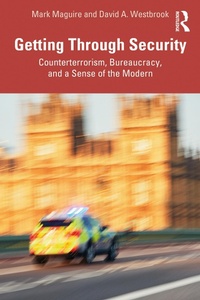
Getting Through Security
Counterterrorism, Bureaucracy, and a Sense of the Modern
1st Edition
Published on 29. November 2020
192 pages
978-1-000-21751-3 (ISBN)
Description

Getting Through Security offers an unprecedented look behind the scenes of global security structures. The authors unveil the "secret colleges" of counterterrorism, a world haunted by the knowledge that intelligence will fail, and Leviathan will not arrive quickly enough to save everyone. Based on extensive interviews with both special forces and other security operators who seek to protect the public, and survivors of terrorist attacks, Getting Through Security ranges from targeted European airports to African malls and hotels to explore counterterrorism today. Maguire and Westbrook reflect on what these practices mean for the bureaucratic state and its violence, and offer suggestions for the perennial challenge to secure not just modern life, but humane politics.
Mark Maguire has long had extraordinary access to a series of counterterrorism programs. He trained with covert behavior detection units and attended secret meetings of international special forces. He found that security professionals, for all the force at their command, are haunted by ultimately intractable problems. Intelligence is inadequate, killers unexpectedly announce themselves, combat teams don't arrive quickly enough, and for a time an amorphous public is on its own. Such problems both challenge and occasion the institutions of contemporary order. David Westbrook accompanied Maguire, pushing for reflection on what the dangerous enterprise of securing modern life means for key concepts such as bureaucracy, violence, and the state. Introducing us to the "secret colleges" of soldiers and police, where security is produced as an infinite horizon of possibility, and where tactics shape politics covertly, the authors relate moments of experimentation by police trying to secure critical infrastructure and conversations with special forces operators in Nairobi bars, a world of shifting architecture, technical responses, and the ever-present threat of violence. Secrecy is poison. Government agencies compete in the dark. The uninformed public is infantilized. Getting Through Security exposes deep flaws in the foundations of bureaucratic modernity, and suggests possibilities that may yet ameliorate our situation.
Mark Maguire has long had extraordinary access to a series of counterterrorism programs. He trained with covert behavior detection units and attended secret meetings of international special forces. He found that security professionals, for all the force at their command, are haunted by ultimately intractable problems. Intelligence is inadequate, killers unexpectedly announce themselves, combat teams don't arrive quickly enough, and for a time an amorphous public is on its own. Such problems both challenge and occasion the institutions of contemporary order. David Westbrook accompanied Maguire, pushing for reflection on what the dangerous enterprise of securing modern life means for key concepts such as bureaucracy, violence, and the state. Introducing us to the "secret colleges" of soldiers and police, where security is produced as an infinite horizon of possibility, and where tactics shape politics covertly, the authors relate moments of experimentation by police trying to secure critical infrastructure and conversations with special forces operators in Nairobi bars, a world of shifting architecture, technical responses, and the ever-present threat of violence. Secrecy is poison. Government agencies compete in the dark. The uninformed public is infantilized. Getting Through Security exposes deep flaws in the foundations of bureaucratic modernity, and suggests possibilities that may yet ameliorate our situation.
Reviews / Votes
Getting Through Security's systematic examination of a particular security regime (airports) and ramified exploration of a particular realm of expertise (counterterrorism) prepares the way for a strikingly insightful examination of issues at the heart of the contemporary security state. Highly distinctive in style, structure, sources, and originality of thought, this book reads and should be read across disciplines-anthropology, cultural studies, law, political science, and sociology. Perhaps as significantly, Getting Through Security is the product of a highly successful collaboration, arising from conversation, thinking and writing together, in ways that frankly I, or any anthropologist, would envy. In a sense, achieved collaborations are as important for anthropology today as the topics that they might address.-George Marcus, author of Ethnography Through Thick and Thin and coauthor of Collaborations Now
In Getting Through Security Mark Maguire and David Westbrook have crafted a masterful account of the people and ideas that animate security culture. The book is a tour de force, but of an unusual sort: written not merely as a review of the relevant scholarship, but as a generous invitation to the reader to reflect on the modern state, the media, bureaucracy, and expertise in relation to fundamental ideas about the resilience and vulnerabilities of the contemporary social order.
Drawing on scores of examples of successful and failed attacks, the authors challenge basic assumptions underwriting the politics and practices of security. They also provide glimpses of the multinational group of actors, of current and former police, military, terrorism and counter terrorism experts as well as consultants, managers, and bureaucrats who populate what Maguire and Westbrook term the "secret college:" the formal and informal networks in which the strategic and tactical of issues of security are relentlessly scrutinized and appraised. Getting Through Security thus opens familiar and unfamiliar terrains to expansive forms of anthropological inquiry and ethnographic reflection.
-Douglas Holmes, author of Economy of Words: Communicative Imperatives in Central Banks and Integral Europe: Fast-Capitalism, Multiculturalism, Neofascism
This intriguing book takes the reader into the dispersed worlds of security, exploring by way of ethnographic glimpses and reflexive exercise, what 'security' in the broader sense, as a 'horizon for certain kinds of thought and institutional action', is. Ultimately, the book is about the uncanniness of not knowing, of being out of control, in a state of fear, yet attempting to come to grips with uncertainty and risk. In the end, it is not just about security and the officials who deal with security as a profession, but about modes of navigating with only fragments of maps at hand. A gripping and extraordinary read!
-Christina Garsten, Principal, Swedish Collegium for Advanced Study, and Principal Investigator, Global Foresight, Stockholm University
This short book does much more than pull back the curtains that shroud airport security. Getting Through Security humanizes the security officials who, through long hours of boredom punctuated by sudden minutes of terror, become practicing ethnographers to keep the skies safe. It's a fascinating read for any air traveler interested in pondering the dilemmas faced by the security bureaucracy.
-Michael Glennon, author of National Security and Double Government, and former Legal Adviser, Senate Foreign Relations Committee
More details
Edition
1. Auflage
Language
English
Place of publication
London
United Kingdom
Publishing group
Taylor & Francis Ltd
Target group
College/higher education
ISBN-13
978-1-000-21751-3 (9781000217513)
Copyright in bibliographic data and cover images is held by Nielsen Book Services Limited or by the publishers or by their respective licensors: all rights reserved.
Schweitzer Classification
Other editions
Additional editions
Mark Maguire | David A. Westbrook
Getting Through Security
Counterterrorism, Bureaucracy, and a Sense of the Modern
Book
11/2020
1st Edition
Routledge
€241.50
Shipment within 15-20 days
Mark Maguire | David A. Westbrook
Getting Through Security
Counterterrorism, Bureaucracy, and a Sense of the Modern
Book
11/2020
1st Edition
Routledge
€59.90
Shipment within 15-20 days
Persons
Mark Maguire is Dean of Maynooth University Faculty of Social Sciences, and former Head of the Department of Anthropology. He has edited a number of recent collections on the anthropology of security, most recently Spaces of Security (NYU Press, 2019) with Setha M. Low.
David A. Westbrook is Louis A. Del Cotto Professor, University at Buffalo School of Law, State University of New York. His books include Navigators of the Contemporary: Why Ethnography Matters and Deploying Ourselves: Islamist Violence and the Responsible Projection of US Force.
David A. Westbrook is Louis A. Del Cotto Professor, University at Buffalo School of Law, State University of New York. His books include Navigators of the Contemporary: Why Ethnography Matters and Deploying Ourselves: Islamist Violence and the Responsible Projection of US Force.
Content
SECURITY BETWEEN THE PROFESSION AND THE PUBLIC
1. Introduction: A Sense of the Modern, 2. The Horizon of Fear, 3. The Secret College,
4. The Mysterious Public
A VIEW FROM THE PROFESSION
5. Knowledgeable Uncertainty and the Specter of Failure, 6. Learning from Experience, or Not, 7. Security by Design, 8. Conflicted Domains, Scarce Resources, Limited Agency,
9. Leviathan Sometimes
A VIEW FROM THE PUBLIC
10. The Glamour of Security, 11. The Resilience of the Individual, 12. Violence, Legitimacy, and the State, 13. Security and the Humanization of Bureaucracy, 14. Is Security Modern?
CONCLUSION
15. Will It End?
Appendix: Attacks Mentioned
Bibliography
1. Introduction: A Sense of the Modern, 2. The Horizon of Fear, 3. The Secret College,
4. The Mysterious Public
A VIEW FROM THE PROFESSION
5. Knowledgeable Uncertainty and the Specter of Failure, 6. Learning from Experience, or Not, 7. Security by Design, 8. Conflicted Domains, Scarce Resources, Limited Agency,
9. Leviathan Sometimes
A VIEW FROM THE PUBLIC
10. The Glamour of Security, 11. The Resilience of the Individual, 12. Violence, Legitimacy, and the State, 13. Security and the Humanization of Bureaucracy, 14. Is Security Modern?
CONCLUSION
15. Will It End?
Appendix: Attacks Mentioned
Bibliography
