

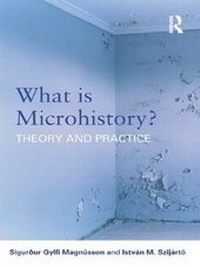
What is Microhistory?
Theory and Practice
1st Edition
Published on 29. May 2013
192 pages
978-1-135-04707-8 (ISBN)
Description

This unique and detailed analysis provides the first accessible and comprehensive introduction to the origins, development, methodology of microhistory - one of the most significant innovations in historical scholarship to have emerged in the last few decades.
The introduction guides the reader through the best-known example of microstoria, The Cheese and the Worms by Carlo Ginzburg, and explains the benefits of studying an event, place or person in microscopic detail. In Part I, Istvan M. Szijarto examines the historiography of microhistory in the Italian, French, Germanic and the Anglo-Saxon traditions, shedding light on the roots of microhistory and asking where it is headed. In Part II, Sigur?ur Gylfi Magnusson uses a carefully selected case study to show the important difference between the disciplines of macro- and microhistory and to offer practical instructions for those historians wishing to undertake micro-level analysis. These parts are tied together by a Postscript in which the status of microhistory within contemporary historiography is examined and its possibilities for the future evaluated.
What is Microhistory? surveys the significant characteristics shared by large groups of microhistorians, and how these have now established an acknowledged place within any general discussion of the theory and methodology of history as an academic discipline.
The introduction guides the reader through the best-known example of microstoria, The Cheese and the Worms by Carlo Ginzburg, and explains the benefits of studying an event, place or person in microscopic detail. In Part I, Istvan M. Szijarto examines the historiography of microhistory in the Italian, French, Germanic and the Anglo-Saxon traditions, shedding light on the roots of microhistory and asking where it is headed. In Part II, Sigur?ur Gylfi Magnusson uses a carefully selected case study to show the important difference between the disciplines of macro- and microhistory and to offer practical instructions for those historians wishing to undertake micro-level analysis. These parts are tied together by a Postscript in which the status of microhistory within contemporary historiography is examined and its possibilities for the future evaluated.
What is Microhistory? surveys the significant characteristics shared by large groups of microhistorians, and how these have now established an acknowledged place within any general discussion of the theory and methodology of history as an academic discipline.
Reviews / Votes
"Magnusson's and Szijarto's book is one of the first comprehensive introductions to microhistorical theory. They show that microhistory has not only been a temporary fashion and that it should be respected as a fully-fledged historical research method... The book is intended to stimulate new debate about the position of microhistory in current historiography."English Historical Review 'The voices of two authors combine in this important analysis of the evolving character of microhistory. This study guides the reader through the achievements of microhistory to date. It also offers a thought-provoking perspective on the potential for microhistory to continue to make a significant contribution to our understanding of the past."
Graeme Murdock, Trinity College Dublin, Republic of Ireland
"...[Szijarto's] achievement is impressive; he displays a useful familiarity with scores of publications treating widely divergent periods and places...Magnusson's exploration of the possibilities and limitations of microhistory is original and daring."
Richard D. Brown, University of Connecticut in The American Historical Review
"...[Szijarto and Magnusson] both argue for a method understood in epistemological terms, and their ultimate answer to the question that their book bears as a title is that microhistory is the method, and probably the right one, to gain reliable knowledge of the past."
Zoltan Boldizsar Simon, University of Bielefeld
"Magnusson's and Szijarto's book is one of the first comprehensive introductions to microhistorical theory. They show that microhistory has not only been a temporary fashion and that it should be respected as a fully-fledged historical research method... The book is intended to stimulate new debate about the position of microhistory in current historiography."
English Historical Review
More details
Language
English
Place of publication
London
United Kingdom
Publishing group
Taylor & Francis Ltd
Target group
College/higher education
File size
3,67 MB
ISBN-13
978-1-135-04707-8 (9781135047078)
Copyright in bibliographic data and cover images is held by Nielsen Book Services Limited or by the publishers or by their respective licensors: all rights reserved.
Schweitzer Classification
Other editions
Additional editions
Book
05/2013
1st Edition
Routledge
€206.00
Shipment within 15-20 days
Book
05/2013
1st Edition
Routledge
€73.20
Shipment within 15-20 days
Persons
Sigur?ur Gylfi Magnusson is currently the chair of the Center for Microhistorical Research at the Reykjavik Academy (www.microhistory.org) and Dr. Kristjan Eldjarn Research Fellow at the National Museum of Iceland. He is the author of seventeen books and numerous articles published in Iceland and abroad. His previous publications include Wasteland with Words. A Social History of Iceland (2010).
Istvan M. Szijarto is Associate Professor in the Department of Economic and Social History at Lorand Eoetvoes University, Hungary. He is the author of three books and several articles published in Hungary and abroad. His previous publications include Experience, Agency, Responsibility. The Lessons of Russia's Microhistory (2011).
Istvan M. Szijarto is Associate Professor in the Department of Economic and Social History at Lorand Eoetvoes University, Hungary. He is the author of three books and several articles published in Hungary and abroad. His previous publications include Experience, Agency, Responsibility. The Lessons of Russia's Microhistory (2011).
Content
Part I (Istvan M. Szijarto) Introduction: Against simple truths. Chapter 1: Italian microhistory. Chapter 2: Under the impact of microstoria: the French and German perspective. Chapter 3: Microhistory in a broader sense: the Anglo-Saxon landscape. Chapter 4: The periphery and the new millennium: answers and new questions. Part II (Sigur?ur Gylfi Magnusson) Chapter 5: The doctor's tale: the living and the dead. Chapter 6: Refashioning of famous French peasants. Chapter 7: New and old theoretical issues: criticism of microhistory. Chapter 8: A West Side story, and the one who gets to write it. Postscript: To step into the same stream twice. References. Extended Bibliography. Index.
