

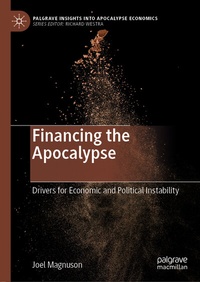
Financing the Apocalypse
Description

As we tour the 400 year history of capitalism through its various phases of development, financial system instability is always there lurking in the shadows. The historical record attests that the processes of aggregating capital for real investment are inescapably vulnerable to risk, manic speculation, unserviceable debt, and crises; and with each episode of instability, a trail of devastation follows. Economic historians such as Hyman Minsky, Charles Kindleberger and others have studied this history and have exposed certain boom-bust patterns that have a way of stubbornly repeating themselves.
This book posits that the large-scale financial crises that the world has experienced over the last 30 years are more or less the latest segments in this narrative, but with some distinct characteristics. In the period spanning the stock market crash of 1987 to the banking crisis of 2008 and its aftermath - the Greenspan Era - there were key institutional and ideological developments rooted in contemporary neoliberalism that have reshaped the historic rise-and-fall patterns to become more severe and widespread. In this important volume, Magnuson suggests the next episode will be a massive financial cyclone that will send us all tumbling toward a perilous future.Reviews / Votes
"Magnuson has long been the proverbial canary in the coal mine urging us to wake up to the various pathologies of a greed-based, corporate-controlled, and growth-addicted modern economy. What he calls, tongue-in-cheek, Financing the Apocalypse , exposes the system's institutional and ideological drivers. The many flavors of life, and, quite possibly, our planetary future, vanishing behind the stench of greed. A must-read for anyone who cares about human and ecological wellbeing." (Dirk Philipsen, Associate Research Professor of Economic History, Sanford School of Public Policy, Duke University)
More details
Other editions
Additional editions
Person
Content
Chapter 1: Introduction.- Chapter 2: Taking the Long View.- Chapter 3: Fortune 500 and Wall Street Leviathans.- Chapter 4: Corporate Hegemony and the Mutual Support Network.- Chapter 5: Contemporary Neoliberalism.- Chapter 6: Everyday Neoliberalism.- Chapter 7: The Crises of the Eighties and the Ascent of the Greenspan Era.- Chapter 8: The Washington Consensus and the Epic Crises of the Nineties.- Chapter 9: The 2008 Meltdown.- Chapter 10: Microfinance and Loan Sharking.- Chapter 11: Will Peer-to-Peer and Equity Crowdfunding Be Different?.- Chapter 12: The Neoliberal Oxymoron of Green Capitalism.- Chapter 13: Conclusion.
