

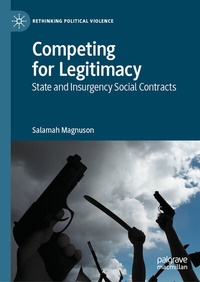
Competing for Legitimacy
Description

This book answers the question of why and how people form bonds with each other and with insurgent groups in fragile state contexts. It develops an overarching framework depicting a political social contract, presents the Grievance-Driven Pathway as one way through which a reformist insurgency-society contract can form, and conducts a systematic comparison using two novel case studies not yet evaluated in insurgency literature, the UFDR in the Central African Republic and the SLM/A in Darfur, Sudan. The core claim is that perceptions of legitimacy across the four social contract elements lead to consent to form the intangible "bond" and foster societal and political trust. Studying social contracts-specifically the interaction between state-society contracts and reformist insurgency-society contracts-facilitates a greater understanding of what constitutes legitimacy in the twenty-first century and how perceptions of illegitimacy can lead to a breakdown of trust and the outbreak of violent conflict.
Reviews / Votes
"Smart, accessible, and deeply informed by fieldwork, Salamah Magnuson offers a fresh and compelling approach to understanding insurgency and peacebuilding through the framework of social contracts. A vital read for policymakers and practitioners alike." (Ambassador (retired) Reuben Brigety II)
"Salamah Magnuson offers a groundbreaking exploration of insurgency and peacebuilding through the lens of social contracts. With compelling insight, she illuminates both the widely known yet lesser-understood Sudanese Liberation Army in Darfur and a lesser-known armed group whose successor factions shape dynamics in the Central African Republic. A compelling and essential read for scholars, practitioners, and all those dedicated to the pursuit of peace."
(Brian Christopher D'Disilva, Senior Policy Advisor, Sudan and South Sudan. USAID)
"Salamah Magnuson delivers a compelling book on why people join insurgent organizations at a time when there is great need to understand the drivers of conflict and the willingness of citizens to align themselves with non-state actors to solve their grievances. Her scholarship is rooted in her decades of work in operational roles, and she has a deep appreciation for the complexities of working in fragile and conflict-affected states. Her book adds to the existing literature and she offers a conceptual framework for understanding political social contracts, drawing from social contract theory, state-building, peacebuilding, and insurgency literature. "Competing for Legitimacy: State and Insurgency Social Contracts" should be required reading for policymakers, academics, and emerging professionals." (President and Chief Executive Officer, Counterpart International, Ann Hudock)
More details
Other editions
Additional editions
Person
Salamah Magnuson, PhD, is a recognized social scientist and conflict mitigation expert with two decades of experience advising, implementing, and evaluating peacebuilding initiatives in transitional and conflict-affected contexts. A published author and thought leader, Dr. Magnuson has served as a senior advisor leading civil-military, stabilization, and environmental peacebuilding change initiatives.
Content
Chapter 1: Social Contracts in the Study of Political Violence.- Chapter 2: Revisiting Social Contract Theory.- Chapter 3: Understanding State-Society Contracting and the Comprehensive Social Contract Framework.- Chapter 4: Reformist Insurgency-Society Contracts and The Grievance-Driven Pathway to Bonding with Armed Groups.- Chapter 5: Bonding with the UFDR in the Central African Republic.- Chapter 6: Bonding with the SLM/A in Sudan.- Chapter 7: Why and How do People Bond With Each Other and With Reformist Insurgent Organizations to Form Social Contracts and What is the Role of the Government.- Chapter 8: A Curious Way Forward.
