

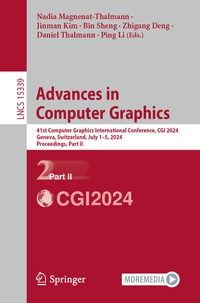
Advances in Computer Graphics
Description

The three-volume set LNCS 15338, 15339 and 15340 constitutes the refereed proceedings from the 41st Computer Graphics International Conference, CGI 2024, held during July 1-5, 2024, in Geneva, Switzerland.
The 84 full papers presented in these proceedings were carefully reviewed and selected from 211 submissions. The papers are organized in the following topical sections:
Part I: Colors, painting and layout; detection and recognition; image analysis and processing; image restoration and enhancement; and visual analytics and modeling.
Part II: Graphics and VR/AR; reconstruction; rendering and animation; and theoretical analysis.
Part III: Image analysis and visualization; image attention and perception; medical imaging and robotics; synthesis and generation; and empowering novel geometric algebra for graphics & engineering workshop.
More details
Other editions
Additional editions
Content
Graphics and VR/AR.- VR Isle Academy: A VR Digital Twin Approach for Robotic Surgical Skill Development.- BoneStory: Visual Storytelling in 3D Virtual Surgical Planning for Bone Fracture Reduction.- The Significance of Interaction in Determining Learning Outcomes in Serious Games.- A Computational Medical XR Discipline, by George Papagiannakis, Walter Greenleaf.- Physiological Factors based Depression Assessment in Virtual Reality.- Assessing Cognitive Load in Distraction and Task Switching: Implications for Developing Realistic Clinical XR Training.- SPARC: Shared Perspective with Avatar Distortion for Remote Collaboration in VR.- Numerical Coarsening for Tetrahedral Meshes.- Reconstruction.- Towards Finer Human Reconstruction for Single RGB-D Images.- UrgRF: Radiance Field Reconstruction Guided by Low-Resolution Grids.- DeGraRec: 3D Deformable Object Reconstruction using Graph Neural Networks and Depth Estimation.- DUE-MVSNet: Learning Multi-View Stereo Based on Dual Uncertainty Estimation.- GRD: Garment Reconstruction and Draping with Preserved Design Based on 2D Image.- Survey on Multi-Person 3D Reconstruction from Monocular View.- SewPCT: Sewing Pattern Reconstruction from Point Cloud with Transformer.- Rendering and Animation.- Neural Metameric Enhancement for Foveated Rendering.- Expression Fusion to Enhance Video- and Speech-driven 3D Facial Animation.- Real-ESRGAN based EXR Upscale for VFX Pipeline.- Unsupervised Real-time Garment Deformation Prediction Driven by Human Body Pose and Shape.- GPN: Generative Point-based NeRF.- Interactive Ray Tracing of 3D Indoor Scanned Point Clouds.- Theoretical Analysis.- A Manifold Representation of the Key in Vision Transformers.- Mamba-Spike: Enhancing the Mamba Architecture with a Spiking Front-End for Efficient Temporal Data Processing.- PDGC: Properly Disentangle by Gating and Contrasting for Cross-Domain Few-Shot Classification.- Multi-scale Similarity Information Fusion Hashing for Unsupervised Cross-modal Retrieval.- YFLM: An Improved Levenberg-Marquardt Algorithm for Global Bundle Adjustment.- Automated Data Exploration and Analysis.
