

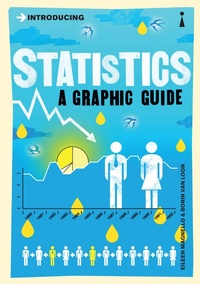
Introducing Statistics
A Graphic Guide
Published on 5. June 2014
176 pages
978-1-84831-773-4 (ISBN)
Description

From the medicine we take, the treatments we receive, the aptitude and psychometric tests given by employers, the cars we drive, the clothes we wear to even the beer we drink, statistics have given shape to the world we inhabit. For the media, statistics are routinely 'damning', 'horrifying', or, occasionally, 'encouraging'. Yet, for all their ubiquity, most of us really don't know what to make of statistics. Exploring the history, mathematics, philosophy and practical use of statistics, Eileen Magnello - accompanied by Bill Mayblin's intelligent graphic illustration - traces the rise of statistics from the ancient Babylonians, Egyptians and Chinese, to the censuses of Romans and the Greeks, and the modern emergence of the term itself in Europe. She explores the 'vital statistics' of, in particular, William Farr, and the mathematical statistics of Karl Pearson and R.A. Fisher.She even tells how knowledge of statistics can prolong one's life, as it did for evolutionary biologist Stephen Jay Gould, given eight months to live after a cancer diagnoses in 1982 - and he lived until 2002. This title offers an enjoyable, surprise-filled tour through a subject that is both fascinating and crucial to understanding our world.
More details
Other editions
Additional editions
Book
09/2009
Icon Books
€11.50
Shipment within 3-4 weeks
Persons
Eileen Magnello trained and worked as a statistician before doing her doctorate in the history of science at St Antony's College, Oxford. She has published extensively on the life and statistical innovations of the Victorian statistician Karl Pearson and is a Research Associate at University College London. Bill Mayblinhas illustrated a number of Introducing titles including Derrida and Logic.
Content
- Intro
- Cover
- Title Page
- Copyright
- Contents
- Drowning by Numbers
- Averages or Variation?
- Why Study Statistics?
- What are Statistics?
- What Does Statistics Mean?
- Vital Statistics vs. Mathematical Statistics
- The Philosophy of Statistics
- Darwin and Statistical Populations
- Victorian Values
- Where Did it All Begin?
- Parish Registers
- The London Bills of Mortality
- Halley's Mortality Tables
- Malthusian Populations
- Demography - the Science of Populations
- The Statistical Society of London
- Edwin Chadwick and Sanitary Reforms
- William Farr and Vital Statistics
- Florence Nightingale: the Passionate Statistician
- The Statistics of the Crimean War
- Mortality Statistics in the Crimea
- Polar Area Graphs
- Probability
- Variables
- Games of Chance
- De Moivre and Gambling in Soho
- The Mathematical Theory of Probability
- Relative Frequency
- The Bayesian Approach
- Probability Distributions
- The Poisson Distribution
- The Normal Distribution
- Astronomical Observations
- The Central Limit Theorem
- The Gaussian Curve and the Principle of Least Squares
- What's Normal?
- The Naming of the Normal
- So What is the Normal Distribution?
- Quetelismus
- Galton's Pantograph
- How to Summarise the Data?
- Quetelet and the Arithmetical Mean
- The Mean
- The Median
- How to Locate or Calculate the Median
- Does it Matter Which Statistical Average is Used?
- Misleading With Statistics
- Data Management Procedures
- Standardized Frequency Distributions
- Samples vs. Populations
- The Histogram
- Frequency Distributions
- The Method of Moments
- Natural Selection: the Changing Shapes of Darwinian Distributions
- The Peppered Moth
- The Pearsonian Family of Curves
- The Interquartile Range
- The Standard Deviation
- Coefficient of Variation
- Comparing Variation of Variables
- Practical Applications
- Pearson's Scales of Measurement
- Nominal and Ordinal Variables
- Ratio and Interval
- Early Uses of Correlation
- Causation and Spurious Correlation
- Path Analysis and Causation
- Scatter Diagrams
- Weldon and Negative Correlation
- Curvilinear Relationships
- Galton and Biological Regression
- Regression to the Mean
- Galton's Two Regression Lines
- George Udny Yule and the Method of Least Squares
- Correlation vs. Regression
- Galton's Dilemma
- Pearson's Product-Moment Correlation
- Simple Correlation and Multiple Correlation
- Statistical Control
- Discrete 2 × 2 Relationships
- Biserial Correlations
- Egon Pearson and Polychoric Correlations
- Factor Analysis
- Maurice Kendall's Tau Coefficient
- Correlation vs. Association
- Curve-Fitting for Asymmetrical Distributions
- Interpreting Results with Degrees of Freedom
- The Chi-Square Probability Table
- A Statistical Test for the Guinness Brewery
- Quantifying Brewery Material
- Agricultural Variation
- Small Samples vs. Large Samples
- Testing Statistical Differences Between Two Means
- Statistical Results for Guinness
- Student's t-test
- A New Statistical Era: Rothamsted's Broadbalk Agricultural Data
- Fisher's Statistical Analysis of Variance
- The Analysis of Agricultural Variation
- The Analysis of Variance and Small Samples
- Inferential Statistics
- The Sampling Distribution
- Conclusion
- Bibliography
- About the Author
- Index
