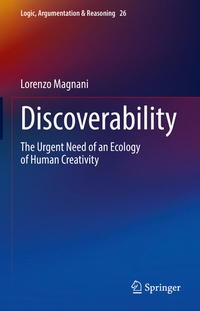
Discoverability
Description

The book analyses the concept of discoverability, and some current epistemological problems related to it, with a special attention to science. It shows that discoverability is closely related to the sustainability of human creativity in an "eco-cognitive" perspective. Advocating the need of an integral ecology and leveraging the important concept of abduction, it demonstrates that an ecology of human creativity should have priority over other needs, i.e that the first ecological duty is to protect and sustain discoverability. Enhancing discoverability will protect human creativity, and it is exactly human creativity, a form of innovative abductive cognition, that can promote the implementation of the other kinds of ecology. The author guides readers through a comprehensive discussion on the concept of discoverability, eco-cognitive situatedness, and eco-cognitive openness and closure alike. By describing some key real-world examples, he highlights the main challenges that are currently posed to human creativity and epistemic integrity. He also describes future eco-cognitive settings, discussing the problem of overcomputationalism and suggesting a reinterpretation of the role of human knowledge.
Overall, this book fills an important gap in the literature on the nexus abduction - creativity - discovery, offering a source of inspiration to philosophers, epistemologists, and cognitive scientists. Yet, it also addresses researchers in other disciplines interested in the problems of scientific discovery and epistemic integrity of research.
More details
Other editions
Additional editions