

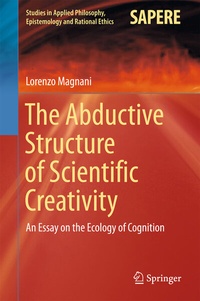
The Abductive Structure of Scientific Creativity
Description

This book employs a new eco-cognitive model of abduction to underline the distributed and embodied nature of scientific cognition. Its main focus is on the knowledge-enhancing virtues of abduction and on the productive role of scientific models.
What are the distinctive features that define the kind of knowledge produced by science? To provide an answer to this question, the book first addresses the ideas of Aristotle, who stressed the essential inferential and distributed role of external cognitive tools and epistemic mediators in abductive cognition. This is analyzed in depth from both a naturalized logic and an ecology of cognition perspective. It is shown how the maximization of cognition, and of abducibility - two typical goals of science - are related to a number of fundamental aspects: the optimization of the eco-cognitive situatedness; the maximization of changeability for both the input and the output of the inferences involved; a high degree of information-sensitiveness; and the need to record the "past life" of abductive inferential practices. Lastly, the book explains how some impoverished epistemological niches - the result of a growing epistemic irresponsibility associated with the commodification and commercialization of science - are now seriously jeopardizing the flourishing development of human creative abduction.
Reviews / Votes
"The book presents a broadly dynamic attitude to epistemology and science. . the book makes for appropriate reading in a graduate seminar on science education, epistemology and the philosophy of science, and beyond. Magnani's broad and dynamic view . should help instructors and students alike gain a fair view of the role that abduction plays for science, and of the crisis it faces." (Shiyang Yu and Frank Zenker, Science & Education, Vol. 30, 2021)
"Thanks to the notion of manipulative abduction, Magnani was able to treat some of the dilemmas in Peirce scholarship. . Backed up by his intriguing discussions of 'thinking through doing', 'affordances', and 'unconscious habits of inference', perceptual model-based ways of cognition are inseparably intertwined with inferential processes . ." (Woosuk Park, Transactions of the Charles S. Peirce Society, Vol. 56 (3), 2020)
More details
Other editions
Additional editions
Content
Enhancing Knowledge: Tracking the External World.- Distributed Model-Based Science: Scienti?c Models Are Not Fictions.- Not Everything in Scienti?c Cognition Is Evidence-Based: The Epistemology of Evidentially Inert Knowledge Enhancing.- Epistemic Warfare: Are Scienti?c Models Fictions or Epistemic Weapons?.- The Genealogy of Abduction: Geometry, and Logic Intertwined.- Maximizing Cognition in Science: Irrelevance and Implausibility Exculpated.- Science Maximizes Abducibility: The Optimization of Eco-Cognitive Situatedness in Ampliative Inferences.- Human Creative Abduction Assaulted: Impoverishing Epistemological Niches.
