

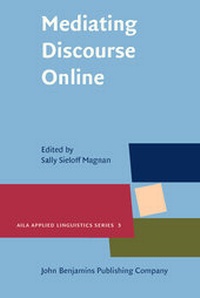
Mediating Discourse Online
1st Edition
Published on 21. May 2008
VII, 364 pages
978-90-272-9117-2 (ISBN)
Description

Information and communication technology is transforming our notion of literacy. In the study of second language learning, there is an acute need to understand how learners collaborate in mediating discourse online. This edited volume offers essays and research studies that lead us to question the borders between speech and writing, to redefine narrative, to speculate on the consequences of many-to-many communication, and to ponder the ethics of researching online interaction. Using diverse technologies (bulletin boards, course management systems, chats, instant messaging, online gaming) and situated in different cultural environments, the studies explore intercultural notions of identity, voice, and collaboration. Although the studies come from varying theoretical perspectives, they point, as a whole, to insights to be gained from an ecological approach to studying how people make discourse online. The volume will especially benefit researchers in the digital arena and instructors who must consider how online interaction affects language learning and use.
More details
Other editions
Additional editions
Sally Magnan Pierce
Mediating Discourse Online
Book
05/2008
John Benjamins Publishing Co
€111.30
Shipment within 10-15 days
Person
Content
- Mediating Discourse Online
- Editorial page
- Title page
- LCC data
- Table of contents
- Acknowledgements
- Introduction
- References
- Part I. Overview of existing research
- Computer-mediated discourse in instructed environments
- Opportunities
- Overview of CMC for SLA
- Challenges
- Directions for the future
- References
- Research perspectives on online discourse and foreign language learning
- Guiding metaphors
- Criteria used for classifying CMC research
- Approaches to CMC research
- Conclusion
- References
- Part II. Creating collaboration
- Postcards from the (turbulent) edge (of chaos)
- Computer-mediated communication
- Complexity theory
- Complexity and a CMC learning environment
- The study
- Further implications and conclusion
- Acknowledgements
- References
- Interpersonal and intercultural understanding in a blended second culture classroom
- Critical social-constructivism
- Sociality and co-construction
- Blended learning
- Data
- The participants
- The class
- The online component
- Student perception of D2L use
- Intercultural understanding
- Co-construction
- Development of identity
- Predispositions
- A disconnect between FTF contact and CMC
- Conclusions and implications
- References
- Appendix A
- Appendix B
- Appendix C
- Creating comfort zones of orality in online discussion forums
- The communicative setting of a discussion forum
- Written or oral communication?
- Characterization of a particular discussion forum: The Zeit-Debatte
- Who serves whom?
- Conclusion
- References
- Part III. Co-constructing interactions
- Use of communication strategies in a synchronous CMC environment
- Previous research in CMC
- The present study
- Results and discussion
- Conclusion
- References
- Appendix A
- Appendix B
- Appendix C
- Appendix D
- Online discourse strategies
- Computer-mediated communication and data-driven pedagogy
- Participants and data collection
- Online discourse and communication strategies in Beginning German
- Academic discourse and pragmatic competence in Advanced German
- Conclusion
- References
- Negotiating meaningfulness
- Negotiation for meaning in CMC environments
- The current study of negotiation for meaning from an interactionist approach
- Socio-cognitive perspectives on CMC in telecollaboration
- Discussion
- Conclusion
- References
- Appendix. Negotiation sequences
- Foreign language resistance
- Theoretical framework
- Context and framing of the larger study
- Conclusion
- References
- Appendix
- Part IV. Mediating social spaces
- Using instant messaging interaction (IMI) in intercultural learning
- Theoretical frameworks
- The study
- Participants
- Data collection
- Findings and discussion
- Four main features of IM-mediated intercultural learning
- Conclusion
- Acknowledgement
- References
- Appendix A
- Appendix B
- Appendix C
- Transcultural communication in open Internet environments
- Learning through living online
- Questions and challenges
- Review of research
- Gaming and L2 learning
- Discussion
- References
- Part V. Ethical ramifications of work in online environments
- Online interactions and L2 learning
- Tempering euphoric views of L2 online participation and productivity
- Problematizing intercultural learning in online interactions
- Complicating notions of culture in the study of L2 online communication
- Reexamining images of interlocutors and learners online
- Elucidating ethical research conduct when investigating online L2 interactions
- Conclusion
- References
- Index
- The AILA Applied Linguistics Series
