

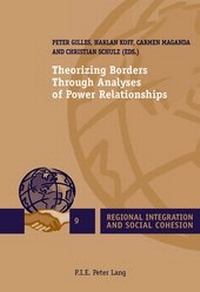
Theorizing Borders Through Analyses of Power Relationships
300th Edition
Published on 4. November 2013
339 pages
978-3-0352-6311-4 (ISBN)
Description

The cumulative body of research on borderlands is impressive for its diversity, its interdisciplinarity and its broad scope. One of the richest characteristics of this field is the tendency for scholars to treat borderlands as puzzles which need to be (re)composed. This tendency, however, may impede more ambitious efforts at «theorizing borders», as scholars put forward theories based on empirical cases located in a variety of institutional, economic, cultural and environmental contexts.
This volume, which includes both theoretical and empirical contributions from leading scholars in diverse fields related to borderlands studies, takes a different approach to theorization and borders. It contends that the theorizing of borders must include the notion of complexity. Instead of proposing a monolithic theory, it adopts strategy that pluralizes theory-building around a core theme which affects different spheres of borderlands studies. Specifically, it examines how power relationships affect border integration in the fields of political cooperation (with a particular focus on local government), spatial planning, environmental management and language policies and practices. While integration processes differ in each of these fields, they are always affected by local power dynamics.
Instead of studying the differences that exist between different integration arenas, the contributors to this volume explore the idea of power as a federating theme. The book's innovative aim is to identify a common thread around which «border theory» can be constructed, while respecting geographic and thematic differences in border integration processes.
This volume, which includes both theoretical and empirical contributions from leading scholars in diverse fields related to borderlands studies, takes a different approach to theorization and borders. It contends that the theorizing of borders must include the notion of complexity. Instead of proposing a monolithic theory, it adopts strategy that pluralizes theory-building around a core theme which affects different spheres of borderlands studies. Specifically, it examines how power relationships affect border integration in the fields of political cooperation (with a particular focus on local government), spatial planning, environmental management and language policies and practices. While integration processes differ in each of these fields, they are always affected by local power dynamics.
Instead of studying the differences that exist between different integration arenas, the contributors to this volume explore the idea of power as a federating theme. The book's innovative aim is to identify a common thread around which «border theory» can be constructed, while respecting geographic and thematic differences in border integration processes.
More details
Other editions
Additional editions
Peter Gilles | Harlan Koff | Carmen Maganda
Theorizing Borders Through Analyses of Power Relationships
Book
06/2013
Presses Interuniversitaires Europeennes
€61.95
Article not available at the moment
Persons
Peter Gilles is Professor of Linguistics in the Department of Luxembourgish Linguistics and Literatures at the University of Luxembourg.
Harlan Koff is Professor of Social Sciences at the University of Luxembourg. He is the founder and President of the Consortium for Comparative Research on Regional Integration and Social Cohesion (RISC).
Carmen Maganda is a Research Associate in the Political Science Institute at the University of Luxembourg. She is Executive Director of the RISC Consortium and with Harlan Koff she edits the journal Regions & Cohesion.
Christian Schulz is Professor of European Sustainable Spatial Planning and Analysis at the University of Luxembourg.
Harlan Koff is Professor of Social Sciences at the University of Luxembourg. He is the founder and President of the Consortium for Comparative Research on Regional Integration and Social Cohesion (RISC).
Carmen Maganda is a Research Associate in the Political Science Institute at the University of Luxembourg. She is Executive Director of the RISC Consortium and with Harlan Koff she edits the journal Regions & Cohesion.
Christian Schulz is Professor of European Sustainable Spatial Planning and Analysis at the University of Luxembourg.
Content
Contents: Emmanuel Brunet-Jailly: Power, Politics and Governance of Borderlands. The Structure and Agency of Power - Cathal McCall: Good Friday Governance on the Island of Ireland. The Cross-border Dimension - Daniel M. Sabet: Border Burden. Public Security in Mexican Border Communities and the Challenge of Polycentricity - Bettina Bruns/Judith Miggelbrink/Kristine Müller/Andreas Wust/Helga Zichner: Making a Living on the Edges of a Security Border. Everyday Tactics and Strategies at the Eastern Border of the European Union - Christian Schulz: Power Topographies in Cross-Border Spatial Development Policies - Julia Affolderbach: Negotiating Border Regions. Retail Development in Luxembourg and the Greater Region - Stephen P. Mumme/Oscar Ibañez: Power and Cooperation in Mexico-United States Water. Management Since NAFTA - Casey Walsh: Borders, Infrastructures and Power - Carmen Maganda: Water in the PITs. Power, Information and Transparency in Different Regional Contexts - Peter Auer: State Borders and Language Change. The (Non-)Effects of Political Border Permeability on Language - Anne Franziskus/Julia de Bres/Peter Gilles: 'I learnt English - the wrong thing, eh'. Power, Interests and Language Practices among Cross-border Workers in Luxembourg - Göz Kaufmann: Group and Language Contact at the Brazilian-Argentinean and Brazilian-Uruguayan Borders - John Agnew: Thinking about Borders. Not Just on the Ground but Also in the Mind.
