

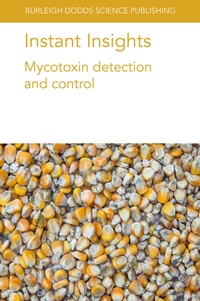
Instant Insights: Mycotoxin detection and control
Published on 13. April 2021
158 pages
978-1-80146-076-7 (ISBN)
Description

This collection features five peer-reviewed literature reviews on mycotoxin control in agriculture.
The first chapter reviews advances in post-harvest detection and control of fungal contaminants in cereals. It examines abiotic factors affecting spoilage, methods for early detection of contamination and the range control measures for preventing toxin growth.
The second chapter focuses on post-harvest storage and handling practices of barley grain and how these methods can be used to mitigate mycotoxin issues. The chapter also reviews the various mycotoxins and fungi that are associated with barley.
The third chapter considers the current strategies available to prevent mycotoxin contamination in groundnut cultivation, focussing on peanuts. It also covers models that predict contamination, as well as the challenges associated with research and quantification of aflatoxin.
The fourth chapter presents an overview of the current understanding of mycotoxin contamination of cocoa. The chapter summarises the various methods available to aid detection of mycotoxins and control further contamination.
The final chapter addresses the critical safety issue of mycotoxin contamination of food waste planned for re-use. It reviews factors affecting mycotoxin growth and the particular problem of masked mycotoxins.
The first chapter reviews advances in post-harvest detection and control of fungal contaminants in cereals. It examines abiotic factors affecting spoilage, methods for early detection of contamination and the range control measures for preventing toxin growth.
The second chapter focuses on post-harvest storage and handling practices of barley grain and how these methods can be used to mitigate mycotoxin issues. The chapter also reviews the various mycotoxins and fungi that are associated with barley.
The third chapter considers the current strategies available to prevent mycotoxin contamination in groundnut cultivation, focussing on peanuts. It also covers models that predict contamination, as well as the challenges associated with research and quantification of aflatoxin.
The fourth chapter presents an overview of the current understanding of mycotoxin contamination of cocoa. The chapter summarises the various methods available to aid detection of mycotoxins and control further contamination.
The final chapter addresses the critical safety issue of mycotoxin contamination of food waste planned for re-use. It reviews factors affecting mycotoxin growth and the particular problem of masked mycotoxins.
More details
Other editions
Additional editions
Naresh Magan | Esther Garcia-Cela | Carol Verheecke-Vaessen
Instant Insights: Mycotoxin Detection and Control
Mycotoxin detection and control
Book
04/2021
Burleigh Dodds Science Publishing Limited
€68.20
Shipment within 3-4 weeks
Persons
Author
Cranfield University
Professor Naresh Magan completed his BSc (Hons) Botany and MSc (Plant Pathology) at Exeter University. He completed his PhD at Rothamsted Research (external student Reading University) in 1982 and was awarded his DSc in 2013 for his work on mycotoxins in food chains. He holds the Chair in Applied Mycology at Cranfield University and has carried out research on food security/safety and spoilage fungi for 35+ years.
Professor Naresh Magan completed his BSc (Hons) Botany and MSc (Plant Pathology) at Exeter University. He completed his PhD at Rothamsted Research (external student Reading University) in 1982 and was awarded his DSc in 2013 for his work on mycotoxins in food chains. He holds the Chair in Applied Mycology at Cranfield University and has carried out research on food security/safety and spoilage fungi for 35+ years.
Cranfield University
Cranfield University
Cranfield University
North Dakota State University
North Dakota State University
North Carolina State University
North Carolina State University
North Carolina State University
University of Georgia
University of Georgia
University of Georgia
Savanna Agricultural Research Institute
University of Georgia
University of Georgia
Kwame Nkrumah University of Science and Technology
Kwame Nkrumah University of Science and Technology
Kwame Nkrumah University of Science and Technology
Virginia Polytechnic Institute and State University
University of Florida
Dr Kenneth Boote is Emeritus Professor in the Department of Agronomy at the University of Florida, USA. He is widely regarded as a pioneer in crop modelling, helping to develop the DSSAT software application program that simulates growth for over 40 different crops. He is presently serving as Co-Lead for Crop Modeling in AgMIP, the global Agricultural Model Intercomparison and Improvement Project. Amongst his many distinctions, Professor Boote is a Fellow of the American Association for the Advancement of Science, the Crop Science Society of America and the American Society of Agronomy.
Dr Kenneth Boote is Emeritus Professor in the Department of Agronomy at the University of Florida, USA. He is widely regarded as a pioneer in crop modelling, helping to develop the DSSAT software application program that simulates growth for over 40 different crops. He is presently serving as Co-Lead for Crop Modeling in AgMIP, the global Agricultural Model Intercomparison and Improvement Project. Amongst his many distinctions, Professor Boote is a Fellow of the American Association for the Advancement of Science, the Crop Science Society of America and the American Society of Agronomy.
University of Florida
Auburn University
University of Connecticut
University of Connecticut
University of Ghana
University of Zambia
University of Zambia
University of Zambia
Crops Research Institute
Crops Research Institute
International Food Policy Research Institute
Mozambique Institute of Agricultural Research
Lilongwe University of Agriculture and Natural Resources
ICRISAT
National Semi-Arid Resources Research Institute
University for Development Studies
North West University
CIBNOR
Instituto Tecnológico de Tepic (Mexico)
Content
Chapter 1 - Advances in post-harvest detection and control of fungal contamination of cereals: Naresh Magan, Esther Garcia-Cela, Carol Verheecke-Vaessen and Angel Medina, Cranfield University, UK; 1 Introduction2 Factors affecting the activity of spoilage moulds and mycotoxin contamination3 Volatiles as an early indicator of spoilage of stored cereals4 Carbon dioxide monitoring for real-time identification of the risk of spoilage moulds and mycotoxins in stored cereals5 Control strategies to minimise spoilage and mycotoxin contamination of stored grain: monitoring of relative humidity (RH) and temperature andthe use of molecular methods6 Control strategies: hermetic storage of grain and use of natural compounds7 Control strategies: biological control and irradiation techniques8 Control technologies: cold plasma technology and ozone fumigation9 Conclusions10 Where to look for further information11 References
Chapter 2 - Advances in postharvest storage and handling of barley: methods to prevent or reduce mycotoxin contamination: Zhao Jin and Paul Schwarz, North Dakota State University, USA; 1 Introduction2 Postharvest handling and storage operations for barley3 Mycoflora and mycotoxins of barley4 Prevention or decontamination of mycotoxins in barley storage5 Post-storage treatment of barley6 Conclusion and future trends7 Where to look for further information8 References
Chapter 3 - Preventing mycotoxin contamination in groundnut cultivation: David Jordan, Rick Brandenburg and Gary Payne, North Carolina State University, USA; David Hoisington, Nick Magnan and James Rhoads, The University of Georgia, USA; Mumuni Abudulai, Savanna Agricultural Research Institute, Ghana; Koushik Adhikari and Jinru Chen, The University of Georgia, USA; Richard Akromah, William Appaw and William Ellis, Kwame Nkrumah University of Science and Technology, Ghana; Maria Balota and Kumar Mallikarjunan, Virginia Polytechnic Institute and State University, USA; Kenneth Boote and Greg MacDonald, University of Florida, USA; Kira Bowen, Auburn University, USA; Boris Bravo-Ureta and Jeremy Jelliffe, University of Connecticut, USA; Agnes Budu, University of Ghana, Ghana; Hendrix Chalwe, Alice Mweetwa and Munsanda Ngulube, University of Zambia, Zambia; Awere Dankyi and Brandford Mochia, Crops Research Institute, Ghana; Vivian Hoffmann, International Food Policy Research Institute, USA; Amade Muitia, Mozambique Institute of Agricultural Research, Mozambique; Agnes Mwangwela, Lilongwe University of Agriculture and Natural Resources, Malawi; Sam Njoroge, International Crops Research Institute for the Semi-Arid Tropics (ICRISAT), Malawi; David Okello, National Semi-Arid Resources Research Institute (NaSARRI), Uganda; and Nelson Opoku, University for Development Studies, Ghana; 1 Introduction2 Factors impacting aflatoxin development3 Prediction models for aflatoxin development4 Minimizing aflatoxin contamination5 Aflatoxin contamination during drying, storage and processing6 Challenges in mycotoxin research7 Value chain projects8 Conclusion9 Where to look for further information10 References
Chapter 4 - Mycotoxins in cocoa: causes, detection and control: Mary A. Egbuta, Southern Cross University, Australia; 1 Introduction2 Mycotoxins contaminating cocoa3 Detection of mycotoxins in cocoa4 Controlling mycotoxins in cocoa production5 Conclusion6 Where to look for further information7 References
Chapter 5 - Reusing food waste: the importance of mycotoxin detection and decontamination: F. Ascencio, Centro de Investigaciones Biológicas del Noroeste, Mexico; and T. Sandoval-Contreras, Instituto Tecnológico de Tepic, Mexico; 1 Introduction2 Recycling and reuse of food waste3 Mycotoxins, food production and food waste4 Factors affecting mycotoxin growth5 The problem of masked mycotoxins6 Detection and modeling of mycotoxin contamination7 Processing methods to inactivate mycotoxins8 Biological degradation of mycotoxins and mycotoxin-adsorbing agents9 Where to look for further information10 References
Chapter 2 - Advances in postharvest storage and handling of barley: methods to prevent or reduce mycotoxin contamination: Zhao Jin and Paul Schwarz, North Dakota State University, USA; 1 Introduction2 Postharvest handling and storage operations for barley3 Mycoflora and mycotoxins of barley4 Prevention or decontamination of mycotoxins in barley storage5 Post-storage treatment of barley6 Conclusion and future trends7 Where to look for further information8 References
Chapter 3 - Preventing mycotoxin contamination in groundnut cultivation: David Jordan, Rick Brandenburg and Gary Payne, North Carolina State University, USA; David Hoisington, Nick Magnan and James Rhoads, The University of Georgia, USA; Mumuni Abudulai, Savanna Agricultural Research Institute, Ghana; Koushik Adhikari and Jinru Chen, The University of Georgia, USA; Richard Akromah, William Appaw and William Ellis, Kwame Nkrumah University of Science and Technology, Ghana; Maria Balota and Kumar Mallikarjunan, Virginia Polytechnic Institute and State University, USA; Kenneth Boote and Greg MacDonald, University of Florida, USA; Kira Bowen, Auburn University, USA; Boris Bravo-Ureta and Jeremy Jelliffe, University of Connecticut, USA; Agnes Budu, University of Ghana, Ghana; Hendrix Chalwe, Alice Mweetwa and Munsanda Ngulube, University of Zambia, Zambia; Awere Dankyi and Brandford Mochia, Crops Research Institute, Ghana; Vivian Hoffmann, International Food Policy Research Institute, USA; Amade Muitia, Mozambique Institute of Agricultural Research, Mozambique; Agnes Mwangwela, Lilongwe University of Agriculture and Natural Resources, Malawi; Sam Njoroge, International Crops Research Institute for the Semi-Arid Tropics (ICRISAT), Malawi; David Okello, National Semi-Arid Resources Research Institute (NaSARRI), Uganda; and Nelson Opoku, University for Development Studies, Ghana; 1 Introduction2 Factors impacting aflatoxin development3 Prediction models for aflatoxin development4 Minimizing aflatoxin contamination5 Aflatoxin contamination during drying, storage and processing6 Challenges in mycotoxin research7 Value chain projects8 Conclusion9 Where to look for further information10 References
Chapter 4 - Mycotoxins in cocoa: causes, detection and control: Mary A. Egbuta, Southern Cross University, Australia; 1 Introduction2 Mycotoxins contaminating cocoa3 Detection of mycotoxins in cocoa4 Controlling mycotoxins in cocoa production5 Conclusion6 Where to look for further information7 References
Chapter 5 - Reusing food waste: the importance of mycotoxin detection and decontamination: F. Ascencio, Centro de Investigaciones Biológicas del Noroeste, Mexico; and T. Sandoval-Contreras, Instituto Tecnológico de Tepic, Mexico; 1 Introduction2 Recycling and reuse of food waste3 Mycotoxins, food production and food waste4 Factors affecting mycotoxin growth5 The problem of masked mycotoxins6 Detection and modeling of mycotoxin contamination7 Processing methods to inactivate mycotoxins8 Biological degradation of mycotoxins and mycotoxin-adsorbing agents9 Where to look for further information10 References
