

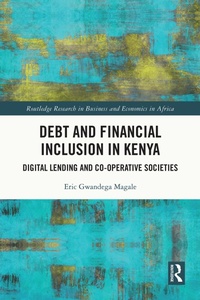
Debt and Financial Inclusion in Kenya
Digital Lending and Co-operative Societies
Published on 26. March 2026
198 pages
978-1-040-57869-8 (ISBN)
Description

What is the relationship of the people of Kenya to credit and debt? Exploring two increasingly popular financial services providers, digital lenders, and cooperative societies, Debt and Financial Inclusion in Kenya identifies fundamental flaws in financial inclusion strategies deployed in Kenya and their ability to alleviate poverty.
Co-operatives have long been important institutions for low- to middle-income Kenyans, long before the financial inclusion discourse came about. But it was the advent of mobile money in 2008 that transformed Kenya's financial services industry tremendously and saw different fintech innovations built on the M-Pesa platform. In the last decade or so, there has been a digital credit boom in Kenya with institutions of different kinds, and more recently the government offering microloans to millions of Kenyans, arguing that that credit has the potential to help the poor forge their paths out of poverty. Based on extensive original research, this book examines how digital lenders and Savings and Credit Co-operative Societies (SACCOs) go about extending credit, and how borrowers experience this. The book shows that digital credit is an important component of a Kenyan's credit mix. However, the use of digital credit varies greatly between people who occupy different income classes. For the poor, who are the targets of financial inclusion, these loans often take the form of 'bad credit' which compromises their financial health, leaving them overindebted. The book explains the ways in which the current monetary system does not work for the poor, arguing that true financial inclusion can only be achieved via a fundamental rethinking of the money system.
Exposing important problems of speculative profiteering and the financialization of the poor, Debt and Financial Inclusion in Kenya will be an important read for researchers of finance, banking, and development in Africa.
Co-operatives have long been important institutions for low- to middle-income Kenyans, long before the financial inclusion discourse came about. But it was the advent of mobile money in 2008 that transformed Kenya's financial services industry tremendously and saw different fintech innovations built on the M-Pesa platform. In the last decade or so, there has been a digital credit boom in Kenya with institutions of different kinds, and more recently the government offering microloans to millions of Kenyans, arguing that that credit has the potential to help the poor forge their paths out of poverty. Based on extensive original research, this book examines how digital lenders and Savings and Credit Co-operative Societies (SACCOs) go about extending credit, and how borrowers experience this. The book shows that digital credit is an important component of a Kenyan's credit mix. However, the use of digital credit varies greatly between people who occupy different income classes. For the poor, who are the targets of financial inclusion, these loans often take the form of 'bad credit' which compromises their financial health, leaving them overindebted. The book explains the ways in which the current monetary system does not work for the poor, arguing that true financial inclusion can only be achieved via a fundamental rethinking of the money system.
Exposing important problems of speculative profiteering and the financialization of the poor, Debt and Financial Inclusion in Kenya will be an important read for researchers of finance, banking, and development in Africa.
More details
Series
Language
English
Place of publication
London
United Kingdom
Publishing group
Taylor & Francis Ltd
Target group
College/higher education
Professional and scholarly
Illustrations
8 Halftones, black and white; 8 Illustrations, black and white
File size
12,39 MB
ISBN-13
978-1-040-57869-8 (9781040578698)
Copyright in bibliographic data and cover images is held by Nielsen Book Services Limited or by the publishers or by their respective licensors: all rights reserved.
Schweitzer Classification
Other editions
Additional editions
Eric Gwangdega Magale
Debt and Financial Inclusion in Kenya
Digital Lending and Co-operative Societies
Book
03/2026
1st Edition
Routledge
€212.40
Shipment within 15-20 days
Person
Eric Gwandega Magale is a Post-Doctoral Fellow under the Human Economy Programme at the Centre for The Advancement of Scholarship, University of Pretoria, South Africa.
Content
1. The Financial Inclusion Discourse 2. History of the Co-operative Movement and Banking Sector in Kenya 3. Interactions with the Co-operative and Digital Lending Models 4. A Critical Analysis of the Proposed Ideal Sacco Model and the Question of Financial Inclusion 5. Scattering Seeds: The Digital Lending Model 6. Borrowers' Experiences with Digital Credit 7. Responses, Perspectives, and Counter-Narratives from Industry Insiders 8. Money as an Object of Contest: Which Way?
