
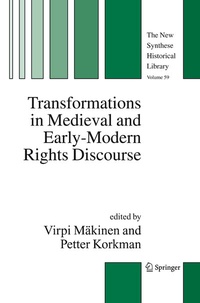
Transformations in Medieval and Early-Modern Rights Discourse
Description
Alles über E-Books | Antworten auf Fragen rund um E-Books, Kopierschutz und Dateiformate finden Sie in unserem Info- & Hilfebereich.
Rights language is a fundamental feature of the modern world. Virtually all significant social and political struggles are waged, and have been waged for over a century now, in terms of rights claims. In some ways, it is precisely the birth of modern rights language that ushers in modernity in terms of moral and political thought, and the struggle for a modern way of life seems for many synonymous with the fight for a universal recognition of equal, individual human rights. Where did modern rights language come from? What kinds of rights discourses is it rooted in? What is the specific nature of modern rights discourse; when and where were medieval and ancient notions of rights transformed into it? Can one in fact find any single such transformation of medieval into modern rights discourse?
This book brings together some of the most central scholars in the history of medieval and early-modern rights discourse. Through the different angles taken by its authors, the volume brings to light the multifaceted nature of rights languages in the medieval and early modern world.
More details
Other editions
Additional editions

Content
System requirements
File format: PDF
Copy protection: Watermark-DRM (Digital Rights Management)
System requirements:
- Computer (Windows; MacOS X; Linux): Use the free software Adobe Reader, Adobe Digital Editions, or any other PDF viewer of your choice (see eBook Help).
- Tablet/Smartphone (Android; iOS): Install the free app Adobe Digital Editions or another reading app for eBooks, e.g., PocketBook (see eBook Help).
- E-reader: Bookeen, Kobo, Pocketbook, Sony, Tolino and many more (only limited: Kindle).
The file format PDF always displays a book page identically on any hardware. This makes PDF suitable for complex layouts such as those used in textbooks and reference books (images, tables, columns, footnotes). Unfortunately, on the small screens of e-readers or smartphones, PDFs are rather annoying, requiring too much scrolling.
This eBook uses Watermark-DRM, a „soft” copy protection. This means that there are no technical restrictions to prevent illegal distribution. However, there is a personalised watermark embedded in the eBook that can be used to identify the purchaser of the eBook in the event of misuse and to provide evidence for legal purposes.
For more information, see our eBook Help page.