

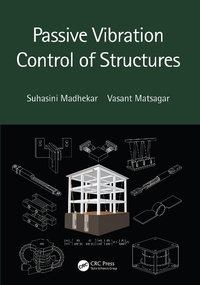
Passive Vibration Control of Structures
1st Edition
Published on 5. May 2022
414 pages
978-1-351-97852-1 (ISBN)
Description

Research in vibration response control deals not only with prevention of catastrophic failures of structures during natural or accidental/manmade hazards but also ensures the comfort of occupants through serviceability. Therefore, the focus of this book is on the theory of dynamic response control of structures by using different kinds of passive vibration control devices. The strategies used for controlling displacement, velocity, and acceleration response of structures such as buildings, bridges, and liquid storage tanks under the action of dynamic loads emanating from earthquake, wind, wave, and so forth are detailed.
The book:
Explains fundamentals of vibration response control devices and their practical applications in response mitigation of structures exposed to earthquake, wind, and wave loading
Offers a comprehensive overview of each passive damper, its functioning, and mathematical modeling in a dynamical system
Covers practical aspects of employing the passive control devices to some of the benchmark problems that are developed from existing buildings and bridges in different countries worldwide
Includes MATLAB (R) codes for determining the dynamic response of single degree of freedom (SDOF) and multi-degree of freedom (MDOF) systems along with computational models of the passive control devices
This book is aimed at senior undergraduate students, graduate students, and researchers in civil, earthquake, aerospace, automotive, mechanical engineering, engineering dynamics, and vibration control, including structural engineers, architects, designers, manufacturers, and other professionals.
The book:
Explains fundamentals of vibration response control devices and their practical applications in response mitigation of structures exposed to earthquake, wind, and wave loading
Offers a comprehensive overview of each passive damper, its functioning, and mathematical modeling in a dynamical system
Covers practical aspects of employing the passive control devices to some of the benchmark problems that are developed from existing buildings and bridges in different countries worldwide
Includes MATLAB (R) codes for determining the dynamic response of single degree of freedom (SDOF) and multi-degree of freedom (MDOF) systems along with computational models of the passive control devices
This book is aimed at senior undergraduate students, graduate students, and researchers in civil, earthquake, aerospace, automotive, mechanical engineering, engineering dynamics, and vibration control, including structural engineers, architects, designers, manufacturers, and other professionals.
More details
Edition
1. Auflage
Language
English
Place of publication
London
United Kingdom
Publishing group
Taylor & Francis Ltd
Target group
College/higher education
Professional and scholarly
Illustrations
114 Tables, black and white; 31 Line drawings, color; 319 Line drawings, black and white; 26 Halftones, color; 36 Halftones, black and white; 57 Illustrations, color; 355 Illustrations, black and white
ISBN-13
978-1-351-97852-1 (9781351978521)
Copyright in bibliographic data and cover images is held by Nielsen Book Services Limited or by the publishers or by their respective licensors: all rights reserved.
Schweitzer Classification
Other editions
Additional editions
Suhasini Madhekar | Vasant Matsagar
Passive Vibration Control of Structures
Book
03/2025
1st Edition
CRC Press
€195.70
Shipment within 10-20 days
Suhasini Madhekar | Vasant Matsagar
Passive Vibration Control of Structures
Book
05/2022
1st Edition
CRC Press
€282.90
Shipment within 10-20 days
Persons
Suhasini N. Madhekar is currently working as Professor of Applied Mechanics in the Department of Civil Engineering at College of Engineering Pune (COEP). She obtained her doctorate degree from Indian Institute of Technology (IIT) Bombay. The subject of her doctoral research was "Seismic Control of Benchmark Highway Bridge." Her PhD thesis is published in a form of book by LAP LAMBERT Academic Publishing GmbH and Company, Germany. Her research interests include structural dynamics and vibration control, bridge engineering, and protection of structures from earthquake. She is a supervisor of students for doctoral research. She is Fellow of Institution of Engineers, IEI (India), Indian Society of Earthquake Technology (ISET), and life member of ISSE, Indian ASTR, IIBE, ISET and ICI. Prof. Madhekar has published a book, Seismic Design of RC Buildings - Theory and Practice, coauthored by Mr. Sharad Manohar. The book is of international repute, published by Springer. The book was awarded "Best book of the year - Useful to consultants," in 2015, by the Association of Consulting Civil Engineers, India. She has published international journal papers, conference papers, and book chapters. Prof. Madhekar has delivered invited lectures in different educational institutes and is invited as examiner for evaluation of masters and PhD theses by different universities. Prof. Madhekar is recipient of the Excellence in Teaching Award at College of Engineering Pune, the "COEP Star Award." She works as a member of board of studies and as a member of research and review committees at different universities in India.
Vasant A. Matsagar is currently serving as a Dogra Chair Professor in the Department of Civil Engineering at Indian Institute of Technology (IIT) Delhi. He obtained his doctorate degree from the Indian Institute of Technology (IIT) Bombay in 2005 in the area of seismic base isolation of structures. He performed his postdoctoral research at the Lawrence Technological University (LTU), United States, in the area of carbon fiber reinforced polymers (CFRP) in bridge structures for about four years. His current research interests include structural dynamics and vibration control; multi-hazard protection of structures from earthquake, blast, fire, and wind; finite element methods; fiber reinforced polymers (FRP) in prestressed concrete structures; and bridge engineering. He has guided students at both undergraduate (UG) and postgraduate (PG) levels in their bachelors' and masters' projects and doctoral research. Besides student guidance, he is actively engaged in sponsored research and consultancy projects at national and international levels. He has published hundreds of international journal papers, other hundreds of international conference manuscripts, a book, six edited proceedings, and has filed for two patents. He is also involved in teaching courses in structural engineering, e.g., structural analysis, finite element methods, numerical methods, structural stability, structural dynamics, design of steel and concrete structures to name a few. He has received the Excellence in Teaching Award. He has organized several short- and long-term courses as part of a quality improvement program (QIP) and continuing education program (CEP) and delivered invited lectures in different educational and research organizations. He is Fellow of Institution of Engineers, IEI (India), Indian Society of Earthquake Technology (ISET), and member of several professional societies. Prof. Matsagar is the recipient of numerous national and international awards including "CDRI Fellowship" by the Coalition for Disaster Resilient Infrastructure (CDRI) in 2021; ASEM-DUO India Professor Fellowship Award in 2020; Erasmus+ Fellowship in 2020; "Humboldt Research Fellowship" in 2017; "Erasmus Mundus Award" in 2013; "DST Young Scientist Award" by the Department of Science and Technology (DST) in 2012; "DAAD Awards" by the Deutscher Akademischer Austausch Dienst (DAAD) in 2009 and 2012; "DAE Young Scientist Award" by the Department of Atomic Energy (DAE) in 2011; "IBC Award for Excellence in Built Environment" by the Indian Buildings Congress (IBC) in 2010; "IEI Young Engineer Award" by the Institution of Engineers (India) in 2009; and "Outstanding Young Faculty Fellowship" by the Indian Institute of Technology (IIT) Delhi in 2009. He has also been appointed as "DAAD Research Ambassador" by the German Academic Exchange Program since the academic session 2010. He is serving as Chief Editor and member of editorials boards of several indexed journals of repute. He is currently serving on code development committees in the Bureau of Indian Standards (BIS) and International Organization for Standardization (ISO).
Vasant A. Matsagar is currently serving as a Dogra Chair Professor in the Department of Civil Engineering at Indian Institute of Technology (IIT) Delhi. He obtained his doctorate degree from the Indian Institute of Technology (IIT) Bombay in 2005 in the area of seismic base isolation of structures. He performed his postdoctoral research at the Lawrence Technological University (LTU), United States, in the area of carbon fiber reinforced polymers (CFRP) in bridge structures for about four years. His current research interests include structural dynamics and vibration control; multi-hazard protection of structures from earthquake, blast, fire, and wind; finite element methods; fiber reinforced polymers (FRP) in prestressed concrete structures; and bridge engineering. He has guided students at both undergraduate (UG) and postgraduate (PG) levels in their bachelors' and masters' projects and doctoral research. Besides student guidance, he is actively engaged in sponsored research and consultancy projects at national and international levels. He has published hundreds of international journal papers, other hundreds of international conference manuscripts, a book, six edited proceedings, and has filed for two patents. He is also involved in teaching courses in structural engineering, e.g., structural analysis, finite element methods, numerical methods, structural stability, structural dynamics, design of steel and concrete structures to name a few. He has received the Excellence in Teaching Award. He has organized several short- and long-term courses as part of a quality improvement program (QIP) and continuing education program (CEP) and delivered invited lectures in different educational and research organizations. He is Fellow of Institution of Engineers, IEI (India), Indian Society of Earthquake Technology (ISET), and member of several professional societies. Prof. Matsagar is the recipient of numerous national and international awards including "CDRI Fellowship" by the Coalition for Disaster Resilient Infrastructure (CDRI) in 2021; ASEM-DUO India Professor Fellowship Award in 2020; Erasmus+ Fellowship in 2020; "Humboldt Research Fellowship" in 2017; "Erasmus Mundus Award" in 2013; "DST Young Scientist Award" by the Department of Science and Technology (DST) in 2012; "DAAD Awards" by the Deutscher Akademischer Austausch Dienst (DAAD) in 2009 and 2012; "DAE Young Scientist Award" by the Department of Atomic Energy (DAE) in 2011; "IBC Award for Excellence in Built Environment" by the Indian Buildings Congress (IBC) in 2010; "IEI Young Engineer Award" by the Institution of Engineers (India) in 2009; and "Outstanding Young Faculty Fellowship" by the Indian Institute of Technology (IIT) Delhi in 2009. He has also been appointed as "DAAD Research Ambassador" by the German Academic Exchange Program since the academic session 2010. He is serving as Chief Editor and member of editorials boards of several indexed journals of repute. He is currently serving on code development committees in the Bureau of Indian Standards (BIS) and International Organization for Standardization (ISO).
Content
1. Structural Vibration Control Using Passive Devices 2. Dynamic Loading on Structures and Structural Response 3. Bracing Systems 4. Viscous and Viscoelastic Dampers 5. Tuned Dampers 6. Friction Dampers 7. Metallic Dampers 8. Re-centering Devices 9. Miscellaneous Response Control Devices 10. Advances in Passive Control Strategies 11. Introduction to Benchmark Control Problems
