

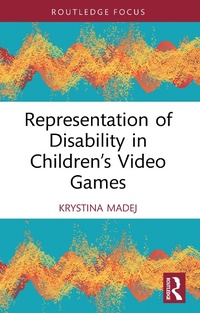
Representation of Disability in Children's Video Games
1st Edition
Published on 10. January 2024
122 pages
978-1-040-00039-7 (ISBN)
Description

Representation of Disability in Children's Video Games looks at how children's engagement with characters and stories in video games helps create the perception of disability they have as teens and adults. Drawing on child development theory supported by neuroscience, the book shows how the scaffold of information, the schema, adults have of disability is first created at a very young age as they interact through play with characters with disabilities in narrative video games.
Positing that early video game play experiences should provide exposure to narrative schemas that add understanding and help create meaning about the disability represented, the book presents how such representation in children's video games maps against cognitive development and the psychomotor and cognitive needs and abilities of children 3-12. Through close readings of over 40 PEGI 3 and PEGI 7 (ESRB E, 10+) games and analysis of games as diverse as Backyard Baseball and Sly Cooper, the author defines broad categories of representation: representation as cosmetic, providing exposure but not game play utility; as incidental, used as a device that provides purpose for the narrative; or as more authentically representing the disability as integral to the character and their life. The book provides readers with an overview of contemporary games that betters their understanding of how children's games present disability and how children create their perceptions through interaction with characters and stories.
This book will be of interest to academics and students of game studies in topics such as behavioural science, ethics, and HCI, as well as in sociology, communications, and digital media. It is pertinent in particular to game developers and to educators, disability advocates, parents, and policy makers.
Positing that early video game play experiences should provide exposure to narrative schemas that add understanding and help create meaning about the disability represented, the book presents how such representation in children's video games maps against cognitive development and the psychomotor and cognitive needs and abilities of children 3-12. Through close readings of over 40 PEGI 3 and PEGI 7 (ESRB E, 10+) games and analysis of games as diverse as Backyard Baseball and Sly Cooper, the author defines broad categories of representation: representation as cosmetic, providing exposure but not game play utility; as incidental, used as a device that provides purpose for the narrative; or as more authentically representing the disability as integral to the character and their life. The book provides readers with an overview of contemporary games that betters their understanding of how children's games present disability and how children create their perceptions through interaction with characters and stories.
This book will be of interest to academics and students of game studies in topics such as behavioural science, ethics, and HCI, as well as in sociology, communications, and digital media. It is pertinent in particular to game developers and to educators, disability advocates, parents, and policy makers.
More details
Series
Edition
1. Auflage
Language
English
Place of publication
London
United Kingdom
Publishing group
Taylor & Francis Ltd
Target group
College/higher education
ISBN-13
978-1-040-00039-7 (9781040000397)
Copyright in bibliographic data and cover images is held by Nielsen Book Services Limited or by the publishers or by their respective licensors: all rights reserved.
Schweitzer Classification
Other editions
Additional editions
Krystina Madej
Representation of Disability in Children's Video Games
Book
05/2025
1st Edition
Routledge
€35.70
Shipment within 10-20 days
Krystina Madej
Representation of Disability in Children's Video Games
Book
01/2024
1st Edition
Routledge
€76.70
Shipment within 10-20 days
Person
Krystina Madej researched children's narrative games at Georgia Tech in Atlanta, Georgia for ten years and currently holds a Research Professorship in The Centre for Games and Animation at the University of Lower Silesia in Wroclaw, Poland.
Content
Chapter 1. Introduction
Chapter 2 Child Development 1: Schema, Play, the Dreamworld, and Societal Norms
Chapter 3: Child Development 2: Children's Cognitive Development
Chapter 4: The Games I, Representation of Physical Disability
Chapter 5. The Games II, Neurodevelopmental Disability
Chapter 6. Content Rating Systems
Chapter 7: Final Words
Chapter 2 Child Development 1: Schema, Play, the Dreamworld, and Societal Norms
Chapter 3: Child Development 2: Children's Cognitive Development
Chapter 4: The Games I, Representation of Physical Disability
Chapter 5. The Games II, Neurodevelopmental Disability
Chapter 6. Content Rating Systems
Chapter 7: Final Words
