

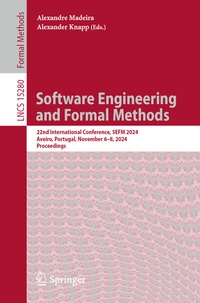
Software Engineering and Formal Methods
Description

This book constitutes the refereed proceedings of the 22nd International Conference on Software Engineering and Formal Methods, SEFM 2024, held in Aveiro, Portugal, during November 6-8, 2024.
The 23 full papers included in this book were carefully reviewed and selected from 68 submissions. The topics covered range from formal modelling, specification, and design in software development over safety-critical, fault-tolerant, and secure systems to real-time, hybrid, and cyber-physical systems and quantum computing.
More details
Other editions
Additional editions
Content
.- Invited Talks.
.- Formal Verification of Cyber-Physical Systems using Domain-specific Abstractions.
.- Paraconsistency for the Working Software Engineer.
.- Picturing Quantum Software.
.- Contributed Papers.
.- User-Guided Verification of Security Protocols via Sound Animation.
.- A Policy Framework for Regulating External Calls in Smart Contracts.
.- Exploiting Assumptions for Effective Monitoring of Real-Time Properties under Partial Observability.
.- SmartML: Towards a Modeling Language for Smart Contracts.
.- Symbolic Execution for Precise Information Flow Analysis of Timed Concurrent Systems.
.- Validating Traces of Distributed Programs Against TLA+ Specifications.
.- Partially-Observable Security Games for Attack-Defence Analysis in Software Systems.
.- Secure Smart Contracts with Isabelle/Solidity.
.- Deductive verification of SYCL in VerCors.
.- Minuska: Towards a Formally Verified Programming Language Framework.
.- Hierarchical Learning of Generative Automaton Models from Sequential Data.
.- Composing Run-time Variability Models.
.- Model-Checking the Implementation of Consent.
.- GrammarForge: Learning Program Input Grammars for Fuzz Testing.
.- Verified Configuration and Deployment of Layered Attestation Managers.
.- Right or Wrong - Understanding How Users Write Software Models in Alloy.
.- An Operational Semantics for Yul.
.- Execution-time opacity control for timed automata.
.- Unlocking the Power of Environment Assumptions for Unit Proofs.
.- Towards Quantum Multiparty Session Types.
.- Automated Invariant Generation for Efficient Deductive Reasoning about Embedded Systems.
.- Formal Analysis of Multi-Factor Authentication Schemes in Digital Identity Cards.
.- Leveraging Contracts for Failure Monitoring and Identification in Automated Driving Systems.
