

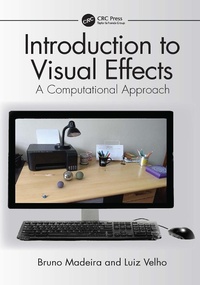
Introduction to Visual Effects
A Computational Approach
1st Edition
Published on 6. December 2022
242 pages
978-1-000-79906-4 (ISBN)
Description

Introduction to Visual Effects: A Computational Approach is the first single introduction to the computational and mathematical aspects of visual effects, incorporating both computer vision and graphics. The book also provides the readers with the source code to a library, enabling them to follow the chapters directly and build up a complete visual effects platform. The book covers the basic approaches to camera pose estimation, global illumination, and image-based lighting, and includes chapters on the virtual camera, optimization and computer vision, path tracing and many more.
Key features include:
Introduction to projective geometry, image-based lighting (IBL), global illumination solved by the Monte Carlo method (Pathtracing), an explanation of a set of optimization methods, and the techniques used for calibrating one, two, and many cameras, including how to use the RANSAC algorithm in order to make the process robust, and providing code to be implemented using the Gnu Scientific Library.
C/C++ code using the OpenCV library, to be used in the process of tracking points on a movie (an important step for the matchmove process), and in the construction of modeling tools for visual effects.
A simple model of the Bidirectional Reflectance Distribution Function (BRDF) of surfaces and the differential rendering method, allowing the reader to generate consistent shadows, supported by a code that can be used in combination with a software like Luminance HDR.
Key features include:
Introduction to projective geometry, image-based lighting (IBL), global illumination solved by the Monte Carlo method (Pathtracing), an explanation of a set of optimization methods, and the techniques used for calibrating one, two, and many cameras, including how to use the RANSAC algorithm in order to make the process robust, and providing code to be implemented using the Gnu Scientific Library.
C/C++ code using the OpenCV library, to be used in the process of tracking points on a movie (an important step for the matchmove process), and in the construction of modeling tools for visual effects.
A simple model of the Bidirectional Reflectance Distribution Function (BRDF) of surfaces and the differential rendering method, allowing the reader to generate consistent shadows, supported by a code that can be used in combination with a software like Luminance HDR.
Reviews / Votes
"The Introduction to Visual Effects: A Computational Approach offers a clear, engaging and well-researched account of fundamental principles that have been used to give life to incredible storytelling for many generations. It is the best reference I have found for academics, studios and enthusiasts alike."- Matteo Moriconi, Director of VFXRio.
More details
Edition
1. Auflage
Language
English
Place of publication
London
United Kingdom
Publishing group
Taylor & Francis Ltd
Target group
College/higher education
Professional and scholarly
Product notice
Reflowable
Illustrations
3 Line drawings, color; 27 Line drawings, black and white; 12 Halftones, color; 15 Illustrations, color; 27 Illustrations, black and white
ISBN-13
978-1-000-79906-4 (9781000799064)
Copyright in bibliographic data and cover images is held by Nielsen Book Services Limited or by the publishers or by their respective licensors: all rights reserved.
Schweitzer Classification
Other editions
Additional editions
Book
10/2024
1st Edition
CRC Press
€85.50
Shipment within 10-20 days
Book
12/2022
1st Edition
CRC Press
€106.65
Shipment within 10-20 days
Persons
Bruno Madeira is a computer engineer from the Military Institute of Engineering (IME). He received his master's and DSc degrees in mathematics with emphasis on computer graphics and vision at IMPA. He has more than 15 years of experience teaching computer graphics at IME and is a member of the Simulators Group at CTEx, Brazil.
Luiz Velho is a senior researcher, professor, and a VISGRAF Laboratory leading scientist at the National Institute for Pure and Applied Mathematics (IMPA), Brazil. His academic background includes a BE in industrial design from ESDI-UERJ, an MS in computer graphics from MIT Media Lab, and a PhD in computer science from the University of Toronto. His experience in computational media spans the fields of modeling, rendering, imaging, and animation.
Luiz Velho is a senior researcher, professor, and a VISGRAF Laboratory leading scientist at the National Institute for Pure and Applied Mathematics (IMPA), Brazil. His academic background includes a BE in industrial design from ESDI-UERJ, an MS in computer graphics from MIT Media Lab, and a PhD in computer science from the University of Toronto. His experience in computational media spans the fields of modeling, rendering, imaging, and animation.
Content
1. Introduction. 2. Virtual Camera. 3. Optimization Tools. 4. Estimating one camera. 5. Estimating two cameras. 6. Feature Tracking. 7. Estimating many cameras. 8. Modeling Tool. 9. Light Transport and Monte Carlo. 10. Image Based Lighting.
