

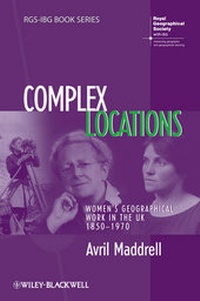
Complex Locations
Description

Reviews / Votes
"With this book, the history and historiography of modern geography- always engaging and much revitalised of late - will beinvigorated yet further. At once a work of scholarly research,sensitive biography and theoretical enquiry, ComplexLocations places women where they have always been in Britishgeography - at its heart. It will interest many and deserves to bewidely read." -Charles W J Withers , University ofEdinburgh "This book is based on highly original and scholarly research andfills a notable absence in historiographies of Geography. It willbe a valuable addition to debates about gender and feminism withinthe discipline." -Cheryl McEwan , Durham University "As the first book length study of early women geographers inBritain, Complex Locations will be essential reading forfeminist geographers and historians of the discipline. Drawing onwonderfully rich and original archival research, the book exploresthe important but often forgotten work of women as academics,educationalists and travellers in shaping British geography sincethe nineteenth century. By studying their lives and work throughits engaging biographical and contextual analysis, the book isvitally important not only in illuminating the long history ofgeographical work by women, but also in understanding the historyof the discipline and the gendered production of knowledge morebroadly." -Alison Blunt , Queen Mary, University ofLondonMore details
Other editions
Additional editions
Person
Content
Chapter Two
Women and British Geographical Societies: Medals, Membership, Inclusion and Exclusion
This chapter explores the various stages of and attitudes towards women’s membership of geographical societies in the UK. Geographical societies were particularly significant as the institutional face of geography prior to the subject’s professionalisation as a university discipline with concomitant qualifications in the early twentieth century (see Chapter Six). They provided accreditation through membership, prizes, publication and invitations to address the given society. Evidence for institutional openness and closure to women is examined, with reference to how this varied over time and space, and degrees to which it was contested and by whom. Women were admitted to the non-metropolitan geographical societies from their foundation in the 1880s onwards: the Royal Scottish (1884), Manchester (1884), Tyneside (1887), Liverpool (1891), Southampton (1897) and Hull (1910) geographical societies; and a brief history of the foundation of a selection of these societies is provided with reference to women’s membership. Particular attention is given to an analysis of the Royal Geographical Society’s (RGS) women’s membership debate 1892–3 and its implications for the epistemology of geography. The biographies of Jane Franklin, Mary Somerville and Isabella Bird demonstrate different engagements with geographical societies, including the varying responses to their work by different societies, how attitudes varied within geographical societies, and how the RGS in particular changed its insti tutional response to women as producers of geographical knowledge over time.
Women’s Membership of British Geographical Societies
The RGS was founded in London in 1830, and was part of a nationwide flowering of philosophical, scientific and arts societies, as well as a European-wide diffusion of geographical societies (see Stoddart 1986; Morris 1990). John Barrow of the Admiralty chaired the first meeting and argued that the success of the Society (which had already gained royal patronage and the support of some leading political figures) would depend not on the Council alone, but on the ‘many individuals eminent in the Arts, Sciences, and Literature, and from the distinguished officers of the Army and Navy, whose names appear on the list of members’.2 In many ways this reflects the Society’s early membership: in 1830 almost all of the 460 members were men of high social standing (Stoddart 1986; Maddrell 2007). As the nineteenth century progressed the RGS continued as ‘a club for travellers and explorers, supported by gentlemen and made intellectually respectable by the scientists’ such as Hooker, Everest, Murchison, Sedgwick, Darwin and Wallace, and the armed services represented a consistently high percentage of RGS membership (17–19 percent, 1830–1900) (Stoddart 1986). Whilst some members sought to combine geographical knowledge with other scientific or cultural knowledge, or to promote the subject within the universities, these were not necessarily distinct from more applied motives, and the majority of members were men who wanted to belong to a club which focused on travel, ‘discovery’ and the interests of Empire. In his presidential address to the RGS in 1885 Lord Aberdare identified the 1880s as a period of unprecedented geographical activity, including the ‘Scramble for Africa’, which was embodied in the formalisation of European territorial annexation at the 1884–5 Berlin Conference. Inevitably the politics and organisation of Empire affected the prevailing ethos within the RGS and this strong link between Empire and British geography and geographical institutions such as the RGS has been widely acknowledged (e.g. see Hudson 1977; Godlewska & Smith 1994; Bell et al. 1995; Driver 2001).
At the time of the debate (1892–3) about women’s membership of the RGS, Queen Victoria, as monarch, was the patron of the Society. The RGS had also previously awarded medals to Lady Jane Franklin (1860) and Mary Somerville (1869) for their contributions to geographical knowledge; indeed the announcement of Somerville’s medal had been met by loud cheers at the RGS (The Times, 25 May 1869), but neither women were ever proposed as fellows of the Society. Other British geographical societies were founded in the 1880s in Scotland, Manchester and Tyneside; the Royal Scottish Geographical Society (RSGS) also opened a London branch in 1892 (see MacKenzie 1992, 1995). All of these non-metropolitan societies admitted women from the outset,3 in keeping with a number of other learned societies which extended their membership to women in the second half of the nineteenth century. Women were admitted to the Zoological, Botanical, Statistical, Asiatic, Hellenic and Anthropological societies and ‘every other geographical society in the empire’ (The Times, 29 May 1893; Stoddart 1986) but not yet to the Royal, Linnaean or Geological societies. Debates around women’s intellectual abilities and public roles need to be placed in the context of the patriarchal structure of British society in the nineteenth century. Women’s educational and employment opportunities improved in the second half of the century (Holloway 2005), as did their legal status, but this was not a smooth or uncontested transition. That women had only had access to universities since 1876 and widows had only been able to be legal guardians of their own children since the Infants Act of 1886, gives some sense of how basic and new these rights were (see Table 1.1). Women’s enfranchisement was fiercely contested in the last quarter of the nineteenth and first quarter of the twentieth century and this issue coloured the motivation for, and responses to, many other campaigns for gender equality.
The question of women’s membership of the RGS had been raised as early as 1847 and was later urged on the Council by Roderick Impey Murchison in 1853, after women had been admitted to RGS meetings under his presidency (1852–3) and to the British Association for the Advancement of Science (BAAS) in 1853 (Stafford 1989). Murchison may have been prompted by his intellectually active wife, Charlotte, and Stafford (1989) credits him with a genuine desire to see women admitted as full members of London’s scientific societies. Murchison later articulated the benefits of women’s membership in terms of gendered citizenship, arguing that women could educate their sons: geographical knowledge ‘to be by them communicated to the sons of England’ (Murchsion 1897). He was not successful, but the question reappeared periodically and in 1887 the RGS council had ‘given its approval in principle and agreed to reconsider the matter when there was evidence of a demand’ (Bell & McEwan 1996: 296).
Whilst women could attend RGS lectures as guests of male fellows, access to the facilities of the Society required a male fellow as intercessory, e.g. world traveller Isabella Bird had to borrow books under the name of her publisher. Similarly, Alexandrine Tinné’s paper on her journeys in the Nile region to the Society in 1889 was read by her son; and the request for an honorary RGS fellowship for Tinné, forwarded by respected explorer J.H. Speke, was unsuccessful. These examples point to the fact that women were actively engaged with the production of geographical knowledge, but that this was obscured by the institutionalised gendered regulations of the RGS. While women’s relation to geographical knowledge remained hidden it did not threaten the male hegemony of travel or the Society itself (Birkett 1989) at a time when the epistemological status of geography as a ‘manly science’ was questioned in academic circles (Keltie 1885); the homosocialility of the space of the RGS was also protected.
These gendered structures were challenged in a number of ways in 1891 and 1892. First, three women had addressed the geographical section at the annual BAAS meeting held in Cardiff in 1891, when Section E under the presidency of E.G. Ravenstein invited Miss E.M. Clerke, Isabella Bird (Mrs Bishop) and May French Sheldon to speak. Secondly, the RSGS suggested reciprocal membership between the two societies, but this was rejected, in part because of women members in the RSGS. This caused the RSGS to set up a London branch, similar to its other regional branches in Scotland and Isabella Bird spoke at the second London branch meeting in 1892. The Marquis of Lothian, chairing the first London RSGS meeting stressed that the scope of the RSGS was wider than that of the RGS, not least in its acknowledgement of women’s ability to produce geographical knowledge (Bell 1995a; Bell & McEwan 1996). In response, RGS secretary, Douglas Freshfield, invited Isabella Bird to speak at a Society meeting. In her reply Bird, unable to speak due to ill health, highlighted the hypocrisy of the RGS which would invite her to speak but not allow her to be a member. This response, much cited by Freshfield, has been credited as the trigger of the 1892–3 controversy around women’s membership of the RGS, but was far from the single flashpoint as the Society had already received several requests from women seeking membership. Bird herself claimed that her involvement with the issue was unintentional and she felt herself to be misrepresented in what became a very public debate which featured in the national press. In a letter to her publisher and friend, John Murray, she wrote: ‘I am annoyed to see that Mr Freshfield both in a circular and...
