

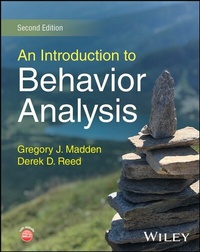
An Introduction to Behavior Analysis
Description

The latest edition of the gold standard in introductory behavior analysis texts
In the newly revised second edition of An Introduction to Behavior Analysis, a team of experienced researchers delivers an engaging and comprehensive introduction to the theoretical fundamentals and applications of behavior analysis. The authors focus on practical issues encountered by practicing behavior analysts, including Pavlovian and operant learning, reinforcement and punishment, motivation and stimulus control, and other key concepts in the field.
The book clearly articulates and defends the philosophical assumptions and overarching goals of behavior analysis. It describes objective data collection, experimental methods, and data analysis in the context of modern psychology. You'll also find:
- Core behavioral analysis principles explained in an accessible way that are appropriate for introductory audiences
- Expert discussions of a variety of common behavior issues, including language, substance-use disorders, and psychological disorders
- Up-to-date examinations of the latest empirical research and theory, along with identifications of areas that require further data and study
- Complimentary access to a companion website containing PowerPoint slides and a test bank for each chapter
Perfect for students undertaking their first course in behavior analysis or behavior modification, An Introduction to Behavior Analysis is also a must-read for trainees pursuing certification through the Behavior Analysis Certification Board and for students of the applied psychological sciences.
Gregory J. Madden, PhD, is a professor of Psychology and Director of the Behavior Analysis program at Utah State University. He has served as the Editor-in-Chief of the APA Handbook of Behavior Analysis and the Journal of the Experimental Analysis of Behavior. He is the co-Editor-in-Chief of the 2nd edition of the APA Handbook of Behavior Analysis (2026). He is an award-winning teacher and scholar and a Fellow of the Association for Behavior Analysis International.
Derek D. Reed, PhD, BCBA-D, is Director of Applied Behavioral Sciences at the Institutes for Behavior Resources, and Adjunct Researcher in the Department of Applied Behavioral Science at the University of Kansas. He has served as an Associate Editor for the Journal of Applied Behavior Analysis, the Journal of the Experimental Analysis of Behavior, Behavior Analysis in Practice, and The Psychological Record. He was previously the Executive Director of the Society for the Quantitative Analyses of Behavior and has published four other co-edited books.
More details
Other editions
Additional editions
Persons
Gregory J. Madden, PhD, is a professor of Psychology and Director of the Behavior Analysis program at Utah State University. He has served as the Editor-in-Chief of the APA Handbook of Behavior Analysis and the Journal of the Experimental Analysis of Behavior. He is the co-Editor-in-Chief of the 2nd edition of the APA Handbook of Behavior Analysis (2026). He is an award-winning teacher and scholar and a Fellow of the Association for Behavior Analysis International.
Derek D. Reed, PhD, BCBA-D, is Director of Applied Behavioral Sciences at the Institutes for Behavior Resources, and Adjunct Researcher in the Department of Applied Behavioral Science at the University of Kansas. He has served as an Associate Editor for the Journal of Applied Behavior Analysis, the Journal of the Experimental Analysis of Behavior, Behavior Analysis in Practice, and The Psychological Record. He was previously the Executive Director of the Society for the Quantitative Analyses of Behavior and has published four other co-edited books.
Content
PREFACE
Why Study Behavior Analysis?
In this course, you will learn foundational principles of behavior analysis-the scientific study of behavior. These principles are the basis of many evidence-based interventions that improve human lives. For example, behavior-analytic principles have helped countless individuals with autism spectrum disorders (Bellini & Akullian, 2007; Eldevik et al., 2009), intellectual disabilities (Heyvaert et al., 2012), antisocial behavior (McCart et al., 2006), anxiety and depression (Öst, 2008; Powers et al., 2009), and substance-use disorders (Dutra et al., 2008; Freese et al., 2023), to name a few. In this course, you will learn how and why these interventions work by mastering the behavioral principles upon which they are built.
Looking ahead, this course can also prepare you for graduate study in behavior analysis. More than 250 universities offer advanced training in the field, and nearly 300,000 professionals are currently certified to provide behavior-analytic services worldwide. These professionals serve individuals with disabilities who depend on students like you to pursue careers in the helping profession of behavior analysis. Jobs are plentiful for professional behavior analysts, be they registered behavioral technicians, certified behavior analysts with an undergraduate degree, or master's level certified behavior analysts. If you are considering a career that makes a real difference in human lives-and has excellent employment opportunities-behavior analysis is a field worth exploring.
For those not drawn to serving those with disabilities, you should know that the principles covered in this book have proven beneficial in the practice of clinical, counseling, and school psychology. For example, in 2012 the Inter-Organizational Task Force on Cognitive and Behavioral Psychology Doctoral Education outlined the most important principles used by effective psychologists (Klepac et al., 2012). More than half of these principles are covered in this book (e.g., shaping, extinction/exposure). Thus, doing well in this course will prepare you for further studies in, for example, clinical psychology.
Perhaps your interests lie elsewhere still. If so, you should know that behavior analysis principles are used in business and organizational settings. Effective managers identify the key behaviors that lead to success, track those behaviors across employees, and implement systems to increase these behaviors through positive reinforcement-not punishment. This course will prepare you for such work by teaching you how to objectively measure and gradually improve human performance. Behavior-analytic managers support high performances while creating productive and enjoyable workplaces.
Behavior analysis has also been used to improve the lives of animals, and human-nonhuman relationships. For example, behavioral principles are used to prepare endangered species for reintroduction into the wild (Shier & Owings, 2006), to train guide dogs for the blind (Funk & Williams, 2020), and to hone the skills of search and rescue dogs (Dickinson & Feuerbacher, 2025). Behavior analysis can also be used to help shelter dogs develop behaviors that improve their chances of adoption (Winslow et al., 2018). So, if you love animals, you will want to learn all you can from this book.
Still not interested? Consider this: many readers of this book will become parents. The principles you will learn are the foundation of most evidence-based parenting programs, such as the Criando con Amor, Promoviendo Armonía y Superacíon [Raising with Love, Promoting Harmony & Improvement] program (Baumann et al., 2014). Your future children may never thank you for learning the behavioral principles covered in this book-but you will be glad you did when it helps to avoid power struggles and to build strong, loving relationships with them.
And if none of this has yet sparked your interest, consider the words of Socrates: "The unexamined life is not worth living." Socrates was encouraging us to use logic, wisdom, and philosophy in pursuit of self-knowledge, better relationships, and a harmonious existence with the natural world. These goals are timeless and universal. Behavior analysis offers powerful tools for examining your life-your actions, your goals, and your values-and improving the world of those around you. Those who master the materials presented in this course are better prepared for living the examined life.
How to Use This Book
This book is designed to help you learn the concepts and principles that are most important for mastering behavior analysis. When new technical terms are introduced, they appear in bold. Their definitions immediately following or preceding in italics. Your instructor will want you to know these terms, their meaning, and how they help us understand behavior. To that end, here is a simple method for turning these technical terms into long-lasting knowledge:
- Write the term on one side of a 3 × 5-inch flashcard. For example, in Chapter 1, the first term introduced is behavior.
- Write the definition (appearing in italics in the book) on the back of the card. For example, Chapter 1 defines behavior as an individual living organism's activity, public or private, which may be influenced by external or internal stimulation.
- When you come across a question in the text (e.g., "What is behavior analysis?") or read something in the book that you think might be a test question (e.g., "Who discovered reinforcement?"), write the question on a flashcard and add the answer-once you have found it-to the back of the card.
- Keep your flashcards handy and review them throughout the day. Just a few minutes here and there can make a big difference. Not as fun as a gaming app, we will admit, but the long-term payoff is greater.
Effective Studying
Most college students think reading and rereading their textbook and lecture notes is a good way to study (Karpicke et al., 2009). It is not. This study method does little to help you remember the materials when you are taking a test or, more importantly, trying to apply the concepts to everyday life. For example, in a study conducted by Roediger and Karpicke (2006), students read the materials four times. Though they thought they had mastered the knowledge, they failed the exam when tested a week later.
A better way to study is called "repeated retrieval," but most college students do not use it (Karpicke et al., 2009). In a repeated retrieval session, the student reads something like a technical definition and then-without peeking-says everything they can remember (out loud or to yourself works equally well; Smith et al., 2013). Want to try it right now? If so, without looking, say, write, or think the definition of behavior that was given earlier.
If you could not recall everything, that is not a problem. Compare what you could recall with the definition provided and then try again. When Karpicke and Roediger (2010) asked students to repeat this read-and-retrieve process three times, the students remembered about 80% of the materials one week later-twice as much as the students who read the book four times.
Repeated Retrieval Made Easy
Here is a practical way to make repeated retrieval an efficient and effective part of your daily study routine (Karpicke et al., 2014):
- Make the flashcards discussed in the previous section of this Preface-a technical term or question on one side, the definition or answer on the other.
- Review the flashcards:
- Look at the front and try to recall everything on the back.
- Flip it over and check your accuracy. If you miss anything, try again before moving to the next card.
- If you do this three to four times a day, most days, you will study less and learn more than ever before.
An Added Benefit
Students who use repeated retrieval do not need to cram the night before an exam. They learn more efficiently, have less test anxiety, and have more time for friends. They also build a stack of flashcards that can be used for review later in the semester-especially helpful for comprehensive exams.
So, what are you waiting for? Start building your deck of flashcards and boost your learning. You will have more time for guilt-free good times (Jia et al., 2019) an important part of going to college. If you prefer digital tools, there are flash card apps available for your phone-but paper cards offer more control and fewer temptations-oh spider solitaire, we love you so.
The Behavior Analysis Task List
Some readers of this book may be interested in earning professional credentials in behavior analysis. At the undergraduate level, the Board Certified Assistant Behavior Analyst (BCaBA®) credential is available, while graduate students may pursue the Board Certified Behavior Analyst (BCBA®) designation. These credentials, issued by the Behavior Analyst Certification Board (BACB®) are the gold standard for practicing and applied behavior analysts.
To qualify for these credentials, students must demonstrate mastering of foundational concepts and principles outlined in the BACB's Sixth Edition Task List. This task list serves as a roadmap for professional preparation. To support students in meeting these expectations, the Appendix of this textbook provides the complete list of foundations and identifies the chapters in which each is...
