

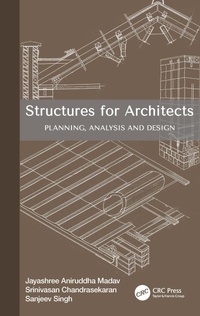
Structures for Architects
Planning, Analysis and Design
1st Edition
Published on 29. August 2025
366 pages
978-1-040-34819-2 (ISBN)
Description

Structures for Architects: Planning, Analysis and Design explains the basics of structural systems to help architects conceive the structural form and analyze and design in a comprehensive manner. The objective is not to explain the structural analysis and design of complex systems in detail but to explain the analysis and design of structural members in a simple and elementary approach. Presenting basic concepts in a simple manner, the book deals with the presentation of structural systems used in the construction of public buildings. Architectural design, urban planning guidelines, basic rules of fire safety, and earthquake-resistant design are discussed in a conceptual manner. Examples included throughout the book shall help students, faculty, and practicing architects understand structural analysis and design in a straightforward manner, and exercise problems are presented to aid in the understanding of the contents presented. This book serves as a useful reference material for both academicians and practicing professionals.
Strengthens the capacity of architects in fundamental structural analysis and design.
Presents numerical examples and exercises for self-study in each chapter, including MATLAB (R) examples.
Includes the basics for understanding architectural design, urban planning, fire safety, and earthquake-resistant design.
Examines construction planning and management through CPM and PERT methods to aid in understanding the fundamentals of project management.
Strengthens the capacity of architects in fundamental structural analysis and design.
Presents numerical examples and exercises for self-study in each chapter, including MATLAB (R) examples.
Includes the basics for understanding architectural design, urban planning, fire safety, and earthquake-resistant design.
Examines construction planning and management through CPM and PERT methods to aid in understanding the fundamentals of project management.
More details
Edition
1. Auflage
Language
English
Place of publication
London
United Kingdom
Publishing group
Taylor & Francis Ltd
Target group
Professional and scholarly
Illustrations
9 Tables, black and white; 88 Line drawings, color; 33 Halftones, color; 121 Illustrations, color
File size
39,22 MB
ISBN-13
978-1-040-34819-2 (9781040348192)
Copyright in bibliographic data and cover images is held by Nielsen Book Services Limited or by the publishers or by their respective licensors: all rights reserved.
Schweitzer Classification
Other editions
Additional editions
Jayashree Aniruddha Madav | Srinivasan Chandrasekaran | Sanjeev Singh
Structures for Architects
Planning, Analysis and Design
Book
08/2025
1st Edition
CRC Press
€184.60
Shipment within 10-20 days
Persons
Jayashree Aniruddha Madav is an urban designer and practicing architect in Mumbai, India. She is currently an Assistant Professor, in the Department of Architecture, Kamla Raheja Vidyanidhi Institute of Architecture and Environmental Studies (KRVIA), Mumbai. She also works as an Associate Director at the Urban Design Research Institute (UDRI), Mumbai. She holds a Bachelor of Architecture and Master of Architecture in Urban Design. She strongly believes that collaborative and participatory methods play a significant role in creating resilient and lively cities. Her master's thesis, titled "An Ecological Approach towards Shaping Urban Peripheries: The Case of Urban Flooding in Chennai City," throws light on ecological and socio-spatial transformations that have led to changing dynamics of peri-urban areas of Chennai City. Over the past five years, she has worked with various communities, local government, institutions and organizations in many projects that hinge on public awareness and participation, community-led development, strategies for communication and outreach, stakeholder engagement and capacity building of local government and communities. She was previously part of the core planning team of the Eastern Waterfront Project at Mumbai Port Trust. She has also been part of the City Investments to Innovate, Integrate and Sustain (CITIIS) program (supported by Ministry of Housing and Urban Affairs (MOHUA), the French Development Agency (AFD), the European Union (EU) and managed by National Institute of Urban Affairs (NIUA)) through projects - Haora Riverfront development, Agartala and Green Mobility Corridor at Hubli-Dharwad while she was working at Urban Design Collective (UDC), Chennai. Currently, she works as an Associate Director at UDRI, and her current research is focused on demystifying the spatial planning process across India. It focuses on understanding the on-ground challenges and best practices adopted in various states as they navigate the spatial planning process guided by state legislations and central schemes. She is involved in the proposals of many prestigious projects of national importance. She has published a number of articles in national newsletters and journals, and is a member of the Professional Council of Architects, India and a Member of Society of Urban Designers, India.
Srinivasan Chandrasekaran is currently a Professor with Higher Academic Grade in the Department of Ocean Engineering, the Indian Institute of Technology, Madras and a Visiting Professor, the Department of Structural Engineering, University of Naples Federico II, Italy. He holds the prestigious fellowship conferred by the Ministry of Italian University Research (a MiUR Fellow). He commands a rich experience in teaching, research, and industrial consultancy of about 30 years. He is also a Visiting Professor, Faculty of International Maritime Studies, Kasetsart University, Sri Racha Campus, Thailand. He has supervised many sponsored research projects and offshore consultancy assignments, both in India and abroad. His active research areas include the dynamic analysis and design of offshore structures, the structural health monitoring of ocean structures, risk and reliability, the fire resistant design of structures, and use of functionally graded materials (FGM). He was a visiting fellow under the Ministry of Italian University Research's invitation to the University of Naples Federico II for two years. During his stay in Italy, he researched the advanced nonlinear analysis of buildings under earthquake loads and other impact loads with experimental validation on full-scale models. He has authored around 170 research papers in peer reviewed international journals and refereed conferences organized by professional societies worldwide. He has authored 22 textbooks with various publishers of international repute. He is an active member of several professional bodies and societies, both in India and abroad. He has also conducted around 30 engineering courses on structural engineering for the National Program on Technology-Enhanced Learning (NPTEL), Government of India. He is a vibrant speaker and has delivered many keynote addresses at international conferences, workshops, and seminars organized in India and abroad. He holds life membership of many national and international professional societies.
Sanjeev Singh is a full professor in the Department of Architecture, SPA, Bhopal. He holds a doctoral degree from the National University, Singapore and a Master of Environmental Studies (by Research) from University of Melbourne, Australia with an Honors Grade. He is an active researcher and dedicated faculty, teaching architectural design, environmental planning and vernacular architecture. He has authored many research articles in peer-reviewed international journals and has presented his research works at many conferences organized by the professional societies of architecture and planning groups in India and abroad. He has also contributed to many book chapters, namely Corporate Environmental Responsibility in Singapore and Malaysia: The Potential and Limits to Voluntary Initiatives (edited by Peter Utting), The Greening of Business in Developing Countries, Stakeholder Influence and Business Behavior, and Sustainable Development and Wisdom of Vernacular Architecture. He has chaired many national level committees in planning and is member of many international committees on architecture and planning. He is member of many professional bodies including the Council of Architects, India.
Srinivasan Chandrasekaran is currently a Professor with Higher Academic Grade in the Department of Ocean Engineering, the Indian Institute of Technology, Madras and a Visiting Professor, the Department of Structural Engineering, University of Naples Federico II, Italy. He holds the prestigious fellowship conferred by the Ministry of Italian University Research (a MiUR Fellow). He commands a rich experience in teaching, research, and industrial consultancy of about 30 years. He is also a Visiting Professor, Faculty of International Maritime Studies, Kasetsart University, Sri Racha Campus, Thailand. He has supervised many sponsored research projects and offshore consultancy assignments, both in India and abroad. His active research areas include the dynamic analysis and design of offshore structures, the structural health monitoring of ocean structures, risk and reliability, the fire resistant design of structures, and use of functionally graded materials (FGM). He was a visiting fellow under the Ministry of Italian University Research's invitation to the University of Naples Federico II for two years. During his stay in Italy, he researched the advanced nonlinear analysis of buildings under earthquake loads and other impact loads with experimental validation on full-scale models. He has authored around 170 research papers in peer reviewed international journals and refereed conferences organized by professional societies worldwide. He has authored 22 textbooks with various publishers of international repute. He is an active member of several professional bodies and societies, both in India and abroad. He has also conducted around 30 engineering courses on structural engineering for the National Program on Technology-Enhanced Learning (NPTEL), Government of India. He is a vibrant speaker and has delivered many keynote addresses at international conferences, workshops, and seminars organized in India and abroad. He holds life membership of many national and international professional societies.
Sanjeev Singh is a full professor in the Department of Architecture, SPA, Bhopal. He holds a doctoral degree from the National University, Singapore and a Master of Environmental Studies (by Research) from University of Melbourne, Australia with an Honors Grade. He is an active researcher and dedicated faculty, teaching architectural design, environmental planning and vernacular architecture. He has authored many research articles in peer-reviewed international journals and has presented his research works at many conferences organized by the professional societies of architecture and planning groups in India and abroad. He has also contributed to many book chapters, namely Corporate Environmental Responsibility in Singapore and Malaysia: The Potential and Limits to Voluntary Initiatives (edited by Peter Utting), The Greening of Business in Developing Countries, Stakeholder Influence and Business Behavior, and Sustainable Development and Wisdom of Vernacular Architecture. He has chaired many national level committees in planning and is member of many international committees on architecture and planning. He is member of many professional bodies including the Council of Architects, India.
Content
Structural Forms Conceived by Architects. Loads on Structures Including Fire. Structural Analysis. Material Characteristics. Structural Design.
