

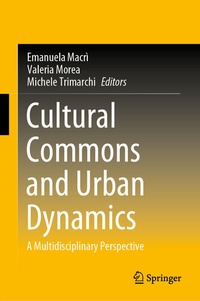
Cultural Commons and Urban Dynamics
Description

Today, cities are being intensively reshaped by unexpected dynamics. The rise and growth of the digital economy have fundamentally changed the relationship between the urban fabric and its resident community, overcoming the conventional hierarchy based on production priorities. Moreover, contemporary society discovers new labour conditions and ways of satisfying needs and desires by developing new synergies and links.
This book examines cultural and urban commons from a multidisciplinary perspective. Economists, architects, urban planners, sociologists, designers, political scientists, and artists explore the impact and implications of cultural commons on urban change. The contributions discuss both cases of successful urban participation and cases of strong social conflict, while also addressing a host of institutional contradictions and dilemmas. The first part of the book examines urban commons in response to institutional constraints from a theoretical point of view. The second and third parts apply the theories to case studies and discuss various practices of sustainable planning and re-appropriation in the urban context. In closing, the fourth part develops a new urban agenda as artists imagine it. This book will appeal to scholars interested in the social, economic and institutional implications of cultural and urban commons, and provide useful insights and tools to help local governments and policymakers manage social, cultural and economic change.
More details
Other editions
Additional editions
Persons
Emanuela Macrì is a research fellow at the Department of Law, Economics and Sociology, Magna Græcia University of Catanzaro (Italy), where she teaches courses on political economy and cultural economics. Her research interests lie in the field of cultural economics with a focus on the impact of culture on health and education.
Valeria Morea is a cultural economist at Erasmus University Rotterdam (the Netherlands), where she teaches courses on cultural economics, economic geography and cultural management. Her research interests focus on public space, public art, and the theory of commons. She is a contributor to the annual report on creative industries in Italy, released by the Fondazione Symbola.
Michele Trimarchi is a professor of Public Economics at Magna Græcia University of Catanzaro (Italy), and teaches courses on cultural economics at Bologna University. He is a member of the editorial board of Creative Industries Journal , co-editor of the European Journal of Creative Processes in Cities and Landscapes , and associate editor of Journal of Public Finance and Public Choice .
