

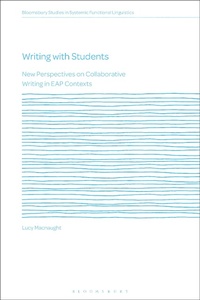
Writing with Students
New Perspectives on Collaborative Writing in Eap Contexts
1st Edition
Published on 8. August 2024
280 pages
978-1-350-29771-5 (ISBN)
Description

Shortlisted for the M. A. K. Halliday Prize 2025
Beginning with a review of the theory and pedagogic practices that have been influential in English for Academic Purposes (EAP) contexts, this book examines the practice of joint construction in a genre-based approach to literacy pedagogy. It investigates how teachers guide students to co-construct a text, drawing attention to the contested rationale for teachers taking a leading role when writing collaboratively with their students.
Informed by systemic functional linguistics, the book puts forward an accessible approach to the analysis of classroom discourse that centres on the dynamic mediation of meaning. Through examples of classroom interaction involving international students who are studying EAP, and specifically as preparation for university entrance, it illuminates how classroom metalanguage and the organisation of classroom talk enables teachers to guide but not provide wording; metalanguage also enables students to critique and justify their choices as they 'try out' new academic language, modify and improve their writing.
Beginning with a review of the theory and pedagogic practices that have been influential in English for Academic Purposes (EAP) contexts, this book examines the practice of joint construction in a genre-based approach to literacy pedagogy. It investigates how teachers guide students to co-construct a text, drawing attention to the contested rationale for teachers taking a leading role when writing collaboratively with their students.
Informed by systemic functional linguistics, the book puts forward an accessible approach to the analysis of classroom discourse that centres on the dynamic mediation of meaning. Through examples of classroom interaction involving international students who are studying EAP, and specifically as preparation for university entrance, it illuminates how classroom metalanguage and the organisation of classroom talk enables teachers to guide but not provide wording; metalanguage also enables students to critique and justify their choices as they 'try out' new academic language, modify and improve their writing.
More details
Series
Edition
1. Auflage
Language
English
Place of publication
London
United Kingdom
Publishing group
Bloomsbury Publishing PLC
Target group
Professional and scholarly
Illustrations
25 bw illus
ISBN-13
978-1-350-29771-5 (9781350297715)
Copyright in bibliographic data and cover images is held by Nielsen Book Services Limited or by the publishers or by their respective licensors: all rights reserved.
Schweitzer Classification
Other editions
Additional editions
Book
approx. 03/2026
Bloomsbury Academic
€45.10
Not yet published

Book
09/2024
Bloomsbury Academic
€141.13
Shipment within 15-20 days
Person
Lucy Macnaught is Senior Lecturer in the role of Learning Advisor at Auckland University of Technology, New Zealand.
Content
List of Figures
List of Tables
Foreword, Maria Brisk
Acknowledgements
List of Abbreviations
1. Writing Development in EAP Contexts
2. Scaffolding Writing Development
3. Student Micro-Tasks During Joint Construction
4. Teacher Guidance During Joint Construction
5. Teacher Organisation of Joint Construction Across a Lesson
6. Creating Classroom Metalanguage with Students
7. Behind the Scenes of Classroom Discourse Analysis
8. Further Developing Intermediate Units of Analysis
References
Appendices
Index
List of Tables
Foreword, Maria Brisk
Acknowledgements
List of Abbreviations
1. Writing Development in EAP Contexts
2. Scaffolding Writing Development
3. Student Micro-Tasks During Joint Construction
4. Teacher Guidance During Joint Construction
5. Teacher Organisation of Joint Construction Across a Lesson
6. Creating Classroom Metalanguage with Students
7. Behind the Scenes of Classroom Discourse Analysis
8. Further Developing Intermediate Units of Analysis
References
Appendices
Index
