

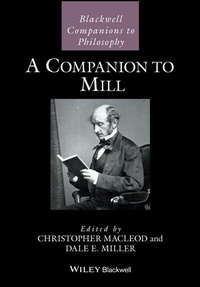
A Companion to Mill
Description

More details
Other editions
Additional editions
Persons
Christopher Macleod is Lecturer in Political Philosophy at the University of Lancaster. His current research focuses on Mill's theoretical philosophy and his theory of normativity. He is the author of "Mill's Antirealism" (Philosophical Quarterly, 2016), "Mill, Intuitions, and Normativity" (Utilitas, 2013) and the entry on J.S. Mill for the Stanford Encyclopedia of Philosophy (2016).
Dale E. Miller is Professor of Philosophy at Old Dominion University in the US. He is the author of J. S. Mill: Moral, Social and Political Thought (Polity, 2010), and the co-editor of several collections: The Cambridge Companion to Utilitarianism ( with Ben Eggleston, 2014); John Stuart Mill and the Art of Life (with Ben Eggleston and David Weinstein, 2011); and Morality, Rules and Consequences (with Brad Hooker and Elinor Mason, 2000).
Content
- Intro
- Title Page
- Copyright Page
- Contents
- Notes on Contributors
- Preface
- Note on Citations
- Part I Mill's Autobiography and Biography
- Chapter 1 Mill's Mind: A Biographical Sketch
- Notes
- References
- Chapter 2 Mill's Epiphanies
- 1. First Epiphany
- 2. Second Epiphany
- 3. Bentham's Two Faces
- 4. From Revolution to Reform
- Notes
- References
- Chapter 3 The Afterlife of John Stuart Mill, 1874-1879
- 1. Immortalizing Mill
- 2. Religious Controversy
- 3. The Character Question
- 4. Politics
- 5. Helen Taylor and the Chapters on Socialism
- 6. Conclusion
- References
- Further Reading
- Chapter 4 Mill's Autobiography as Literature
- 1. An Artifact
- 2. In a Genre
- 3. Necessary Form
- 4. Summary
- References
- Part II Influences on Mill's Thought
- Chapter 5 Mill and the Classics
- 1. Plato's Moral Quandary
- 2. Reforming Plato's Dialectic
- 3. Regenerating Human Agency
- 4. Athens and Sparta
- 5. Spartan Moral Education
- 6. The Athenian Will
- Notes
- References
- Chapter 6 Roots of Mill's Radicalism
- 1. Radical Practice
- 2. Philosophic Radicalism
- 3. Bentham and Radical Democracy
- 4. Bentham's Philosophic Radicalism
- 5. Mill's Revision of Radicalism
- 6. Conclusion
- Notes
- References
- Chapter 7 British Critics of Utilitarianism
- 1. Becoming Acquainted: Mill, Coleridge, Maurice and Sterling
- 2. Maurice and Sterling: Assailants of Benthamism
- 3. Coleridge's Clerisy
- 4. Carlylean Corpuscles
- 5. Macaulay's Assault
- Notes
- References
- Chapter 8 Harriet Taylor Mill
- 1. Early Life, First Meeting, and Friendship
- 2. Paris and the Great Utilitarian Compromise
- 3. Withdrawal from Society and Socialism
- 4. Marriage, Death, and Religion
- Notes
- References
- Further Reading
- Chapter 9 The French Influence
- 1. Emancipation and Revolutions: Mill's Early Discovery of France and its History
- 2. Administering Society: The Saint Simonians
- 3. "Positive Philosophy" or "Positive Politics"? Auguste Comte
- 4. The Uncertain Prospects of Democracy: Alexis de Tocqueville
- 5. The History of Liberty: François Guizot
- 6. The Claims of Justice: 1848, Socialism, and Communism
- Notes
- References
- Part III Foundations of Mill's Thought
- Chapter 10 Psychology, Associationism, and Ethology
- 1. Some Background
- 2. James Mill's Hard-Determinist Ethology
- 3. J.S. Mill's Logic
- 4. Mill's Autobiography
- References
- Chapter 11 Mill on Race and Gender
- 1. Gender
- 2. Race
- 3. Conclusion
- References
- Further Reading
- Chapter 12 Mill on Logic
- 1. The Nature of Logic
- 2. Deduction
- 3. Empiricism in Logic
- 4. Deduction Revisited
- 5. Induction
- 6. Conclusion
- Notes
- References
- Chapter 13 Mill's Epistemology
- 1. Mill's Foundationalism
- 2. Justifying Inductive Reasoning
- 3. The Problem of Perception
- 4. Mill on our Knowledge of "Necessary" Truths
- 5. Mill on the "Reduction" of Deductive Reasoning to Inductive Reasoning
- 6. Mill's Methods
- 7. Mill and Moral Epistemology
- Note
- References
- Chapter 14 Mill's Philosophy of Language
- 1. Propositions and Their Constituents
- 2. Connotation and Denotation
- 3. The Import of Propositions
- 4. Verbal and Real Propositions
- 5. Mill and Contemporary Philosophy of Language
- Notes
- References
- Chapter 15 Mill on Metaphysics
- 1. Introduction
- 2. What is Metaphysics?
- 3. Categorizing Mill
- 4. J.S. Mill as Copernican
- 5. World
- 6. Mind
- 7. Free Will
- References
- Chapter 16 Mill's Philosophy of Science
- 1. Introduction
- 2. The Aims of the Sciences
- 3. The Structure and Methods of the Sciences
- 4. Whewell's Critique of Mill and its Implications for Philosophy of Science
- Notes
- References
- Further Reading
- Chapter 17 Mill's Aesthetics
- 1. Introduction
- 2. What is Poetry?
- 3. Mill's Re-discovery of Poetry
- 4. The Artist and the Scientist
- 5. Mill, Poetry, and Bentham's Omissions
- 6. Conclusion
- Notes
- References
- Chapter 18 Mill on History
- 1. Directionalism and Historicism
- 2. Mill on Directionalism and Historicism
- 3. Combining Directionalism and Historicism
- Notes
- References
- Chapter 19 Mill's Philosophy of Religion
- 1. Mill's Position and Historical Climate
- 2. Religious Morality
- 3. A Religion of Humanity
- 4. God, Afterlife, and Miracles
- 5. Rational Belief and Imaginative Hope
- 6. Assessment of Mill's Philosophy of Religion
- Notes
- Part IV Mill's Moral Philosophy
- Chapter 20 Mill's Art of Life
- 1. Arts and Sciences Distinguished: Metaethical Mill?
- 2. The Content of the Art of Life
- 3. The Art of Life and Mill's Moral Philosophy: Mill's Utilitarianism and Utilitarianism
- 4. Rules in The Art of Life: Mill Wasn't a Rule Utilitarian
- Notes
- References
- Chapter 21 Mill's Conception of Happiness
- 1. Happiness and Pleasure
- 2. Mill's "Proof"
- 3. Qualitative Hedonism
- 4. Hedonism Reconsidered
- Chapter 22 The Proof
- 1. Context and Importance of the Proof
- 2. Reconstruction of the Proof
- 3. Critical Analysis of the Proof
- Notes
- Chapter 23 Mill on Utilitarian Sanctions
- 1. Why a Utilitarian Conscience?
- 2. Developing a Utilitarian Conscience
- 3. The Natural and Normal Utilitarian Conscience
- 4. The Link with Punishment
- 5. Utility in the Largest Sense
- Notes
- References
- Chapter 24 Mill's Moral Standard
- 1. Introduction
- 2. Intention, Aggregation, and Other Issues: A Brief Overview
- 3. Act Utilitarianism
- 4. Rule Utilitarianism
- 5. Sanction Utilitarianism
- 6. Conclusion
- Note
- References
- Chapter 25 Mill on Justice and Rights
- 1. Liberal Rights
- 2. Liberal Rights and Progressive Happiness
- 3. Justice, Rights, and Equality
- 4. Sexual Equality, Rights, and Justice
- 5. Justice, Rights, and Duty
- 6. The Sanction Theory of Rights
- 7. Rights as Secondary Principles
- 8. Rights as Pre-Eminent Goods
- 9. Conclusion
- References
- Chapter 26 Mill and Virtue
- 1. Virtue and its Value: Chapter 2 of Utilitarianism
- 2. Virtue and Happiness: Chapter 4 of Utilitarianism
- 3. Moral and Self-Regarding Virtues and Vices
- 4. Duty, Virtue, and the Art of Life
- 5. Individuality, Malleability, Relativity
- Notes
- References
- Part V Mill's Social Philosophy
- Chapter 27 The Harm Principle
- 1. The Harm Principle and the Essay On Liberty
- 2. What the Principle Does and Does Not Say
- 3. The Theory of Liberty as a Whole
- 4. The Weighing of Utilities
- 5. Toward Moral Foundations
- 6. The Art of Morality
- 7. The Content of Substantive Moral Requirement
- 8. Mill as Avant-Garde
- Note
- References
- Chapter 28 Mill on Individuality
- 1. Introduction
- 2. Millian Individuality: The Fundamentals
- 3. Contemporary Applications of Millian Individuality
- 4. Mill's Liberty Principle and Theory of Justice and Rights
- Note
- References
- Chapter 29 Mill on Freedom of Speech
- 1. Freedom of Speech and the Principle of Liberty
- 2. Limits of Speech and the Corn Dealer Example
- 3. Agency and Self-Development
- Notes
- Chapter 30 Mill on Democracy Revisited
- 1. The Development of Mill's Views on Democracy Prior to 1861: From "Spiritual Power" to "The Principle of Antagonism"
- 2. Mill's Case for Representative Government in the Considerations
- 3. Potential Dangers of Democracy
- 4. How to Make the Most of Democracy: Mill's Constitutional Proposals
- 5. Conclusion: Elitist or Democrat?
- Notes
- Chapter 31 Mill on the Family
- 1. Mill's Experiences of Family
- 2. Critique of Victorian Marriage Laws
- 3. Marriage Between Equals
- 4. Parents and Children
- 5. The Family as a "School in the Relation of Equality"
- Notes
- Chapter 32 Mill's Normative Economics
- 1. Is Normative Economics an Independent Field for Mill?
- 2. The Sharp Positive/Normative Distinction Questioned
- 3. Economic Freedom in Mill's Normative Economics
- 4. Mill's Analysis of Socialism: Drawing the Elements Together
- Notes
- References
- Chapter 33 Mill on Education and Schooling
- 1. Mill's Education and Intellectual Heritage
- 2. Direct and Indirect Education
- 3. Controversies in Education
- 4. Conclusion
- Notes
- References
- Chapter 34 Mill on Colonialism
- 1. Introduction
- 2. Mill's Historical Milieu
- 3. Reconstructing Mill
- 4. Conclusion
- Notes
- References
- Part VI Mill and Later Movements in Philosophy
- Chapter 35 Mill, German Idealism, and the Analytic/Continental Divide
- 1. Bentham and Coleridge
- 2. Mill and Schiller
- 3. Two Schools or Three?
- 4. The Analytic/Continental Divide
- 5. The Unbearable Elusiveness of Being
- Notes
- Chapter 36 Mill and Modern Utilitarianism
- 1. What Kind of Utilitarian Was Mill?
- 2. Pleasure and Well-Being
- 3. The Case for Utilitarianism
- 4. Toward a More Refined Utilitarianism
- 5. Concluding Remarks
- Note
- References
- Chapter 37 Mill and Modern Liberalism
- 1. Introduction
- 2. The Arguments of On Liberty
- 3. Mill and Public Reason Liberalism
- 4. Conclusion
- Notes
- References
- Index
- EULA
Notes on Contributors
Terence Ball is Emeritus Professor of Political Science and Philosophy at Arizona State University, to which he moved in 1998 after a long career at the University of Minnesota. He has held visiting appointments at Cambridge, Oxford, and the University of California, San Diego. He is the author of several books, including Transforming Political Discourse: Political Theory and Critical Conceptual History (1988), Reappraising Political Theory: Revisionist Studies in the History of Political Thought (1995), and a mystery novel, Rousseau's Ghost (1998). He is coeditor (with Richard Bellamy) of The Cambridge History of Twentieth-Century Political Thought and for the Cambridge Texts series has edited James Mill: Political Writings (1992), The Federalist (2003), Abraham Lincoln: Political Writings and Speeches (2013), and (with Joyce Appleby) Thomas Jefferson: Political Writings (1999).
David O. Brink is Distinguished Professor of Philosophy at the University of California, San Diego. His research interests are in ethical theory, history of ethics, moral psychology, and jurisprudence. He is author of Moral Realism and the Foundations of Ethics (Cambridge 1989), Perfectionism and the Common Good: Themes in the Philosophy of T.H. Green (Oxford 2003), and Mill's Progressive Principles (Oxford 2013).
D.G. Brown who sadly passed away just as this volume went to press, was Professor Emeritus at the University of British Columbia. He was a Fellow of Magdalen College Oxford 1952-1955, and taught the Philosophy Department in the University British Columbia 1955-1985. His last papers on Mill include "Mill's Moral Theory: Ongoing Revisionism" (Politics, Philosophy and Economics, 2010), and "Mill on the Harm in Not Voting" (Utilitas, 2010).
Nicholas Capaldi is Legendre-Soule Distinguished Chair in Business Ethics at Loyola University New Orleans. Among his numerous publications are two books on David Hume and the Cambridge University Press intellectual biography John Stuart Mill.
Samuel Clark is Lecturer in Philosophy at Lancaster University, UK. He works on the nature, conditions, and ethical significance of human well-being, and on the form and value of various kinds of literary text - utopias, dialogues, autobiographies - which investigate these issues. Within these broad concerns, he has written on anarchist utopianism, on John Stuart Mill, on the roles of pleasure in good lives, on friendship and comradeship in the lives of soldiers, on David Hume, and on work and human flourishing. He has published a book, Living Without Domination, and articles in journals including Res Publica, Philosophy, Inquiry, Ratio, Hume Studies, and The Journal of Applied Philosophy. He is currently writing a book about autobiography and well-being.
Aaron D. Cobb is Associate Professor of Philosophy at Auburn University at Montgomery. His research focuses primarily on nineteenth-century British philosophy of science and he has published journal articles on John F.W. Herschel, William Whewell, John Stuart Mill, and Michael Faraday.
Wendy Donner is Professor Emeritus of Philosophy at Carleton University, Ottawa, Canada. She is the author of two books on John Stuart Mill - Mill (with Richard Fumerton, Wiley-Blackwell, 2009) and The Liberal Self (Cornell, 1991). She has also published many articles on Mill, environmental ethics, feminist ethics, and Buddhist ethics.
Robert Devigne is Professor of Political Science at Tufts University. He is the author of Reforming Liberalism: J.S. Mill's Use of Ancient, Religious, Romantic and Liberal Moralities (2006) and Recasting Conservatism: Oakeshott, Strauss, and the Response to Postmodernism (1994), both published by Yale University Press.
Ben Eggleston is Professor of Philosophy at the University of Kansas. He is a coeditor, with Dale E. Miller, of The Cambridge Companion to Utilitarianism (Cambridge University Press, 2014), and a coeditor, with Dale E. Miller and David Weinstein, of John Stuart Mill and the Art of Life (Oxford University Press, 2011).
Graham Finlay is a lecturer in the School of Politics and International Relations, University College Dublin. Besides articles on Mill and education, he has published articles on Mill and power, toleration and empire. Other research interests include migration and human rights.
Guy Fletcher is Lecturer in Philosophy at the University of Edinburgh. He is interested in metaethics and ethics, and their history, and political philosophy.
Richard Fumerton received his B.A. from the University of Toronto in 1971, his Ph.D. from Brown University in 1974, and is currently the F. Wendell Miller Professor of Philosophy at the University of Iowa. His research has focused mainly in epistemology, but he has also published books and articles on metaphysics, philosophy of mind, philosophy of science, value theory, and philosophy of law. He is the author of Metaphysical and Epistemological Problems of Perception (1985), Reason and Morality: A Defense of the Egocentric Perspective (1990), Metaepistemology and Skepticism (1996), Realism and the Correspondence Theory of Truth (2002), Epistemology (2006), Mill, co-authored with Wendy Donner (2009), and Knowledge, Thought and The Case for Dualism (2013).
Gerald Gaus is the James E. Rogers Professor of Philosophy at the University of Arizona, where he directs the program in Philosophy, Politics, Economics & Law. He is the author of a number of books, most recently The Order of Public Reason, published by Cambridge in 2011; with Piers Norris Tuner, he is co-editor of the forthcoming History of Public Reason in Political Philosophy (Routledge). His most recent book, the Tyranny of the Ideal: Justice in a Diverse Society, is forthcoming from Princeton University Press.
David Godden received his Ph.D from McMaster University in 2004. He is an Assistant Professor of Philosophy at Michigan State University, researching in epistemology and argumentation. His previous work on Mill includes "Psychologism in the logic of John Stuart Mill" in History and Philosophy of Logic (2005), and "Mill's System of Logic" in W.M. Mander's Oxford Handbook of British Philosophy in the Nineteenth Century (2014).
Vincent Guillin is currently Associate Professor at the Université du Québec à Montréal, where he teaches the history and philosophy of the human sciences and the history of modern philosophy. His publications focus on John Stuart Mill, Auguste Comte, the history of nineteenth-century moral sciences. Recently, his research interests have centered on the French reception of John Stuart Mill and the history and philosophy of experimental social engineering.
Don A. Habibi is professor of philosophy at the University of North Carolina Wilmington. He specializes in social and political philosophy, ethics, and philosophy of law.
Daniel Jacobson is Professor of Philosophy at the University of Michigan. He works on a range of topics in ethics, moral psychology, aesthetics, and the moral and political philosophy of J.S. Mill. His essay, "Utilitarianism Without Consequentialism: The Case of John Stuart Mill" was chosen by The Philosophers' Annual as one of the ten best philosophy articles published in 2008. He has published extensively on issues concerning sentimentalism, the relation between moral and aesthetic value, the philosophy of emotion, and freedom of speech.
Bruce Kinzer is Professor of History at Kenyon College (Ohio). Most of his scholarship has focused on J.S. Mill. He is the author of J.S. Mill Revisited: Biographical and Political Explorations (2007), England's Disgrace? J.S. Mill and the Irish Question (2001), and co-author, with Ann P. Robson and John M. Robson, of A Moralist In and Out of Parliament: John Stuart Mill at Westminster, 1865-1868 (1992). He joined John M. Robson in co-editing Mill's Public and Parliamentary Speeches, volumes 28-9 of Mill's Collected Works (1988). Apart from his contributions to Mill Studies, Kinzer has worked on various aspects of Victorian politics, editing The Gladstonian Turn of Mind: Essays Presented to J.B. Conacher (1985), and writing The Ballot Question in Nineteenth-Century English Politics (1982).
Frederick Kroon is Professor of Philosophy at the University of Auckland. His main research areas are formal and philosophical logic, philosophy of language, philosophy of science, and metaphysics, and he has authored papers in these and other areas for a range of journals, including the Australasian Journal of Philosophy, Philosophy and Phenomenological Research, The Philosophical Review, The Journal of Philosophy, Ethics, and Noûs. His current research is mainly focused on the theory of reference and fictionalism. He is on the editorial board of the Australasian Journal of Philosophy and is a subject editor for Twentieth-Century Philosophy for the Stanford Encyclopedia of Philosophy.
Antis Loizides teaches at the Department of Social and Political Science, University of Cyprus....
