

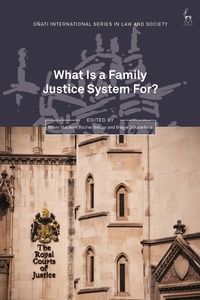
What Is a Family Justice System For?
1st Edition
Published on 25. August 2022
288 pages
978-1-5099-5099-7 (ISBN)
Description

Does a justice system have a welfare function? If so, where does the boundary lie between justice and welfare, and where can the necessary resources and expertise be found?
In a time of austerity, medical emergency, and limited public funding, this book explores the role of the family justice system and asks whether it has a function beyond decision-making in dispute resolution. Might a family justice system even help to prevent or minimise conflict as well as resolving dispute when it arises?
The book is divided into 4 parts, with contributions from 22 legal scholars working across Europe, Australia, Argentina and Canada.
- Part 1 looks at what constitutes a family justice system in different jurisdictions, and how a welfare element is included in the legal framework.
- Part 2 looks at those engaged with a family justice system as professionals and users, and explores how far private ordering is encouraged in different countries.
- Part 3 looks at new ways of working within a family justice system and raises the question of whether the move towards privatisation derives from the intrinsic value of individual autonomy and acceptance of responsibility in family disputes, or whether it is also a response to the increasing burden on the state of providing a welfare-minded family justice system.
- Part 4 explores recent major changes of direction for the family justice systems of Australia, Argentina, Turkey, Spain, and Germany.
In a time of austerity, medical emergency, and limited public funding, this book explores the role of the family justice system and asks whether it has a function beyond decision-making in dispute resolution. Might a family justice system even help to prevent or minimise conflict as well as resolving dispute when it arises?
The book is divided into 4 parts, with contributions from 22 legal scholars working across Europe, Australia, Argentina and Canada.
- Part 1 looks at what constitutes a family justice system in different jurisdictions, and how a welfare element is included in the legal framework.
- Part 2 looks at those engaged with a family justice system as professionals and users, and explores how far private ordering is encouraged in different countries.
- Part 3 looks at new ways of working within a family justice system and raises the question of whether the move towards privatisation derives from the intrinsic value of individual autonomy and acceptance of responsibility in family disputes, or whether it is also a response to the increasing burden on the state of providing a welfare-minded family justice system.
- Part 4 explores recent major changes of direction for the family justice systems of Australia, Argentina, Turkey, Spain, and Germany.
More details
Series
Edition
1. Auflage
Language
English
Place of publication
London
United Kingdom
Publishing group
Bloomsbury Publishing PLC
Target group
College/higher education
ISBN-13
978-1-5099-5099-7 (9781509950997)
Copyright in bibliographic data and cover images is held by Nielsen Book Services Limited or by the publishers or by their respective licensors: all rights reserved.
Schweitzer Classification
Other editions
Additional editions
Mavis Maclean | Rachel Treloar | Bregje Dijksterhuis
What Is a Family Justice System For?
Book
02/2024
Hart Publishing
€73.22
Shipment within 15-20 days
Mavis Maclean | Rachel Treloar | Bregje Dijksterhuis
What Is a Family Justice System For?
Book
08/2022
Hart Publishing
€117.50
Shipment within 15-20 days
Persons
Mavis Maclean is Co-Founder of the Oxford Centre for Family Law and Policy, Department of Social Policy and Intervention, Oxford University and Senior Research Fellow of St Hilda's College, Oxford, UK.
Rachel Treloar is Lecturer in Law at Keele University, UK.
Bregje Dijksterhuis is Assistant Professor at Utrecht University, the Netherlands.
Rachel Treloar is Lecturer in Law at Keele University, UK.
Bregje Dijksterhuis is Assistant Professor at Utrecht University, the Netherlands.
Content
Introduction
Mavis Maclean (University of Oxford, UK)
PART A
BOUNDARIES
1. Recent Family Law Reforms and High-Conflict Post-Separation Parenting Disputes in Canada
Rachel Treloar (Keele University, UK)
2. Co-operation: The Glue that Unites the Danish Family Justice System
Annette Kronborg (University of Southern Denmark) and Christine Jeppesen de Boer (Utrecht University, the Netherlands)
3. Family Justice Systems, Social Behaviour and Financial Arrangements after Divorce in the Netherlands
Bregje Djksterhuis (University of Utrecht, the Netherlands) and Alexander Flos (VU University Amsterdam, the Netherlands)
4. Implementing Gender Equality as an Aim of the Swiss Family Justice System
Michelle Cottier, (University of Geneva, Switzerland), Binda Sahdeva (University of Geneva, Switzerland), and Gaelle Aeby (University of Geneva, Switzerland)
PART B
PARTICIPANTS
5. Reforms and Reorganisation of Family Justice in France: What Are the Current Responses to the Needs of Divorcees?
Benoit Bastard (University of Paris-Saclay, France)
6. Family Matters in the Polish Court: Law and Public Opinion
Malgorzata Fuszara (University of Warsaw, Poland) and Jacek Kurczewski (University of Warsaw, Poland)
7. The Current Situation for Mediation and Other Forms of ADR in Spain with Special Reference to the Consequences of the Covid-19 Health Crisis
Teresa Picontó (University of Zaragoza, Spain) and Elena Lauroba (University of Barcelona, Spain)
PART C
INNOVATIVE PRACTICE
8. Experimenting with a Non-Adversarial Procedure for Child-related Parental Disputes in the Netherlands
Masha Antokolskaia (VU University of Amsterdam, the Netherlands), Marit Buddenbaum (VU University of Amsterdam, the Netherlands), and Lieke Coenraad (VU University of Amsterdam, the Netherlands)
9. Legal Needs across the Family Justice System: Who Needs What, Where and When? The Contribution of CLOCK, a Community Outreach System in England and Wales
Jane Krishnadas (Keele University, UK)
PART D
MAJOR POLICY CHANGE
10. Developing Holistic and Inclusive Family Justice in Argentina
Julieta Marotta (Maastricht University, the Netherlands)
11. Raising Questions on the Family Justice System in Turkey: An Ambivalent Fragmentation
Verda Irtis (Galatasaray University, Turkey)
12. How Does a Legal System Deal with Malfunctions by Its Judicial Officers?
Belinda Fehlberg (University of Melbourne, Australia) and Richard Ingleby (Victorian Bar, Australia)
13. Family Court Proceedings in Parent and Child Matters in Germany: A Binding Setting for Alternative Dispute Resolution
Thomas Meysen (International Centre for Socio Legal Studies, Heidelberg, Germany)
14. What is a Family Justice System for? Concluding Observations and Next Steps
Mavis Maclean (University of Oxford, UK)
Mavis Maclean (University of Oxford, UK)
PART A
BOUNDARIES
1. Recent Family Law Reforms and High-Conflict Post-Separation Parenting Disputes in Canada
Rachel Treloar (Keele University, UK)
2. Co-operation: The Glue that Unites the Danish Family Justice System
Annette Kronborg (University of Southern Denmark) and Christine Jeppesen de Boer (Utrecht University, the Netherlands)
3. Family Justice Systems, Social Behaviour and Financial Arrangements after Divorce in the Netherlands
Bregje Djksterhuis (University of Utrecht, the Netherlands) and Alexander Flos (VU University Amsterdam, the Netherlands)
4. Implementing Gender Equality as an Aim of the Swiss Family Justice System
Michelle Cottier, (University of Geneva, Switzerland), Binda Sahdeva (University of Geneva, Switzerland), and Gaelle Aeby (University of Geneva, Switzerland)
PART B
PARTICIPANTS
5. Reforms and Reorganisation of Family Justice in France: What Are the Current Responses to the Needs of Divorcees?
Benoit Bastard (University of Paris-Saclay, France)
6. Family Matters in the Polish Court: Law and Public Opinion
Malgorzata Fuszara (University of Warsaw, Poland) and Jacek Kurczewski (University of Warsaw, Poland)
7. The Current Situation for Mediation and Other Forms of ADR in Spain with Special Reference to the Consequences of the Covid-19 Health Crisis
Teresa Picontó (University of Zaragoza, Spain) and Elena Lauroba (University of Barcelona, Spain)
PART C
INNOVATIVE PRACTICE
8. Experimenting with a Non-Adversarial Procedure for Child-related Parental Disputes in the Netherlands
Masha Antokolskaia (VU University of Amsterdam, the Netherlands), Marit Buddenbaum (VU University of Amsterdam, the Netherlands), and Lieke Coenraad (VU University of Amsterdam, the Netherlands)
9. Legal Needs across the Family Justice System: Who Needs What, Where and When? The Contribution of CLOCK, a Community Outreach System in England and Wales
Jane Krishnadas (Keele University, UK)
PART D
MAJOR POLICY CHANGE
10. Developing Holistic and Inclusive Family Justice in Argentina
Julieta Marotta (Maastricht University, the Netherlands)
11. Raising Questions on the Family Justice System in Turkey: An Ambivalent Fragmentation
Verda Irtis (Galatasaray University, Turkey)
12. How Does a Legal System Deal with Malfunctions by Its Judicial Officers?
Belinda Fehlberg (University of Melbourne, Australia) and Richard Ingleby (Victorian Bar, Australia)
13. Family Court Proceedings in Parent and Child Matters in Germany: A Binding Setting for Alternative Dispute Resolution
Thomas Meysen (International Centre for Socio Legal Studies, Heidelberg, Germany)
14. What is a Family Justice System for? Concluding Observations and Next Steps
Mavis Maclean (University of Oxford, UK)
