

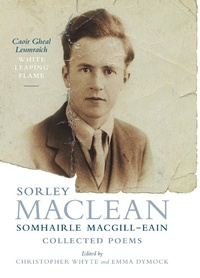
Collected Poems
Published on 1. October 2011
1083 pages
978-1-84777-883-3 (ISBN)
Description

Sorley MacLean (Somhairle MacGill-Eain 1911-1996) is generally recognised as the most significant writer in Scottish Gaelic of the twentieth century. Yet his work possesses a relevance extending far beyond the bounds of his nation or his language. His 1943 collection Dain do Eimhir (Poems to Eimhir) brought Gaelic poetry abreast of the modern world with breathtaking and notorious effectiveness. The love sequence at its core shows a young man battling with the conflicting claims of love and duty against the background of a continent hurtling unstoppably into all-out war. His political poem 'An Cuilithionn' ('The Cuillin') links the tragedy of the Highland Clearances with a tradition of left-wing radicalism which had the French and Bolshevik revolutions as its highpoints.
His work was characterised by a mixture of reticence and outspokenness. The love sequence could not be published in its entirety while he was alive, and An Cuilithionn waited half a century before finally appearing in an abridged and shortened form.
This definitive edition brings together everything published during the poet's life time and the love sequence in its fullest form, along with extracts from the 1939 manuscript of An Cuilithionn and a generous selection of unpublished poems. MacLean's own English versions are complemented, where necessary, by versions from the editors. A section of notes highlights historical and traditional references, and two maps and a glossary of place-names are provided.
His work was characterised by a mixture of reticence and outspokenness. The love sequence could not be published in its entirety while he was alive, and An Cuilithionn waited half a century before finally appearing in an abridged and shortened form.
This definitive edition brings together everything published during the poet's life time and the love sequence in its fullest form, along with extracts from the 1939 manuscript of An Cuilithionn and a generous selection of unpublished poems. MacLean's own English versions are complemented, where necessary, by versions from the editors. A section of notes highlights historical and traditional references, and two maps and a glossary of place-names are provided.
Reviews / Votes
Sorley MacLean, who died 15 years ago, has been the principal poetic experience of my life (along with the songs of Burns), and it is satisfying at the end of 2011, the centenary of his birth, to see how his stature has been consolidated since his death.His impact on me was no doubt heightened by the fact I first read him as a student, but both then and since I have always been impressed by his determination to say, in words, what can barely be expressed in them.
MacLean admired Gaelic song - 'an exhalation from the people', he called it - as much as any art form, but it was one in which he could not participate. Like the best of songs, MacLean's poetry walks a plank between reserve and a full-throated lyric cry. The unsayable mounts up between lines and between poems and can achieve a state of music. There is also the moral seriousness and inevitability of MacLean's poetry, much of it coming to him in the form of dreams. It is a voice unmediated by social conformity, and it has the intensity of poetry which survives despondency, war and schoolteaching to reach paper.
It is often paradoxical as it cannot accept easy answers. The Western Highlands are so integral to the plasticity of his work that I have found myself regretting the lack of a poet in other parts of the Highlands to make geology human.
Last year saw the publication of Peter Mackay's monograph, Sorley MacLean, following Maire Ni Annrachain's Aisling agus Toir in Irish in 1992 and Raymond Ross's and Joy Hendry's Critical Essays in 1986. This year saw Birlinn publish the complete collected poems, Caoir Gheal Leumraich (sic)/ White Leaping Flame, edited by Christopher Whyte and Emma Dymock. The book is a fitting monument to his hundredth year, a handsome hardback [ published as an ebook by Carcanet Press], expanded from O Choille gu Bearradh/From Wood to Ridge of 1989 by a third again, to contain all of MacLean's known poetry, and hitherto uncollected, untranslated and unpublished items.
It is a matter of great pride and importance to have the original sequence of Dain do Eimhir restored and complete, and to have the long poem, An Cuilithionn, compared in its 1939 and 1989 versions. (Both these texts Whyte has published with detailed annotations for the ASLS in 2002 and 2011 respectively.) It has long been Whyte's ambition that the poems should be presented in their original form, and he sees his task as editor 'to restore its strangeness to MacLean's poetry'.
I reeled a little at his accusations of deception on MacLean's part in suppressing some of the poems in Dain do Eimhir and some of the passages of An Cuilithionn, in the first instance in the context of an abortion, and in the second, in the context of the poet's changing perceptions of Stalin and the Red Army. Artistic integrity must surely yield to discretion during the lifetime of those involved. The inclusion of 28 poems which the poet chose not to publish himself I feel confirms his good taste, as their emotion is mostly crude and un-nuanced. While they exist in the public domain in manuscript, their inclusion here is a democratic principle, but they do not add to the standing of his work - though they perhaps show part of the process.
Whyte speaks of the 'colonialist appropriation' of Heaney and James Campbell, who, while not comprehending the Gaelic, impute meaning to MacLean's voice alone. His point is justified to some extent, but I don't think it should be overlooked how Gaelic an imagination MacLean has, for all his internationalist outlook in politics, art and philosophy. John Purser has compared MacLean's voice production to that used in the recitation of Fenian lays and of Greek epic. I expect Heaney understood the otherworldly trajectory of the poet in Gaelic culture. It is no surprise that MacLean encounters his co-choisiche, or double, in the wilderness of the Cuillin, on whose inhospitable peaks the tree of his creativity flourishes.
He also has a sexualized relationship with nature springing entirely from the Gaelic conceptualisation of human society and nature. Nature is the nurturing lover of the 'Woods of Raasay', but she is also the demonic and destructive lover of the Cuillin, her 'mother-breasts of the world/ erect with the world's concupiscence' and the 'green bitch of death' encountered in the 'Cave of Gold'. She is the ultimate source of creativity for piper and poet alike. Hero and artist must take risks to make a mark in human terms against the eternal indifference of nature. I suggest that it is from such an essentially Gaelic perspective that MacLean's eye ranges over Europe.
The article was originally published in The Scotsman. Click here to read it on the publication's website.
More details
Edition
Abridged edition
Language
English
Place of publication
London
United Kingdom
Publishing group
Carcanet Press Ltd
Edition type
Abridged edition
File size
1,26 MB
ISBN-13
978-1-84777-883-3 (9781847778833)
Copyright in bibliographic data and cover images is held by Nielsen Book Services Limited or by the publishers or by their respective licensors: all rights reserved.
Schweitzer Classification
Other editions
Additional editions
Sorley Maclean | Christopher Whyte | Emma Dymock
White Leaping Flame / Caoir Gheal Leumraich
Sorley Maclean: Collected Poems
Book
10/2011
Polygon An Imprint of Birlinn Limited
€50.95
Article exhausted; check different version
Persons
Sorley MacLean (Somhairle MacGill-Eain) was born on the island of Raasay in 1911. In his family Gaeli traditions, especially of song, survived. He took a first-class degree in English at Edinburgh. He served in North Africa in World War II and was wounded three times. He was instrumental in preserving the teaching of Gaelic in Scottish schools. He died in 1996. Christopher Whyte is probably the greatest living expert on MacLean's poetry. His annotated editions of the Dain do Eimhir and An Cuilithionn 1939 contained a significant quantity ofhitherto unpublished material and have been met with acclaim. He is himself a Gaelic poet of substance whose fifth collection, An Daolag Shionach, is due to appear in 2012. Author of four novels in English, he taught from 1990 to 2005 at the Department of Scottish Literature in Glasgow University. He now lives and writes full-time in Budapest. Emma Dymock gained a First Class Honours in Celtic at the University of Edinburgh in 2003, and has since completed an MSc on symbolism in twentieth-century Gaelic poetry and a PhD on themes of politics and concepts of the self in Sorley MacLean's An Cuilithionn. She is currently a Post-Doctoral Fellow in the Department of Celtic and Scottish Studies at the University of Edinburgh and has written various articles and chapters on the subject of Sorley MacLean's poetry, as well as co-editing two books on Scottish and Gaelic literature.
Content
- Cover
- Title Page
- Dedication
- Table of Contents
- Clàr-innsidh
- Foreword
- The Poetry of Sorley MacLean: Reinvention and Reparation
- The Poet's Landscape: Shifting Boundaries
- Sorley MacLean: Biographical Outline
- Select Bibliography
- 1: 1932-1940
- 1: 1932-1940
- The Heron
- A' Chorra-ghritheach
- The Black Boat
- Am Bàta Dubh
- Conchobhar
- Conchobhar
- A Spring
- Fuaran
- The Ship
- An Saothach
- Road to the Isles
- Road to the Isles
- A Highland Woman
- Ban-Ghàidheal
- The Island
- An t-Eilean
- Calvary
- Calbharaigh
- Kinloch Ainort
- Ceann Loch Aoineart
- The Black Tree
- An Crann Dubh
- Glen Eyre
- Gleann Aoighre
- Cornford
- Cornford
- The Clan MacLean
- Clann Ghill-Eain
- The Castle on Fire
- An Dun 'na Theine
- On the Same Topic
- Air an Adhbhar Cheudna
- To Mr Neville Chamberlain
- Do Mhgr. Niall Mac an t-Seumarlain
- To the Judge who told John Maclean that he was a coward
- Don Bhritheamh a thubhairt ri Iain MacGill-Eain gum b' e gealtair a bh'ann
- Aros Burn
- Abhainn Àrois
- The Old Song
- An Seann Òran
- The Tree of Strings
- Craobh nan Teud
- 'Is it your desire .'
- 'N e d' mhiann .
- 'Get out of my poetry'
- Gabh a-mach às mo bhàrdachd
- 'Yeats spent forty years'
- 'Thug Yeats dà f hichead bliadhna'
- 'When the constriction comes'
- 'An uair a thig an teannachadh'
- 'Here is love'
- 'An seo an gaol'
- A New Moon
- Gealach Ùr
- Scotus Erigena
- Scotus Erigena
- The Woods of Raasay
- Coilltean Ratharsair
- 2: Extracts from 'An Cuilithionn'
- 2: An Cuilithionn (1939) (cùibhreannan)
- from Part I
- à Earrann I
- from Part II
- à Earrann II
- from Part III
- à Earrann III
- from Part VI
- à Earrann VI
- from Part VII
- à Earrann VII
- Poem
- Poem
- 3: Poems to Eimhir
- 3: Dàin do Eimhir
- I Girl of the red-gold hair,
- I A nighean a' chùil ruaidh òir,
- II Reason and Love
- II A Chiall 's a Ghràidh
- III Never has such turmoil
- III Cha do chuir de bhuaireadh riamh
- IV Girl of the yellow, heavy-yellow, gold-yellow hair,
- IV A nighean a' chùil bhuidhe, throm-bhuidh, òr-bhuidh,
- V Red-haired girl, heavy the burden
- V A nighean ruadh, 's trom an èire
- VI In spite of the uproar of slaughter
- VI A dh'aindeoin ùpraid marbhaidh
- VIII I thought that I believed from you
- VIII Bha dùil leam gun do chreid mi bhuatsa
- IX I spoke of the beauty of your face
- IX Rinn mi luaidh air àilleachd t' aodainn
- X Maybe the variously swift lyric art
- X Theagamh nach eil i 'nam chàs,
- XI Often when I called Edinburgh
- XI Tric 's mi gabhail air Dùn Èideann
- XII Four there are to whom I gave love,
- XII Ceathrar ann dan tug mi luaidh,
- XIII To my eyes you were Deirdre
- XIII Dom shùilean-sa bu tu Deirdre
- XIV The Selling of a Soul
- XIV Reic Anama
- XV Three Paths
- XV Trì Slighean
- XVI How could I be entitled
- XVI Carson a bhithinn-sa dligheach
- XVII Multitude of the skies,
- XVII Lìonmhorachd anns na speuran,
- XVIII Prayer
- XVIII Ùrnaigh
- XIX I gave you immortality
- XIX Thug mise dhut biothbhuantachd
- XX If I had the ability I wish for,
- XX Nan robh an comas mar a b' àill leam,
- XXI What does it matter to me, my place
- XXI Dè dhòmhsa m' àite
- XXII I walked with my reason
- XXII Choisich mi cuide ri mo thuigse
- XXIII Deaf, agitated, angry,
- XXIII Bodhar, neo-shuaimhneach, am feirg,
- XXIV When you said that beauty
- XXIV Nuair thuirt thu nach robh bhòidhche
- XXV I'd prefer, to stealing fire
- XXV B' f heàrr leam na goid an teine
- XXVI Red-haired girl, were I to get your kiss
- XXVI A nighean ruadh, nam faighinn do phòg
- XXVII The critic said that my art
- XXVII Thubhairt an sgrùdair gu robh m' ealain
- XXVIII The Ghosts
- XXVIII Na Samhlaidhean
- XXIX Dogs and Wolves
- XXIX Coin is Madaidhean-allaidh
- XXX A Bolshevik who never gave heed
- XXX 'S mi 'm Bhoilseabhach nach tug suim
- XXXI William Ross, what should we say
- XXXI Uilleim Rois, dè chanamaid
- XXXII Let me lop off with sharp blade every grace
- XXXII Sgatham le faobhar-rinn gach àilleachd
- XXXIII The lot of poets is not
- XXXIII Chan eil freastal nam bàrd
- XXXIV When I speak of the face
- XXXIV An uair a labhras mi mu aodann
- XXXV Come before me, gentle night,
- XXXV Thig am chomhair, oidhche chiùin,
- XXXVI I should have sold my soul
- XXXVI Bhithinn air m' anam a reic
- XXXVII It is not the beauty of your body,
- XXXVII Chan e àilleachd do dhealbha,
- XXXVIII I talked of selling a soul
- XXXVIII Labhair mi mu reic anama
- XXXIX As the slow embers of the fire
- XXXIX Mar thèid grìosach mhall an teine
- XL I am not striving with the tree that will not bend for me,
- XL Chan eil mi strì ris a' chraoibh nach lùb rium
- XLI My love for you has gone beyond poetry,
- XLI Chaidh mo ghaol ort thar bàrdachd,
- XLII Shores
- XLII Tràighean
- XLIII But for you the Cuillin would be
- XLIII Mur b' e thusa bhiodh an Cuilithionn
- XLIV Though I should remove the clothes
- XLIV Ged chuirinn dhiom èideadh
- XLV The knife of my brain made incision,
- XLV Rinn sgian m' eanchainn gearradh
- XLVI We are together, dear,
- XLVI Tha sinn còmhla, a ghaoil,
- XLVIa There was strife between my heart,
- XLVIa Bha connspaid eadar mo chridhe,
- XLVII Remorse after the kisses
- XLVII Aithreachas an deaghaidh nam pòg
- XLVIII With you my humility
- XLVIII Mar riutsa tha m' irisleachd
- XLIX My boat was under sail and the Clàrach
- XLIX Bha 'm bàt' agam fo sheòl 's a' Chlàrach
- L Grief is only a nothing
- L Chan eil anns a' bhròn ach neoni
- LI My prudence said to my heart
- LI Thuirt mo chrìonnachd ri mo chridhe
- LII To my steady gaze you were a star
- LII Dom dhùr-amharc bha thu nad reul
- LIII I lightly hold the great revolution
- LIII Gur suarach leam an t-ar-a-mach mòr
- LIV You were dawn on the Cuillin
- LIV Bu tu camhanaich air a' Chuilithionn
- LV I do not see the sense of my toil
- LV Chan f haic mi fàth mo shaothrach
- LVI In my ten years of labour
- LVI 'Na mo dheich bliadhna saothrach
- LVII A face haunts me,
- LVII Tha aodann ga mo thathaich,
- LVIII Girl, who enrich
- LVIII A nighean 's tu beairteachadh
- LIX Carmichael, I often think
- LIX MhicGille-Mhìcheil, 's tric mi smaointinn
- LX When I saw the red hair last night
- LX Nuair chunna mi 'n cùl ruadh a-raoir
- Dimitto Go, little ineffective book,
- Dimitto Thalla, a leabhair bhig neo-euchdaich:
- 4: 1941-1944
- 4: 1941-1944
- 'She to whom I gave .'
- 'An tè dhan tug mi .'
- The Little Jewel
- An t-Àilleagan
- If I Go Up To Yonder Town
- Ma Thèid Mi Suas don Bhail' Ud Shuas
- The Mountain
- A' Bheinn
- William Ross and I
- Uilleam Ros is Mi Fhìn
- The Prodigal Son
- Am Mac Stròidheil
- The Image
- An Ìomhaigh
- The Nightmare
- An Trom-laighe
- Springtide
- Reothairt
- The False Exchange
- A' Mhalairt Bhreugach
- The Farther End
- An Ceann Thall
- The Proper War
- An Cogadh Ceart
- The Rotten Wood
- A' Choille Ghrod
- 'My Reason Mocked'
- 'Mhag mo reusan'
- Knightsbridge, Libya
- Knightsbridge, Libia
- To a Depraved Lying Woman
- Do Bhoireannach Breugach Coirbte
- The Two Gehennas, 1939-44
- An Dà Ghehenna, 1939-44
- 5: Battlefield (1942-1943)
- 5: Blàr (1942-1943)
- Going Westwards
- Dol an Iar
- Alasdair MacLeod
- Alasdair MacLeòid
- Move South
- Gluaisibh gu Deas
- Heroes
- Curaidhean
- Death Valley
- Glac a' Bhàis
- An Autumn Day
- Latha Foghair
- 6: 1945-1972
- 6: 1945-1972
- Paradise Lost: the Argument
- Pàrras Caillte: an Argamaid
- Culloden 16.iv.1946
- Cùil Lodair 16.iv.1946
- Lights
- Solais
- A Summer Afternoon: the Sound of Raasay
- Feasgar Samhraidh: Linne Ratharsair
- 'Who Worked as Hard as You?'
- 'Cò Rinn Coimeas Ur Saothrach?'
- Who can say?
- Cò Their
- A Girl and Old Songs
- Nighean is Seann Òrain
- The Ebb-Tide Running
- Sruth Tràghaidh
- Hallaig
- Hallaig
- Two MacDonalds
- Dà Dhòmhnallach
- A Memory of Alexander Nicolson, One of My Uncles
- Cuimhne air Alasdair MacNeacail, Bràthair Mo Mhàthar
- A Ruined Church
- Làrach Eaglais
- Funeral in Clachan
- Tìodhlacadh sa Chlachan
- Creagan Beaga
- Creagan Beaga
- In the Big Park
- Anns a' Phàirce Mhòir
- Creag Dallaig
- Creag Dallaig
- Twenty-Five Years from Richmond:
- Còig Bliadhna Fichead o Richmond:
- The Broken Bottle
- Am Botal Briste
- Id, Ego and Super-Ego
- Eadh is Fèin is Sàr-Fhèin
- To William Matheson
- Do Uilleam MacMhathain
- The Field of the Two Descents
- Ach an Dà Theàrnaidh
- Palach
- Palach
- Time and Sgurr Urain
- Tìm is Sgùrr Ùrain
- A poem made when the Gaelic Society of Inverness was a hundred years old
- Dàn a rinneadh nuair a bha Comann Gàidhlig Inbhir Nis ceud bliadhna a dh'aois
- The National Museum of Ireland
- Àrd-Mhusaeum na h-Èireann
- At Yeats's Grave
- Aig Uaigh Yeats
- The Lost Mountain
- A' Bheinn air Chall
- Elegy for Calum I. MacLean
- Cumha Chaluim Iain MhicGill-Eain
- 7: 1972 and After
- 7: 1972 is às dèidh sin
- Dr John MacLachlan
- An Dotair MacLachlainn
- The Cave of Gold
- Uamha 'n Òir
- A Church Militant
- Eaglais Chatharra
- Honeysuckle
- Iadhshlat
- Poem (by John Cornford)
- Dàn (le John Cornford, air a chur an Gàidhlig)
- Screapadal
- Sgreapadal
- The Great Famine
- A' Ghort Mhòr
- Escallonia
- An t-Ascalon
- Spring 1937
- An t-Earrach 1937
- Festubert 16/17.v.1915
- Festubert 16/17.v.1915
- A Waxing Moon above Sleat
- Gealach an Fhàis os Cionn Shlèite
- 8: The Cuillin (1989)
- 8: An Cuilithionn (1989)
- The Cuillin (1989)
- An Cuilithionn (1989)
- PART I
- EARRANN I
- PART II
- EARRANN II
- PART III
- EARRANN III
- PART IV
- EARRANN IV
- PART V
- EARRANN V
- PART VI
- EARRANN VI
- PART VII
- EARRANN VII
- 9: Unpublished Poems
- 9: Dàin nach deach fhoillseachadh
- Shelley 8.VII.34
- Shelley 8.VII.34
- Come and see
- Thig is faic
- To the Pope who offered thanks to God for the fall of Barcelona
- Don Phàp a thug buidheachas do Dhia airson tuiteam Bharsalòna
- Greeting to Kennedy-Fraser
- Soraidh le NicUalraig-Fhriseal
- The Powers That Be
- Na Cumhachdan a Tha
- 'Venerable George MacLean'
- 'A Sheòrais MhicGhill-Eathain f hiachail'
- Tailor's Dummy
- Cumadh Tàilleir
- Naked Girl
- Nighean Nochd
- 1939. Blood
- 1939. Fuil
- My love in the plundered garden
- Mo ghaol san lios chreachte
- Snuffling
- Snòtachadh
- 'Making a laughing-stock of my gifts'
- 'Cùis-bhùrta dhèanamh de mo bhuadhan'
- 'What did you get, my heart'
- 'Dè a f huair thusa, 'chridhe'
- 'You ruined everything there was'
- 'Mhill thu h-uile nì a bh' ann'
- To my lying love
- Do mo luaidh breugach
- 'I thought she suffered from an infirmity'
- 'Shaoil mi i bhith fo èislean'
- At Ebb-Tide'
- Aig muir-tràigh
- 'Woman who was fond of a playboy'
- 'Tè lem bu mhiann an gille-mirein'
- 'Pride caused you to stay'
- 'Thug an t-àrdan ort fuireach'
- To the Rev. Thomas M. Murchison at the Gaelic Society of Inverness Dinner 14.IV.61
- Don Urramach Tòmas MacCalmain aig Dinneir Comann Gaidhlig Inbhir Nis 14.IV.61
- 'Is the world going to wake up anywhere'
- 'Am bi dùsgadh anns an t-saoghal'
- My Country
- Mo Dhùthaich
- Stalin
- Stàilin
- James Connolly
- Seamus Ó Conghaile
- For Sir Lachlan MacLean of Duart on the 80th anniversary of the restoration of the Castle
- Do Shir Lachlainn MacGill-Eain Dhubhaird air ochdadhach
- 'That breaking means a double breaking'
- ''S e bhith briste leis an dà bhristeadh'
- The Silver Button
- Am Putan Airgid
- 'The mountains are speechless'
- 'Tha na beanntan gun bhruidhinn'
- Notes
- Clàr-innsidh nan tiotal is rann-toiseachadh
- Index of Titles and First Lines
- Locations
- Glossary of Place-names
- Copyright
