

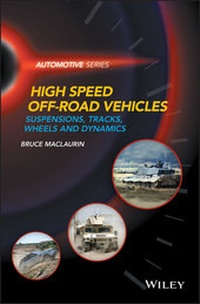
High Speed Off-Road Vehicles
Description

High Speed Off-Road Vehicles is an excellent, in-depth review of vehicle performance in off-road conditions with a focus on key elements of the running gear systems of vehicles. In particular, elements such as suspension systems, wheels, tyres, and tracks are addressed in-depth. It is a well-written text that provides a pragmatic discussion of off-road vehicles from both a historical and analytical perspective. Some of the unique topics addressed in this book include link and flexible tracks, ride performance of tracked vehicles, and active and semi-active suspension systems for both armoured and unarmoured vehicles.
The book provides spreadsheet-based analytic approaches to model these topic areas giving insight into steering, handling, and overall performance of both tracked and wheeled systems. The author further extends these analyses to soft soil scenarios and thoroughly addresses rollover situations. The text also provides some insight into more advanced articulated systems.
High Speed Off-Road Vehicles: Suspensions, Tracks, Wheels and Dynamics provides valuable coverage of:
* Tracked and wheeled vehicles
* Suspension component design and characteristics, vehicle ride performance, link track component design and characteristics, flexible track, and testing of active suspension test vehicles
* General vehicle configurations for combat and logistic vehicles, suspension performance modelling and measurement, steering performance, and the effects of limited slip differentials on the soft soil traction and steering behavior of vehicles
Written from a very practical perspective, and based on the author's extensive experience, High Speed Off-Road Vehicles provides an excellent introduction to off-road vehicles and will be a helpful reference text for those practicing design and analysis of such systems.
More details
Other editions
Additional editions
Person
BRUCE MACLAURIN initially worked in the aircraft industry on structural design and analysis and then spent over 35 years on the research and design of the automotive systems of military vehicles. His main area of research is tracked and wheeled vehicle steering systems, suspensions and tracks including design, computer modelling, and performance measuring. He is now retired from the Ministry of Defence in the UK.
Content
Series Preface xiii
Acknowledgements xv
Introduction xvii
1 Tracked Vehicle Running Gear and Suspension Systems 1
1.1 General Arrangement 1
1.2 Transverse Torsion Bars 2
1.3 Coil Springs 6
1.4 Hydrogas Suspensions 8
1.4.1 Challenger MBT Hydrogas Unit 8
1.4.2 Measured Characteristics of a Challenger Unit 9
1.4.2.1 Spring Characteristics 9
1.4.2.2 Damper Characteristic 11
1.4.2.3 Differential Pressure Across the Damper Valve 11
1.4.2.4 Force/Displacement Loop 11
1.4.2.5 Flow Rig 12
1.4.2.6 Suspension Damping of a Multi-Wheeled Vehicle 13
1.4.3 Temperature Effects 13
1.4.3.1 Two-Stage Units 15
1.4.3.2 Counter-Spring Units 17
1.4.4 Other Types of Hydrogas Suspension 18
1.4.4.1 Twin-Cylinder Units 18
1.4.4.2 In-Arm Units 18
1.5 Dampers 20
1.5.1 Hydraulic Dampers 20
1.5.2 Friction Dampers 20
References 22
2 Vehicle Track Systems 23
2.1 Link Tracks 23
2.1.1 Single-Pin Tracks 26
2.1.1.1 Dry-Pin Tracks 26
2.1.1.2 Rubber-Bushed Tracks 27
2.1.2 Double-Pin Tracks 28
2.1.3 Rubber Track Pads, Road Wheels and Track Tensioners 31
2.1.3.1 Rubber Track Pads 31
2.1.3.2 Road Wheels 32
2.1.3.3 Track Tensioners 33
2.1.4 Track Loadings 33
2.1.4.1 Centrifugal Tension 33
2.1.4.2 Final-Drive Torque Measurements 34
2.1.4.3 Lateral Horn Load 35
2.1.5 Rolling Resistance: Analytical Methods 35
2.1.5.1 On a Metal Wheel Path 35
2.1.5.2 On a Rubber Wheel Path 36
2.1.6 Rolling Resistance: Experimental Measurements 37
2.1.6.1 Chieftain 38
2.1.6.2 FV 432 39
2.1.6.3 Scorpion and Spartan 40
2.1.6.4 Summary 42
2.1.7 Noise and Vibration 42
2.1.8 Approaches for Reducing Noise and Vibration 43
2.1.8.1 Finite Element Analysis and Experimental Sprockets 43
2.1.8.2 Fully Decoupled Running Gear 44
2.1.8.3 Flexible Rubber Tracks 44
2.1.9 Reducing Noise and Vibration 44
2.1.9.1 Stage (a): Establishing the Principal Noise Sources 45
2.1.9.2 Stage (b): Design and Production of the Resilient Mountings 46
2.1.9.3 Stage (c): Test Results with the Resilient Mountings 47
2.2 Flexible Tracks 48
2.2.1 Earlier Flexible Tracks 49
2.2.2 Contemporary Flexible Tracks 50
2.2.3 'Proof-of-Principle' Flexible Tracks for a Spartan APC 51
2.2.3.1 Mark 1 Tracks 53
2.2.3.2 Mark 2 Tracks 54
2.2.3.3 Mark 3 Tracks 55
2.2.3.4 Durability Trials 57
2.2.4 Later Developments 57
References 58
3 Tracked Vehicle Suspension Performance: Modelling and Testing 59
3.1 Human Response to Whole-Body Vibration (WBV) and Shock 59
3.1.1 BS 6841:1987 and ISO 2631-1 (1997) 59
3.1.2 Further Standards Relating to WBV 61
3.1.2.1 Absorbed Power 61
3.1.2.2 The European Physical Agents (Vibration) Directive 2002/44/EC 64
3.1.2.3 ISO 2631-5 (2004) 64
3.2 Terrain Profiles 64
3.2.1 Characterisation 64
3.2.2 DERA Suspension Performance Test Courses 65
3.2.3 Response of Multi-Wheel Vehicles 66
3.2.4 Quarter-Car Model 68
3.2.5 Computer Modelling 71
3.2.5.1 Parameter Specification 73
3.2.5.2 Assumptions 74
3.5.2.3 Examples of Use of the Model 74
3.5.2.4 Comparison with Trials Data 75
3.5.2.5 Upgrading the Suspension Performance of the Scorpion Family of Vehicles 76
3.2.6 Ride Performance Trials of a Challenger Suspension Test Vehicle 76
3.2.7 Pitch Response to Braking and Accelerating 79
3.2.7.1 Compensating Idler 83
3.2.8 Sprung Idler Test Vehicle (SITV) 85
References 88
4 Controllable Suspensions 89
4.1 Height and Attitude Control 89
4.1.1 Tracked Vehicles 89
4.1.2 Wheeled Vehicles 91
4.2 Actively Controlled Damping (Semi-Active Suspensions) 91
4.2.1 Adaptive Damping 91
4.3 Active Suspension Systems 91
4.4 DERA Active Suspension Test Vehicles 93
4.4.1 Narrow-Bandwidth Systems 93
4.4.1.1 Wheeled Vehicle 95
4.4.1.2 Tracked Vehicle 97
4.4.1.3 Laboratory Test Rig 97
4.4.2 Broad-Bandwidth System 97
4.5 Conclusions 100
References 101
5 Wheeled Vehicle Drivelines and Suspensions 103
5.1 Unarmoured Vehicles 103
5.1.1 Leyland DAF DROPS 8×6 Logistic Load Carrier 103
5.1.2 MAN SX 8×8 High-Mobility Load Carrier 105
5.1.3 Pinzgauer 4×4 and 6×6 Light Trucks 105
5.1.4 Range Rover 106
5.1.5 Alvis Stalwart 107
5.1.6 Caterpillar Mining/Dump Truck 108
5.1.7 Euclid (Later Hitachi) Mining/Dump Trucks 110
5.2 Armoured Vehicles 112
5.2.1 H-Drive 112
5.2.2 I-Drive 113
5.3 Interconnected Suspensions 116
5.3.1 Methods of Interconnection 116
References 122
6 Wheeled Vehicle Suspension Performance 123
6.1 Quarter-Car Model 123
6.2 Wheelbase Filter 126
6.3 DROPS Truck Ride Measurements 127
Reference 132
7 Steering Performance of Tracked and Wheeled Vehicles 133
7.1 Tracked Vehicles 133
7.1.1 Skid Steering Mechanisms 133
7.1.2 Skid Steering Models 136
7.1.3 The Magic Formula 139
7.1.4 Deriving the Magic Formula Parameters for the Track 140
7.1.5 Steering Performance Model 144
7.1.6 Results from the Model 146
7.1.6.1 Driver Control Arrangements 146
7.1.6.2 Pivot Turn 146
7.1.6.3 Effect of Radius of Turn on Slewing Moment 147
7.1.6.4 Driving on a 15 m Radius Turn at Varying Speed to Show the Effects of Track Tension and a Suspension System 148
7.1.6.5 Driving on a 15 m Radius Turn at Varying Speeds with New and Worn Pads and on a Low-Friction Surface 150
7.1.6.6 Driving at 15 m s-1 on Turns of Varying Radii 152
7.1.6.7 Effect of the Centre of Gravity (CG) Position 154
7.1.6.8 Model Validation 156
7.2 Comparing Skid and Ackermann Steered Wheeled Vehicles 156
7.2.1 Tyre Force-Slip Data 157
7.2.2 Choice of Tyre Model 158
7.2.2.1 The Skid Steered Vehicle: Vehicle Model 159
7.2.3 Results from the Model 159
7.2.3.1 Neutral Turn 159
7.2.3.2 Variation of Slewing Moment with Radius of Turn 161
7.2.3.3 Cornering on 15 m and 30 m Radius Turns at Different Speeds 162
7.2.4 Ackermann Steered Vehicle Model 163
7.2.5 Model Results 163
7.2.5.1 Steering Performance 163
7.2.5.2 Power Requirements 165
7.2.5.3 Tyre Wear 165
7.2.6 Torque Vectoring 166
7.2.6.1 Individual Wheel Motor Control 169
7.2.6.2 Articulated Vehicles 169
Appendix A: Equations of Motion 170
Appendix B: Equations of Motion 173
References 175
8 Soft-Soil Performance of Wheeled and Tracked Vehicles 177
8.1 Basic Requirements 177
8.1.1 Soil 177
8.1.2 Basic Definitions 178
8.1.3 Soil-Vehicle Models 179
8.2 Models for Soft Cohesive Soils 180
8.2.1 Vehicle Cone Index (VCI) Model 180
8.2.1.1 Mobility Index for Tracked Vehicles 181
8.2.1.2 Mobility Index for Wheeled Vehicles 181
8.2.2 WES Mobility Number Model 182
8.2.3 Mean Maximum Pressure (MMP) 182
8.2.4 Vehicle Limiting Cone Index (VLCI) 183
8.2.4.1 Tyres 184
8.2.4.2 Tracks 187
8.3 Models for Dry Frictional Soils 189
8.3.1 WES Mobility Number for Wheeled Vehicles 189
8.3.2 DERA Trials 190
8.3.3 Tracked Vehicles 193
8.4 Space Efficiency of Running Gear Systems for Armoured Vehicles 194
8.5 Tractive Force-Slip Relationship for Tyres in Soft Cohesive Soils 197
8.5.1 Describing Force-Slip Characteristics 197
8.5.1.1 Rectangular Hyperbolae 197
8.5.1.2 Exponentials 197
8.5.2 The Magic Formula 198
8.5.3 Development of the Modified Magic Formula 199
References 202
9 Effect of Free, Locked and Limited-Slip Differentials on Traction and Steering Performance 203
9.1 Types of Lockable and Limited-Slip Differentials 203
9.1.1 Lockable Differentials 203
9.1.2 Using the Braking System 204
9.1.3 Velocity-Dependent Limited-Slip Differentials 204
9.1.4 Frictional Limited-Slip Differentials 205
9.2 Relationships for Frictional Limited-Slip Differentials 206
9.3 Traction Performance 209
9.3.1 Traction Model 209
9.3.2 Model Results 210
9.3.2.1 Effect of Weight Transfer Across an Axle 210
9.3.2.2 Different Soil Strengths Under the Tyres 212
9.3.2.3 On a Split µ Surface 214
9.4 Steering Performance on a Road Surface 214
9.4.1 Steering Performance Model 214
9.4.2 Model Results 214
Reference 216
10 Articulated Vehicles 217
10.1 Articulated Tracked Vehicles 217
10.1.1 Traction Forces with Skid and Articulated Steering 221
10.2 Articulated Wheeled Vehicles 222
10.2.1 Steering Behaviour with Ackermann, Skid and Articulated Steering 225
10.2.1.1 Hard Surfaces 225
10.2.1.2 Soft Soils 225
References 226
11 Vehicle Rollover Behaviour 227
11.1 Basic Considerations 227
11.2 Methods to Reduce the Likelihood of Rollover 229
11.2.1 Warning Systems 229
11.2.2 Electronic Stability Programmes 230
11.2.3 Active Anti-Roll Bars 230
11.2.4 Driver Training 230
11.3 Truck Rollover: A Case Study 230
11.3.1 Calculating the Rollover Angle 231
References 233
Notation 235
Abbreviations 243
Bibliography 245
Index 247
1
Tracked Vehicle Running Gear and Suspension Systems
The running gear systems used on high speed, mainly military, tracked vehicles provide four essential functions:
- the transmission of drive to a relatively large number of road wheels;
- the distribution of the weight of the vehicle over a relatively large area;
- a large suspension displacement to allow high speeds over rough terrains; and
- a particular requirement of military armoured vehicles, the running gear system should occupy the minimum space in the overall vehicle envelope in order to maximise internal hull volume (as will be shown in Section 8.4, this is a particular attribute of tracked vehicles compared to wheeled vehicles of similar soft-soil performance).
In addition, the running gear must be of minimum weight, reliable, easy to maintain, and compared to some other vehicle components, relatively cheap to produce.
1.1 General Arrangement
Figure 1.1 shows the running gear of the Warrior Infantry Fighting Vehicle (IFV) and is typical of modern practice. Trailing suspension arms carry rubber-tyre road wheels and operate transverse torsion bars which run across the floor of the vehicle. Rotary vane hydraulic dampers are incorporated into the pivots of the front, second and rear road wheel stations. Link tracks run under the road wheels and around hull-mounted drive sprockets and return idlers. Track pretension is adjusted by means of oil-filled rams reacting against the idlers, which are carried on short pivoting arms. The drive sprockets are front-mounted but could be at the rear of the vehicle, depending on the position of the power pack. Small diameter rollers support the top run of the track. The track link pivots are rubber-bushed and the links are fitted with replaceable rubber road pads to minimise road damage and reduce noise and vibration.
Figure 1.1 Warrior running gear layout. Source: Courtesy of Ministry of Defence.
Figure 1.2 shows the arrangement on the Leopard 2 Main Battle Tank (MBT). Rotary friction dampers are built into the front three and rear two axle arm pivots. The vehicle is fitted with rubber-bushed double-pin tracks (see Chapter 2).
Figure 1.2 Leopard 2 running gear layout. Source: Courtesy of ATZ.
1.2 Transverse Torsion Bars
Modern high-strength spring steels, used with suitable presetting, shot peening and corrosion prevention techniques, allow nominal shear stresses of up to 1250 mPa to be used with a reasonable fatigue life [1.1, p. 226]. Suspension torsion bars are only loaded in one direction and so can be 'preset'. To preset a torsion bar, it is wound up to induce partial yielding in the outer layers of the bar. On release, the outer layers take on negative shear stresses and torques opposed by positive stresses and torques in the inner layers of the bar (Figure 1.3).
Figure 1.3 The principle of presetting a torsion bar.
The relationship between the various variables that affect the maximum shear stress in the bar can be explored by setting up a suitable spreadsheet. The vehicle will be considered as a notional MBT with a sprung mass of 600 kN and an effective torsion bar length of 2.13 m. The variables that can be considered are the axle arm length (initially taken as 450 mm), the number of road wheels (initially taken as 12) and the stiffness of the bar. The latter can deduced from the ratio of wheel loads at full bump and at static FB/FS, initially taken as 3:1, and the required static to bump suspension displacement ?SB, taken as 350 mm. This gives a heave natural frequency of about 1.2 Hz, which is typical for an MBT. The shear modulus C is set at 76 mPa [1.1, p. 226]. The diameter of the bar is left open.
This gives a maximum shear stress qmax of 1326 mPa, which can be considered too high for a good fatigue life. Increasing the arm length to 500 mm increases maximum torque on the bar, but also reduces maximum wind-up angle; qmax reduces to 1258 mPa. This may be acceptable depending on the duty cycle. Measurements show that the front wheels nearly always have the most severe duty, largely because of the pitching motion of the vehicle; this can be controlled by an adequate measure of damping.
Softening the suspension to give a FB/FS value of 2.5 and with axle arm length R at 450 mm increases qmax to 1371 kPa. With the stiffer suspension, increasing the number of wheels to 14 reduces the value of qmax to 1276 kPa. With the 0.5 m wheel arms, qmax reduces to 1211 mPa. If the length of wheel arm can be further increased to 0.55 m without causing interference between the arms, then qmax further reduces to 1155 mPa.
Another possibility is of course to simply reduce the static to bump displacement to, say, 325 mm with 500 mm wheel arms, 14 wheels and the stiffer suspension; qmax is then 1158 mPa. Some of the different possibilities are summarised in the table overleaf.
Number of wheels n Arm length R (m) Static to bump travel (m) FS (kN) FB/FS Diameter of torsion bar (mm) qmax (mPa) Mass (kg) 12 0.45 0.350 50.00 3.000 62.0 1326 603 12 0.50 0.350 50.00 3.000 65.8 1258 677 12 0.45 0.350 50.00 2.500 57.7 1371 522 14 0.45 0.350 42.86 3.000 59.7 1276 651 14 0.50 0.350 42.86 2.500 58.9 1252 633 14 0.50 0.350 42.86 3.000 63.3 1211 731 14 0.55 0.350 42.86 3.000 66.6 1155 811 14 0.50 0.325 42.86 2.786 62.9 1158 722 12 0.50 0.325 50.00 2.786 65.3 1204 668The factors that reduce maximum shear stress are longer wheel arms, stiffer suspension and increased number of wheels. As maximum shear stress is reduced, the weight of the bars increases in a virtually linear relationship. This is for the 'spring' part of the torsion bar, that is, neglecting the end fittings which are usually splines.
Suspension bump displacement, and hence maximum torsion bar stresses, is normally limited by some form of bump stop acting on the suspension arm as shown in Figure 1.1. However, bump stops are not fitted on all or some of the wheels of the Alvis Stormer and Scorpion family of vehicles; the wheels are allowed to bottom through the top run of the track onto the hull sponson and trackpads. This apparently crude strategy works well in practice; it saves weight and reduces torsional loading on the axle arms.
If it is not possible to obtain satisfactory values of shear stress with hull width torsion bars, then two strategies can be used to effectively lengthen the bars. One is to approximately double the length of the bar by 'folding' it back. This arrangement was used on the Second World War (WW2) German Panther tank as shown in Figure 1.4. The vehicle used eight interleaved wheels per side, both to improve soft-soil performance and to reduce loading on the rubber tyres of the wheels. Apart from the extra complication, another disadvantage of this arrangement is the possibility of mud and stones becoming stuck between the wheels; at low temperatures this could freeze and immobilise the vehicle. Maximum shear stresses in the torsion bars were limited to a mere 200 mPa because of the qualities of the available steel and the somewhat unrealistic - for a wartime tank - design life of 10 000 km. Factors tending to increase stress levels were the very soft suspension (a pitch frequency of only 0.5 Hz) and the very short axle arms; the latter was a requirement of the interleaved wheels. The static to bump displacement was only 200 mm, tending to reduce stress levels.
Figure 1.4 Panther torsion bar arrangement.
A second strategy is to enclose the torsion bars in torsion tubes. However, torsion tubes are intrinsically much stiffer than the torsion bars, and the diameter of the tubes is increased as a result of the need to pass them over the torsion bar end fittings. Some experimental work has been conducted on the bar and tube arrangement shown in Figure 1.5. The stiffness of the bar was measured at 0.204 kNm/degree and that of the tube at 1.89 kNm/degree; that is, the tube is over 9 times stiffer than the bar. The combined stiffness was 0.184 kN/degree.
Figure 1.5 Torsion tube over bar arrangement. Source: Courtesy of Ministry of Defence.
The failure torque of the tube was measured at about 33 kNm and that of the bar at 14 kNm. It is therefore tempting to reduce the wall thickness of the tube and hence its stiffness, but there is then the possibility of the tube...
