

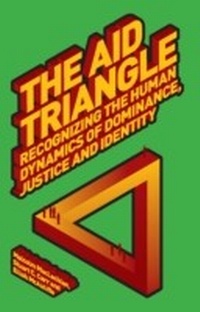
The Aid Triangle
Recognizing the Human Dynamics of Dominance, Justice and Identity
1st Edition
Published on 10. June 2010
184 pages
978-1-84813-835-3 (ISBN)
Description

The Aid Triangle focuses on the human dynamics of international aid and illustrates how the aid system incorporates power relationships, and therefore relationships of dominance.
Using the concept of a triangle of dominance, justice and identity, this timely work explains how the experience of injustice is both a challenge and a stimulus to personal, community and national identity, and how such identities underlie the human potential that international aid should seek to enrich. This insightful new critique provides for the reader an innovative and constructive framework for producing more empowering and more effective aid.
Using the concept of a triangle of dominance, justice and identity, this timely work explains how the experience of injustice is both a challenge and a stimulus to personal, community and national identity, and how such identities underlie the human potential that international aid should seek to enrich. This insightful new critique provides for the reader an innovative and constructive framework for producing more empowering and more effective aid.
Reviews / Votes
At last! A book that addresses the psychological politics braided through civil society, governmental and multilateral agencies involved in aid. I highly recommend it. * A.K. Dube, African Decade for Persons with Disability * A thought-provoking book that poses key questions about the nature and mechanisms of development. * Alastair Ager, Columbia University * This book is a most welcome addition to the growing call to rethink this whole dimension of international relations. * John Berry, Queen's University in Canada. * This book places justice - between individuals, between organisations and between countries and international organisations - at the heart of international aid and development; explaining its relationship with dominance and identity in a challenging, authoritative and engaging way. * Mary Robinson, Realizing Rights: The Ethical Globalization Initiative * This approachable and imaginative book takes a very different look at the practice of International Aid. Written by social scientists with considerable experience in the area, it offers not only a critique of current practices but also advice about how really to help those who need it. It is written with passion and clarity but always supported by the scientific literature in the area. * Professor Adrian Furnham, University College London *More details
Edition
1. Auflage
Language
English
Place of publication
London
United Kingdom
Publishing group
Bloomsbury Publishing PLC
Target group
College/higher education
Professional and scholarly
ISBN-13
978-1-84813-835-3 (9781848138353)
Copyright in bibliographic data and cover images is held by Nielsen Book Services Limited or by the publishers or by their respective licensors: all rights reserved.
Schweitzer Classification
Other editions
Additional editions
Malcolm Maclachlan | Stuart Carr | Eilish McAuliffe
The Aid Triangle
Recognizing the Human Dynamics of Dominance, Justice and Identity
Book
06/2010
Zed Books Ltd
€44.80
Shipment within 3-4 weeks
Malcolm Maclachlan | Stuart Carr | Eilish McAuliffe
The Aid Triangle
Recognizing the Human Dynamics of Dominance, Justice and Identity
Book
06/2010
Zed Books Ltd
€126.28
Shipment within 3-4 weeks
Persons
Professor Malcolm MacLachlan is with the Centre for Global Health and the School of Psychology at Trinity College Dublin, Ireland, and is currently a Visiting Professor at the Centre for Rehabilitation Studies, Stellenbosch University, South Africa and at the Department of Global Health & Social Medicine, Harvard University, USA. He is the Director of the International Doctoral School for Global Health.
Stuart C. Carr is Professor of Psychology, Industrial and Organizational (I/O) Psychology Programme, Massey University, New Zealand. He has worked and lived in UK, Malawi, Remote Australia, Indonesia, Thailand, and New Zealand/Aotearoa. His books are among the first to examine poverty reduction from an I/O, work psychology perspective.He co-edits The Journal of Pacific Rim Psychology.
Eilish Mc Auliffe is Director of the Centre for Global Health at Trinity College Dublin, Ireland. She has worked as a clinician, consultant and academic and lived in Ireland, UK, South African and Malawi, where she worked for Unicef and Irish Aid.
Stuart C. Carr is Professor of Psychology, Industrial and Organizational (I/O) Psychology Programme, Massey University, New Zealand. He has worked and lived in UK, Malawi, Remote Australia, Indonesia, Thailand, and New Zealand/Aotearoa. His books are among the first to examine poverty reduction from an I/O, work psychology perspective.He co-edits The Journal of Pacific Rim Psychology.
Eilish Mc Auliffe is Director of the Centre for Global Health at Trinity College Dublin, Ireland. She has worked as a clinician, consultant and academic and lived in Ireland, UK, South African and Malawi, where she worked for Unicef and Irish Aid.
Content
Introduction
1. Aid
2. Dominan
3. Justice
4. Identity
5. Learning
Conclusion
1. Aid
2. Dominan
3. Justice
4. Identity
5. Learning
Conclusion
