

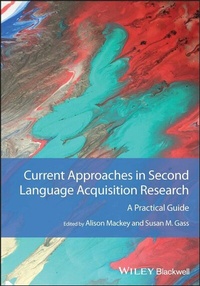
Current Approaches in Second Language Acquisition Research
Description

Current Approaches in Second Language Acquisition Research provides an up-to-date overview of both traditional and cutting-edge techniques and methods in the field. Bringing together contributions from an international team of experts, this authoritative volume covers the qualitative, quantitative, survey-based, interdisciplinary, statistical analysis, and data replication methods that students and early-career researchers need to know when developing their projects and experiments in second language acquisition research. Each chapter includes best practices, case studies, and research questions, together with suggested readings which exemplify a wide range of contemporary methodologies.
Current Approaches in Second Language Acquisition Research builds on the foundation of Research Methods in Second Language Acquisition, the first volume in the Wiley Blackwell Guides to Research Methods series to cover the field of SLA. Eleven new chapters and four revised chapters address classroom research methods, qualitative approaches to data, collecting introspective second language (L2) data, L2 data on brain and articulatory mechanisms, problematic terminology in the SLA community, and more.
* Covers theory-based methodologies, synthetic and meta-analytic work, mixed methods, coding, and statistical analysis
* Describes and evaluates recent methodological advances and experimental approaches in SLA research
* Includes study questions, links to additional resources, and example study boxes that summarize methodological principles and connect them to real-world research studies
Current Approaches in Second Language Acquisition Research is an essential resource for advanced undergraduate and graduate students in SLA and applied linguistics programs, novice researchers studying SLA research methods, and more established scholars looking for a concise and up-to-date overview of SLA methodology.
More details
Other editions
Additional editions
Persons
Alison Mackey is Professor and Chair of the Department of Linguistics at Georgetown University, USA, and a Professor in the Department of Linguistics and English Language at Lancaster University, UK (Summers). She is Editor-in-Chief of Annual Review of Applied Linguistics and the co-editor of Research Methods in Second Language Acquisition: A Practical Guide and the co-author of Second Language Research: Methodology and Design.
Susan M. Gass is University Distinguished Professor Emerita in the Department of Linguistics, Languages, and Cultures at Michigan State University, USA. She is the former editor of Studies in Second Language Acquisition, the co-editor of Research Methods in Second Language Acquisition: A Practical Guide, and the co-author of Second Language Research: Methodology and Design.
Content
List of Figures vii
List of Tables viii
Notes on Contributors x
Preface xiv
Introduction 1
Alison Mackey and Susan M. Gass
Part I Eliciting Second Language Data 11
1 Classroom Research Methods 13
Shawn Loewen, Aysen Tuzcu, and Jenefer Philp
2 Formal Theory- Based Methodologies 33
Tania Ionin
3 Qualitative and Interpretive Approaches to Data in L2 Research 51
Debra A. Friedman
4 Collecting and Analyzing Mixed Methods Data in L2 Research 72
Mohammad R. Hashemi
5 Using Foreign and Second Language Learner Corpora 96
Magali Paquot and Nicole Tracy- Ventura Copyrighted Material
6 Collecting and Analyzing L2 Introspective Data 120
Lara Bryfonski
7 Collecting and Analyzing L2 Sociolinguistic Data 143
Kimberly L. Geeslin and Stacey Hanson
8 Psycholinguistic Methods in Second Language Research 170
Lauren Covey and Alison Gabriele
9 Collecting and Analyzing L2 Pragmatics Data 195
Naoko Taguchi
10 Collecting and Analyzing Individual Differences Data in Foreign Language Learning 215
Jean- Marc Dewaele
11 Collecting and Analyzing L2 Data on Neurocognitive Mechanisms 233
Nick B. Pand?a
Part II Coding, Analysis, and Replication 255
12 Coding Second Language Data Validly and Reliably 257
Andrea Révész
13 How to Run Statistical Analyses 276
Aek Phakiti
14 Advancing Meta- Analytic Methods in L2 Research 304
Luke Plonsky, Yuhang Hu, Ekaterina Sudina, and Frederick L. Oswald
15 How and Why to Conduct a Replication Study 334
Kevin McManus
Index 352
Notes on Contributors
Lara Bryfonski is an assistant professor of linguistics at Georgetown University where she conducts research on second-language acquisition and language teaching, including TBLT, teacher training, language learning in study abroad, and methods for applied linguistics research. She is a former English as a second/foreign language teacher and has taught students from preschool to adulthood in a variety of educational contexts.
Lauren Covey is an assistant professor of linguistics at Montclair State University. She received her PhD from the University of Kansas. Her research takes a cognitive neuroscience approach to second-language acquisition, utilizing psycholinguistic and neurolinguistic techniques to examine how native speakers and second-language learners process sentences in real time.
Jean-Marc Dewaele is emeritus professor in applied linguistics. He is a former president of the European Second Language Association, the International Association of Multilingualism, and is current president of the International Association for the Psychology of Language Learning. He won the Robert Gardner Award for Excellence in Second Language and Bilingualism Research (2016) and the EUROSLA Distinguished Scholar Award (2022).
Debra A. Friedman is an associate professor in the Department of Second Language Studies at Indiana University, Bloomington, where she teaches courses in second language pedagogy, qualitative research, and discourse analysis. Her research focuses on the social, cultural, and ideological aspects of language education in multilingual communities through the framework of language socialization.
Alison Gabriele is a professor of Linguistics at the University of Kansas. She has a PhD in Linguistics from the Graduate Center of the City University of New York. Gabriele's research, which has been supported by the National Science Foundation, focuses on the acquisition and processing of syntax and semantics, focusing on the cognitive and linguistic factors that impact development.
Susan M. Gass is a university distinguished professor emerita at Michigan State University. She has published widely in the field of second-language acquisition, with works translated into Arabic, Russian, Korean, and Chinese. She is the co-author of Second Language Acquisition: An Introductory Course (Routledge) and Second Language Research: Methodology and Design (Routledge). She has served as the president of AAAL and of AILA and was editor of Studies in Second Language Acquisition.
Kimberly L. Geeslin was a professor of Hispanic Linguistics at Indiana University, USA from 1999 until her death in 2023. She investigated the geographic, social, and situationally variable properties of second languages. Her recent publications include Sociolinguistics and Second Language Acquisition (Routledge, 2014), The Acquisition of Spanish as a Second Language (Routledge, 2021), and The Routledge Handbook of Second Language Acquisition and Sociolinguistics (Routledge, 2022).
Stacey Hanson is a doctoral candidate in Hispanic Linguistics at Indiana University, USA. Her research focuses on the second-language acquisition of phonetics and phonology, with a particular interest in second-language perception and production of geographically indexed phones.
Mohammad R. Hashemi currently works at the Department of Foreign Languages, Kharazmi University. Mohammad is a researcher in Applied Linguistics. His current research interests include mixed methods and qualitative research, language teacher professionalism, discourse studies, and ELT materials development.
Yuhang Hu is PhD student in the Applied Linguistics program at Northern Arizona University. She earned her MS in Applied Linguistics at Georgetown University. Her research interests include second-language acquisition, research methods, research synthesis, and meta-analysis in applied linguistics.
Tania Ionin is a professor of Linguistics at the University of Illinois at Urbana-Champaign. Her areas of expertise include second-language acquisition and experimental semantics, with focus on the nominal domain. She has published two co-authored books (Cardinals: The Syntax and Semantics of Cardinal-containing Expressions, MIT Press, 2018; Second Language Acquisition: Introducing Intervention Research, Cambridge University Press, 2023) and numerous articles.
Shawn Loewen is a professor in Applied Linguistics at Michigan State University. His research interests include instructed second-language acquisition, classroom interaction, and mobile-assisted language learning. The second edition of his book, Introduction to Instructed Second Language Acquisition, appeared in 2020. He is the associate editor of The Modern Language Journal.
Alison Mackey is a professor in the Department of Linguistics at Georgetown University, USA, and in summers, professor at Lancaster University, UK. Her research is on how second languages are learned and taught. Her interests include interaction-driven L2 learning, L2 research methodology, the applications of interaction through task-based language teaching, as well as L2 dialects and identities.
Kevin McManus is an associate professor of Applied Linguistics at Penn State University. His research expertise is in second-language acquisition and includes the areas of crosslinguistic influence, instruction, and usage-based accounts of learning. He also has significant interests in replication research, which has involved conducting and promoting replication studies as well as providing guidance and training in the design, execution, and interpretation of replication studies in the field of second language research.
Frederick L. Oswald is professor of Psychological Sciences at Rice University. His meta-analysis expertise reflects conceptual clarifications and advances, evaluation of models in simulation work, and real-world applications. He is a fellow of the American Psychological Association (Div. 5, 8, 14), the Association for Psychological Science, and the Society for Industrial and Organizational Psychology (SIOP). He received his PhD at the University of Minnesota in 1999. Learn more at https://workforce.rice.edu.
Nick B. Pandza is an Assistant Research Scientist at the University of Maryland's Applied Research Laboratory for Intelligence & Security and is affiliated with the Program in Second Language Acquisition and the Language Science Center. His work primarily focuses on the impact of individual differences on language learning outcomes using advanced statistical methods with behavioral, physiological, and neurocognitive data.
Magali Paquot is a research associate at the Centre for English Corpus Linguistics, UCLouvain. She specializes in the use of learner corpora to study key topics in SLA (complexity, phraseology, crosslinguistic influence) and is particularly interested in methodological issues. She is a co-editor in chief of the International Journal of Learner Corpus Research.
Aek Phakiti is an associate professor in TESOL at The University of Sydney, Australia. Aek is the author and editor of numerous books in applied linguistics, including Experimental Research Methods in Language Learning (Bloomsbury, 2014), Quantitative Methods for Second Language Research: A Problem-solving Approach (Routledge, 2018), Palgrave Handbook of Applied Linguistics Research Methodology (Palgrave, 2018).
Jenefer Philp is formerly of Lancaster University. Her research is focused on the role of interaction in instructed language learning, among children and among adults, through socio-cognitive perspectives.
Luke Plonsky (PhD, Michigan State) is an associate professor of Applied Linguistics at Northern Arizona University. His work, focusing primarily on SLA and research methods, has appeared in over 100 articles, book chapters, and books. Luke is editor of SSLA and managing editor of Foreign Language Annals, co-editor of De Gruyter Mouton's Series on Language Acquisition, and co-director of IRIS.
Andrea Révész is a professor of Second Language Acquisition at the IOE, University College London. Her research interests lie at the interface of second-language acquisition and instruction, with particular emphasis on the roles of task, input, and individual differences in SLA. In addition, she holds an interest in the neuro-cognitive processes underlying second-language performance and development.
Ekaterina Sudina is a visiting assistant professor at East Carolina University. Her research interests include individual differences in second-language acquisition, quantitative research methods, and L2 reading and writing. Her work has been published in several prominent journals in the field (e.g., Bilingualism: Language and Cognition, Language Learning, Language Teaching, Studies in Second Language Acquisition, The Modern Language Journal, TESOL Quarterly).
Naoko Taguchi is a professor in the English Department at Northern Arizona University where she teaches courses in applied linguistics and TESOL. Her research interests include second-language pragmatics, technology-enhanced language learning, and intercultural communication. Her recent books include the pragmatics topic area of The...
