

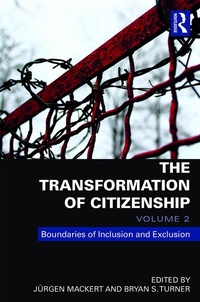
The Transformation of Citizenship, Volume 2
Boundaries of Inclusion and Exclusion
Published on 16. March 2017
210 pages
978-1-317-20383-4 (ISBN)
Description

This volume Boundaries of Inclusion and Exclusion examines the many different and newly emerging ways in which citizenship refers to spatial, symbolic and social boundaries. Today, in the context of citizenship we face processes of inclusion and exclusion on national and supranational level but no less on the level of groups and individuals. The book addresses these different levels and discusses processes of inclusion and exclusion with regard to spatial, social and symbolic boundaries referring to such different problems as political participation, migration, or identity with regard to religion or the EU. This book will appeal to academics working in the field of political theory, political sociology and European studies.
Reviews / Votes
This is a timely and thoughtful set of essays on citizenship's bordered dimensions, with a particular focus on the European context. Addressing the production and defense of boundaries within various domains, including the market, civil society, the administrative state and at territorial frontiers, the collection highlights multiple ways in which regimes of citizenship divide and exclude precisely in the course of constituting collective social life. (Linda Bosniak, Rutgers University)Over the last decade in the face of growing social and political instability, citizenship has been restored as a critical component of social solidarity. However, social solidarity based on citizenship involves an exclusionary principle and it is challenged by the contemporary crisis around migration, religious diversity and terrorism. National sovereignty and national boundaries have become problematic bases of inclusionary citizenship. This volume offers an authoritative overview of, and commentary on, these dilemmas of modern politics. (Gerard Delanty, University of Sussex)
By bringing together the study of citizenship and that of spatial, social and symbolic boundaries, this volume could not be more timely. Its various essays provide essential tools for understanding some of the most important political and social developments of the contemporary era. I highly recommend this book to anyone concerned with mounting challenges in Europe and beyond. (Michele Lamont, President, American Sociological Association)
More details
Language
English
Place of publication
London
United Kingdom
Publishing group
Taylor & Francis Ltd
Target group
College/higher education
Illustrations
7 s/w Abbildungen, 2 s/w Tabellen, 7 s/w Zeichnungen
2 Tables, black and white; 7 Line drawings, black and white; 7 Illustrations, black and white
File size
1,67 MB
ISBN-13
978-1-317-20383-4 (9781317203834)
Copyright in bibliographic data and cover images is held by Nielsen Book Services Limited or by the publishers or by their respective licensors: all rights reserved.
Schweitzer Classification
Other editions
Additional editions
Juergen Mackert | Bryan Turner
The Transformation of Citizenship, Volume 2
Boundaries of Inclusion and Exclusion
Book
12/2019
1st Edition
Routledge
€61.50
Shipment within 15-20 days
Juergen Mackert | Bryan Turner
The Transformation of Citizenship, Volume 2
Boundaries of Inclusion and Exclusion
Book
03/2017
1st Edition
Routledge
€210.50
Shipment within 10-20 days
Persons
Juergen Mackert is Professor of Sociology at the Faculty of Economics and the Social Sciences, and Co-Director of the Centre for Citizenship, Social Pluralism and Religious Diversity at Potsdam University, Germany.
Bryan S. Turner is a Professor in the Institute for Religion, Politics and Society the Australian Catholic University, Melbourne and the Director of the Centre for Citizenship, Social Pluralism and Religious Diversity at Potsdam University, Germany. He is the Max Planck Research Award Winner of the Alexander von Humboldt Foundation and the Max Planck Society 2015. He is Honorary Professor at Potsdam University, Germany.
Bryan S. Turner is a Professor in the Institute for Religion, Politics and Society the Australian Catholic University, Melbourne and the Director of the Centre for Citizenship, Social Pluralism and Religious Diversity at Potsdam University, Germany. He is the Max Planck Research Award Winner of the Alexander von Humboldt Foundation and the Max Planck Society 2015. He is Honorary Professor at Potsdam University, Germany.
Content
1. Introduction. Citizenship and Its Boundaries, (Juergen Mackert / Bryan S. Turner)
2. Citizenship as Political Membership. A Fundamental Strand of Twentieth and Twenty-first Century European History, (Dieter Gosewinkel)
3. Secular Law and Sharia. Accommodation and Friction, (Christian Joppke)
4. The Consumer-Citizen Nexus. Surveillance and Concerns for an Emerging Citizenship, (Jason Pridmore)
5. Contentious Citizenship. Denizens and the Negotiation of Deportation Measures in Switzerland, (Gianni D'Amato and Noemi Carrel)
6. 'In Its Majestic Inequality'. Migration Control and Differentiated Citizenship, (Juan M. Amaya-Castro)
7. National Origins of Frontex Risk Analysis. The French Border Police's Fight against Filieres, (Sara Casella Colombeau)
8. Is there a European Refugee Citizenship in the Making? The Still Weak Institutional Basis of a Common European Asylum System, (Ludger Pries and Natalia Bekassow)
9. Antinomies of European Citizenship. On the Conflictual Passage of a Transnational Membership Regime, (Sandra Seubert)
10. European Citizenship and Identity Politics in Europe. Is the Citizenship Narrative a Good Plot for Constructing the Collective Identity of the People Living in Europe?, (Klaus Eder)
11. European Citizenship Between Cosmopolitan Outlook and National Solidarities, (Richard Muench)
2. Citizenship as Political Membership. A Fundamental Strand of Twentieth and Twenty-first Century European History, (Dieter Gosewinkel)
3. Secular Law and Sharia. Accommodation and Friction, (Christian Joppke)
4. The Consumer-Citizen Nexus. Surveillance and Concerns for an Emerging Citizenship, (Jason Pridmore)
5. Contentious Citizenship. Denizens and the Negotiation of Deportation Measures in Switzerland, (Gianni D'Amato and Noemi Carrel)
6. 'In Its Majestic Inequality'. Migration Control and Differentiated Citizenship, (Juan M. Amaya-Castro)
7. National Origins of Frontex Risk Analysis. The French Border Police's Fight against Filieres, (Sara Casella Colombeau)
8. Is there a European Refugee Citizenship in the Making? The Still Weak Institutional Basis of a Common European Asylum System, (Ludger Pries and Natalia Bekassow)
9. Antinomies of European Citizenship. On the Conflictual Passage of a Transnational Membership Regime, (Sandra Seubert)
10. European Citizenship and Identity Politics in Europe. Is the Citizenship Narrative a Good Plot for Constructing the Collective Identity of the People Living in Europe?, (Klaus Eder)
11. European Citizenship Between Cosmopolitan Outlook and National Solidarities, (Richard Muench)
