

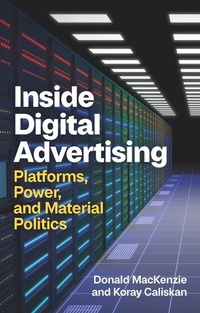
Inside Digital Advertising
Description

Dozens of times daily, access to your screen is auctioned to advertisers, sometimes by your own phone or laptop without your knowledge. In the background are huge, electricity-hungry, carbon-emitting systems that conduct roughly two trillion near-instantaneous, automated auctions every day. This book takes you into the heart of this mysterious world. It describes how Google built its astonishing global system of warehouse-scale computing and turned that system into an unprecedented, multibillion-dollar, money-earning machine, and how Facebook - almost by accident - also became an advertising leviathan. It examines the tensions between those giants and the smaller firms that populate digital advertising's open marketplace. Those tensions, as well as conflicts over user privacy, give rise to a new kind of politics that plays out in material systems in the form of crucial clashes between different ways of designing those systems. Building on work in the emerging interdisciplinary field of market studies, MacKenzie and Caliskan examine digital advertising's material politics, its giant megamachines, and the foundations of platform power. Inside Digital Advertising lays bare the processes that underpin today's global advertising industry. It will be a key book for students and academics in the social sciences, humanities, and business studies, and it will appeal to anyone interested in the forces that are shaping our everyday digital world.
More details
Other editions
Additional editions
Persons
Donald MacKenzie is a Professor of Sociology at the University of Edinburgh.
Koray Caliskan is a Professor of Economic Sociology and Design at the New School, New York City.
Content
Chapter 2: Display ads, cookies, and the open marketplace
Chapter 3: Money machines and the characteristics of digital advertising
Chapter 4: Hacking the system
Chapter 5: Enfolding your phone
Chapter 6: Digital advertising's tensions
Chapter 7: Conclusion
2
Display Ads, Cookies, and the Open Marketplace
Digital advertising began, in the mid-1990s, with display ads shown - at first with only minimal targeting - to visitors to websites. Nowadays, display ads can be videos or sometimes even games, but originally they were simple, static combinations of an image or images and text. They were, however, clickable, with the click usually taking you to the advertiser's website, where you could learn more about the product or service being advertised, and perhaps buy it there and then.
This chapter discusses the emergence of display ads on the Web and their relations to the evolution of the Web itself, to the browsers that enable websites to be rendered on users' screens, and to a crucial innovation that gave the Web a "memory" and left a long-standing mark on digital advertising: the cookie. We will see how the material form of the market for Web-display ads has changed. Originally, buying and selling involved face-to-face contact between human beings, perhaps over Madison Avenue's traditionally lavish expense-account lunches or dinners, but from 2006 onward it increasingly moved inside machines.
That shift gave birth to what practitioners at the time called "programmatic advertising." That name has stuck, but we won't use it because it is confusing: the big systems that we will describe in chapter 3 - which practitioners often call "walled gardens," in contrast to the world whose origins are described in this chapter - are in a literal sense equally programmatic. Instead, we will highlight that contrast (which, curiously, the literature on digital advertising discussed in the previous chapter has given little explicit attention to) by adopting a different practitioners' term: the "open marketplace."
As its name suggests, barriers to entry to the open marketplace are low. Most of the firms that populate it are small, and competition among them is often fierce. The open marketplace is decentralized and sometimes a little chaotic, and there is frequently only limited policing. It is less distant from today's pervasive imaginaries of a "market" than the walled gardens are, as we will discuss in chapter 6. But the form the open marketplace in Web-display ads takes is not an economic inevitability, nor the result of some imagined greater efficiency of a market. It has its roots in the materiality of the Web, as the final part of the chapter will show by contrasting it with the later, materially quite different, world of display ads within apps.
The Web, display ads, and the dot-com bubble
When display ads first appeared in 1994, the Web (then often called the "World Wide Web") was only four years old. Its origins were far from commercial. Famously, it began as a 1989-90 proposal by physicist and computer scientist Tim Berners-Lee for how his employer, Geneva's multinational CERN laboratory for particle physics, should organize and make accessible its growing, ever-changing body of documentation.1 In December 1990, the Web was just a single prototype website and a rudimentary browser with which to access it, both physically existing on Berners-Lee's desktop computer (Berners-Lee 2010: 80).
By June 1993, there were still no more than about 130 websites worldwide, and the United States had only around a couple of dozen ISPs (Internet Service Providers) via which those sites could be accessed from people's homes.2 But the Web was growing fast, doubling in size every three months or less, helped by the development of browsers that integrated the display of text and images on the user's screen: first Mosaic in 1993, and then, crucially, Netscape Communications Corporation's Navigator in 1994. (Earlier browsers rendered images separately, in much the same way as they appear, sometimes even today, in preprints of scientific papers.) By January 1996, there were around 100,000 websites, and by August that year nearly 3,000 ISPs provided US businesses and households with access to them, although still nearly always slow, "dial-up" access via conventional telephone lines.
Many of the new websites created in the mid-1990s had a commercial orientation. Amazon, for example, was founded in 1994, and eBay in 1995. Among them was HotWired (hotwired.com), set up in 1994 by the new, widely read technology magazine Wired as a complement to its print version. HotWired was an experiment to see what could be done with the new medium of the Web, but one that was expected from the start to earn its keep: Andrew Anker, the venture capitalist who had become Wired's Chief Technology Officer, saw HotWired as "building a business." That could not be done by charging visitors to the site: even if they were willing to pay, at the start of 1994 there was not yet any widely available secure way of using a credit card online. So, says Anker, "there was . no other way to make money but getting advertisers to pay."3
Corporations already advertised in Wired's print magazine, so - via the magazine's print-ad sales team - Anker was able to persuade a number of them also to advertise on its new website. The specific ad that has become famous - it's usually regarded as the start of Web-display advertising - was created in 1994 by Joe McCambley and his colleagues at a new digitally oriented marketing agency, Modern Media, for their client, the US telecoms giant, AT&T (McCambley 2013). It was a simple horizontal digital banner, complementing a traditional AT&T advertising campaign pivoting around the slogan "you will." AT&T's name did not appear in the banner. It simply asked: "Have you ever clicked your mouse right HERE?" An arrow pointed to the answer: "YOU WILL." Users who actually clicked there were taken to another page on HotWired's website, which showed a map of the world, AT&T's name and logo, and links to a dozen or so cultural websites, mainly those of art galleries.4
Users did click, at a rate measured by code on HotWired's site of 44% (McCambley 2013). Wired's sales team went on to strike further direct deals with other advertisers' marketing departments to have their ad or ads embedded in HotWired's website for a fixed period of time. "$10,000 was a round number that made the numbers [HotWired's finances] work," says Anker, "and we tried it and everybody sort of seemed to buy it." The website was divided into sections, and "we matched up an advertiser to a section." The same banner ad for Volvo, for example, always appeared above HotWired's "On the Road" section, even if the user "hit reload . There was no idea of targeting."5
HotWired demonstrated that it was possible to fund a website by showing ads. That fact quickly became interwoven with huge enthusiasm in the late 1990 for the stock of the new Web-based commercial enterprises: the "dot-com bubble." On August 5, 1995, the pioneering Web-browser developer, Netscape, yet to make a profit, launched on the stock market, with its shares priced for its IPO (initial public offering) at US$28. They reached US$75 at the peak of the first day's trading (Greenstein 2015: 180). Soon Netscape's 25-year-old co-founder, browser designer Marc Andreessen, was on the cover of Time magazine, wearing jeans, a T-shirt, and no shoes or socks.6
The dot-com bubble quickly spread to other new Web-based enterprises, even those whose business plans were far more tenuous than Netscape's. That in its turn encouraged the rapid growth of Web-display advertising. Mainstream consumer brands embraced the new medium only slowly, although the consumer-goods giant Procter & Gamble, for example, started to spend heavily by the end of the 1990s (Crain 2021: 82, 109). However, the new dot-com companies themselves often advertised intensively as a means of attempting "growth hacking" - speeding up the crucial process of acquiring users - and in the late 1990s, dot-com and other technology companies sometimes accounted for half or more of spending on Web-display advertising (Crain 2021: 81). In a striking form of circularity, advertising revenues were often the crucial anticipated income source for many of the dot-coms that placed those ads. Established print publishers also started to experiment, like Wired had, with developing ad-funded Web offshoots (Boczkowski 2005).
Interviewee BZ's depiction of how Web-display ads were sold, at least by established publishers, in the 1990s and the early 2000s as "schmooze and booze" - or BW's "going out to lunch, drinking a martini" - may contain an element of stereotype, but it remained common for deals to be negotiated face to face between an advertiser (or advertising agency acting on its behalf) and a website's publisher. Pricing, too, was initially largely traditional. Instead of HotWired's fixed price for placing an ad on its site for a specific period of time, these website ad slots - i.e., opportunities to show ads - were, and often still are, usually sold according to a price convention directly inherited from print advertising: the CPM, or cost per mille, in other words, the...
