

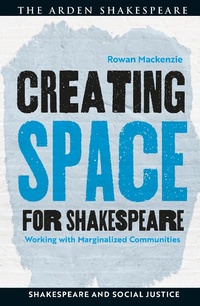
Creating Space for Shakespeare
Working with Marginalized Communities
1st Edition
Published on 9. February 2023
280 pages
978-1-350-27266-8 (ISBN)
Description

Applied Shakespeare is attracting growing interest from practitioners and academics alike, all keen to understand the ways in which performing his works can offer opportunities for reflection, transformation, dialogue regarding social justice, and challenging of perceived limitations. This book adds a new dimension to the field by taking an interdisciplinary approach to topics which have traditionally been studied individually, examining the communication opportunities Shakespeare's work can offer for a range of marginalized people.
It draws on a diverse range of projects from across the globe, many of which the author has facilitated or been directly involved with, including those with incarcerated people, people with mental health issues, learning disabilities and who have experienced homelessness. As this book evidences, Shakespeare can be used to alter the spatial constraints of people who feel imprisoned, whether literally or metaphorically, enabling them to speak and to be heard in ways which may previously have been elusive or unattainable.
The book examines the use of trauma-informed principles to explore the ways in which consistency, longevity, trust and collaboration enable the development of resilience, positive autonomy and communication skills. It explores this phenomenon of creating space for people to find their own way of expressing themselves in a way that mainstream society can understand, whilst also challenging society to 'see better' and to hear better. This is not a process of social homogenisation but of encouraging positive interactions and removing the stigma of marginalization.
It draws on a diverse range of projects from across the globe, many of which the author has facilitated or been directly involved with, including those with incarcerated people, people with mental health issues, learning disabilities and who have experienced homelessness. As this book evidences, Shakespeare can be used to alter the spatial constraints of people who feel imprisoned, whether literally or metaphorically, enabling them to speak and to be heard in ways which may previously have been elusive or unattainable.
The book examines the use of trauma-informed principles to explore the ways in which consistency, longevity, trust and collaboration enable the development of resilience, positive autonomy and communication skills. It explores this phenomenon of creating space for people to find their own way of expressing themselves in a way that mainstream society can understand, whilst also challenging society to 'see better' and to hear better. This is not a process of social homogenisation but of encouraging positive interactions and removing the stigma of marginalization.
More details
Series
Edition
1. Auflage
Language
English
Place of publication
London
United Kingdom
Publishing group
Bloomsbury Publishing PLC
Target group
Professional and scholarly
Illustrations
25 bw illus
ISBN-13
978-1-350-27266-8 (9781350272668)
Copyright in bibliographic data and cover images is held by Nielsen Book Services Limited or by the publishers or by their respective licensors: all rights reserved.
Schweitzer Classification
Other editions
Additional editions
Book
09/2024
The Arden Shakespeare
€55.89
Shipment within 15-20 days
Book
03/2023
The Arden Shakespeare
€119.04
Shipment within 15-20 days
Persons
Rowan Mackenzie is founder of Shakespeare UnBard and Artistic Director of three permanent, collaborative, in-prison theatre companies. She has a PhD from the Shakespeare Institute, University of Birmingham, UK. She has received a number of prestigious awards for her work, including Shakespeare Association of America Public Shakespeare Award 2021, Butler Trust Commendation 2021, Worshipful Company of Educators Inspirational Educator Award for Teaching Shakespeare 2020, Prisoner Learning Alliance Outstanding Individual Award 2019.
Content
List of Illustrations
Introduction
Social justice and Social Injustices
Creative Spaces
Performance Spaces
Reflective Spaces
Mediated Spaces
Chapter 1 - The Need to Break Down Silos
Learning Disabilities
Mental Health Issues
Criminal Justice System
Homelessness
Chapter 2 - Creative Spaces
Short-term Projects
Medium-term Projects
Long-term Projects
Conclusions
Chapter 3 - Performative Spaces
Demarcated Spaces
Appropriated Spaces
Conclusions
Chapter 4 - Reflective Spaces
Individual Reflections
Reflections on Group Dynamics
Conclusions
Chapter 5 - Mediated Spaces
Journalism
Documentaries
Low Budget Media
Written Media
Conclusions
Conclusion
References
Index
Introduction
Social justice and Social Injustices
Creative Spaces
Performance Spaces
Reflective Spaces
Mediated Spaces
Chapter 1 - The Need to Break Down Silos
Learning Disabilities
Mental Health Issues
Criminal Justice System
Homelessness
Chapter 2 - Creative Spaces
Short-term Projects
Medium-term Projects
Long-term Projects
Conclusions
Chapter 3 - Performative Spaces
Demarcated Spaces
Appropriated Spaces
Conclusions
Chapter 4 - Reflective Spaces
Individual Reflections
Reflections on Group Dynamics
Conclusions
Chapter 5 - Mediated Spaces
Journalism
Documentaries
Low Budget Media
Written Media
Conclusions
Conclusion
References
Index
