

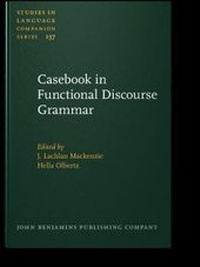
Casebook in Functional Discourse Grammar
1st Edition
Published on 6. September 2013
IX, 313 pages
978-90-272-7158-7 (ISBN)
Description

This book provides ten case studies in Functional Discourse Grammar (FDG), a typologically-oriented theory of the organization of natural languages that has risen to prominence in recent years. The authors, all committed practitioners of FDG, include Kees Hengeveld, the intellectual father of the theory, who shows how it offers a radically new approach to constituent ordering. Other themes covered are evidentiality, modality, adpositions, verb morphology, possession, raising, sequence of tenses, semi-fixed constructions and prelinguistic conceptualization. The volume contains an introduction that explains the rudiments of FDG and summarizes the ten remaining chapters. The Casebook moves on from Hengeveld & Mackenzie's (2008) Functional Discourse Grammar to show how the theory is applied to linguistic problems new and old. The languages treated are Blackfoot, Dutch, English, Spanish, Welsh, indigenous languages of Brazil, and many others.
More details
Other editions
Additional editions
J. Lachlan Mackenzie | Hella Olbertz
Casebook in Functional Discourse Grammar
Book
09/2013
John Benjamins Publishing Co
€100.70
Shipment within 10-15 days
Persons
Content
- Casebook in Functional Discourse Grammar
- Editorial page
- Title page
- LCC data
- Table of contents
- Abbreviations
- Introduction
- References
- A new approach to clausal constituent order
- 1. Introduction
- 2. Constituent ordering in FDG
- 2.1 Introduction
- 2.2 Templates
- 2.3 Hierarchical ordering
- 2.4 Configurational ordering
- 3. Classical constituent order typology
- 4. A new approach to constituent order typology
- 5. An illustration
- 5.1 Introduction
- 5.2 Predicate-medial languages
- 5.2.1 Introduction
- 5.2.2 Dutch
- 5.2.3 English
- 5.2.4 Leti
- 5.2.5 Summary
- 5.3 Predicate-initial languages
- 5.3.1 Introduction
- 5.3.2 Scottish Gaelic
- 5.3.3 Tzotzil
- 5.3.4 Kokota
- 5.3.5 Summary
- 6. Conclusion
- References
- Spatial adpositions between lexicon and grammar
- 1. Introduction: The adposition
- 2. Spatial adpositions, lexical and grammatical
- 3. Justifying the lexical-grammatical distinction for English and other languages
- 4. The Complex Locational Expression and the marking of the semantic category location
- 5. The major adpositional constructions across the world's languages
- 6. Conclusion
- References
- Conceptual representation and formulation
- 1. Introduction
- 2. Outline of the Conceptual Component
- 3. Representing information within the Conceptualizer
- 4. Composition of the Conceptual Level Representation
- 5. Formulation
- 6. Conceptualization and formulation in possessive constructions
- 7. Conceptualization and formulation in passive constructions
- 8. Conclusion
- Abbreviations
- References
- External possessors and related constructions in Functional Discourse Grammar
- 1. Introduction
- 2. Constraints on the indirect object external possessors in Dutch
- 3. The Dutch indirect object external possessor in relation to other constructions
- 3.1 Onomasiological variation
- 3.2 Semasiological variation
- 4. The representation of the indirect object external possessor in FDG
- 5. The representation of related constructions in FDG
- 6. Conclusion
- References
- Time reference in English indirect speech
- 1. Introduction
- 2. Temporal reference: Locating situations in time
- 3. Previous approaches to tense copying
- 3.1 Comrie (1986)
- 3.2 Declerck (1988)
- 4. Functional discourse grammar
- 5. The function of (not) copying tense
- 6. Conclusions
- References
- Raising in Functional Discourse Grammar
- 1. Introduction
- 2. Types of raising
- 3. The pragmatic motivation of raising processes in Spanish
- 3.1 Subject to subject raising (SRR) in Spanish
- 3.1.1 SSR in discourse
- 3.2 Subject-to-Object Raising (SOR) in Spanish
- 4. A FDG analysis of raising
- 4.1 Formal analysis
- 4.2 Pragmatic analysis
- 5. Conclusion
- References
- Objective and subjective deontic modal necessity in FDG - evidence from Spanish auxiliary expressions
- 1. Introduction
- 2. Modal auxiliaries in Spanish
- 3. Objective and subjective deontic modality in FDG
- 4. The scope of objective and subjective deontic modality
- 5. Discussion and conclusion
- 6. Summary and outlook
- References
- Name index
- Language index
- Subject index
