

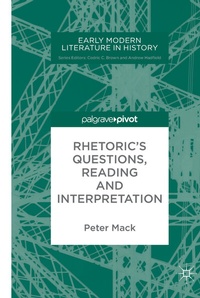
Rhetoric's Questions, Reading and Interpretation
Description

Reviews / Votes
"For over a year I have been privileged to use in my classes the list of questions around which Peter Mack's new publication is constructed. They are the single best tool that I have found to help students determine ways not only to think about texts but more importantly to approach writing about them. Rhetoric's Questions models how to use these questions to analyze significant literary texts, both historical and contemporary, with sophistication and depth. It is an invaluable resource." (Marjorie Curry Woods, Jane and Roland Blumberg Centennial Professor of English, The University of Texas at Austin, USA)"We are familiar today with the ways that rhetoric can help in the teaching of writing and speaking, but less familiar with its role in teaching how to read and listen. But production and interpretation of discourse are reciprocal with one another, and Peter Mack's provocative book on Rhetoric's Questions restores rhetoric to its rightful place as a discipline that shows us how doing either activity teaches us to do the other. The history of rhetoric is a history of responses to a series of enduring and inescapable questions about human discourse, responses that range from reductive school books to philosophical treatises. Mack demonstrates that the now-familiar rhetorical answers to questions about how to produce discourse arise from answers to fundamental and ever-present questions about how to understand discourse. To teach the questions of rhetoric is simultaneously to teach how to read and write, to listen and speak, to understand and act." (Lawrence D. Green, Professor of English and Director of Undergraduate Studies at University of Southern California, USA)
"Rhetoric's Questions is an immensely thoughtful and intelligent guide for readers which outlines the essentials of rhetorical theory and criticism and explains why a knowledge of rhetoric is so valuable for contemporary readers, whatever their particular interests. Peter Mack is a major scholar and critic of rhetoric whose work has explained and illuminated the ways in which the work of Greek and Latin writers was adopted and adapted by thinkers in the European Renaissance to establish how we write and read today. In this short, invaluable, and accessibly-written book, Professor Mack provides an overview of the major rhetorical writers; the strategies they adopted and recommended; and a wealth of examples from Chaucer to Salman Rushdie, to explain how rhetorical theory shapes the writing that we all read and so mediates how we access the world. It is hard to imagine any readers who will not learn a great deal from the author's insights." (Andrew Hadfield, Professor of English at University of Sussex, UK and Chair for Society for Renaissance Studies)
More details
Other editions
Additional editions
Person
Peter Mack FBA is Professor of English at the University of Warwick. His books include: Renaissance Argument (1993), Elizabethan Rhetoric (2002), Reading and Rhetoric in Montaigne and Shakespeare (2010) and A History of Renaissance Rhetoric 1380-1620 (2011). He has been Director of the Warburg Institute, chair of the Society for Renaissance Studies, and editor of the journal Rhetorica .
Content
1. The Questions.- 2. Audience and Occasion.- 3. Structure and Disposition.- 4. Content 1: Narrative.- 5. Content 2: Argument.- 6. Content 3: Further Elements.- 7. Style and Delivery.- 8. From Reading to Writing.- Conclusion.
