

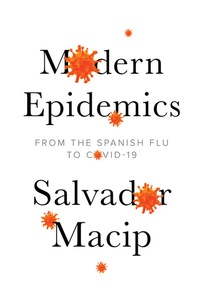
Modern Epidemics
Description

A specialist in the cellular biology of diseases, Salvador Macip explains, in a language everyone can understand, what it means to share the planet with millions of microbes - some wonderful allies, others terrible foes. He provides a concise account of epidemics that changed history, and focuses on the great modern plagues that are still causing millions of deaths every year, from influenza, TB and malaria to COVID-19. Macip also examines the methods we have used - from vaccines to improved sanitation and social distancing - to try to control these invisible enemies.
This authoritative overview of modern epidemics and the pathogens that cause them will be essential reading for anyone who wants to understand our world today, a world in which some of the greatest threats to the human species come from the invisible microbes with which we share this planet.
More details
Other editions
Additional editions
Persons
Content
Introduction
An ever-present danger
In spring 2009, there was an outbreak in Mexico of an influenza pandemic that spread unstoppably around the world in just a few weeks. Many people were taken by surprise as they hadn't imagined that, with all the advances in medicine today, we could still feel so helpless when faced with such a common virus. Yet, scientists had been predicting it for quite some time. When the first edition of this book was published, over a decade ago, by which time that pandemic had started to abate, I was interviewed by some newspapers and repeated the same thing several times: it was indisputable that there would be another pandemic in a few years' time, and we had better prepare in case the virus that would be circulating then turned out to be more aggressive than A(H1N1), the so-called 'swine flu' virus, which was creating so many problems. Such long-term prophecies are easy to make because, if you are wrong, no one remembers, so you don't get taken to task about it afterwards. But, in this case, it wasn't prediction but certainty. All the experts I had spoken to or read while writing this book agreed that it was inevitable. Everyone who had sufficiently studied the matter came to the same conclusion: it wasn't a matter of waiting to see if it would happen but when it would happen.
When I said this, people looked at me not so much with fear as with an amused or incredulous expression. Another alarmist, they must have thought. In the Epilogue of this book, I explain how the publishers of the first version were also surprised when I anticipated the 2009 pandemic some months before it happened. They had an excuse, because they hadn't experienced an infectious disease of such dimensions, but the attitude should have changed after the A(H1N1) flu, which could be regarded as the first pandemic of the modern era, the first to have attacked a globalized, frontierless world. This should have warned us of what can happen when, faced with the appearance of an unknown virus against which we have no defences, we are obliged to act swiftly in order to avert a possible tragedy. But, even so, the outbreak of COVID-19, the disease caused by the new virus called SARS-CoV-2, caught us unawares.
The responses to this second great twenty-first century world health crisis (in terms of viruses) are very similar to those of the first one, namely confusion, panic and uncertainty. Once again, mismanaged information has sown distrust among the public. Perhaps there is one slight improvement in that many countries have responded faster and have shared important data more efficiently. Despite the doubts and unnecessary delays of the early weeks, protective measures are now being more firmly applied. Yet, there are many issues still to be resolved if we want to be better prepared for future pandemics.
Fortunately, SARS-CoV-2 isn't the 'supervirus' that I talk about later in these pages, but it does raise more logistical problems than any of the flu viruses we've seen recently. Although we are still not well enough informed about it, we do know that it spreads very fast (partly because those affected are contagious for a long period without symptoms), and that it has a relatively low mortality rate of probably somewhere near 1 per cent. To give some perspective, this is ten times higher than the 0.1 per cent for seasonal flu but much lower than the 50-80 per cent for Ebola. If we add up these factors, as well as the many uncertainties, there are more than enough reasons to be cautious and to act as fast as possible. It's true that the symptoms it presents are relatively mild in most cases, but in some, especially for certain groups of the population (for example, elderly people and those with serious illnesses), it can be fatal. This, together with the great ease of contagion, can create very serious problems of global health, which is why it is essential to prevent its spread as soon as possible.
However, although COVID-19 is taking up so much media space, it isn't the only infectious disease we should be worried about. In terms of health impact, the four big epidemics and pandemics are still influenza, AIDS, malaria and tuberculosis. It's true that we've recently had the biggest Ebola outbreak in history, but it's still a disease that is restricted to certain areas of the globe. At the same time, we've seen how the coronavirus family has gained prominence, and how these microbes are capable of creating worldwide alerts. The first serious illness caused by these viruses was SARS which, though it was seen as a possible long-term risk at the beginning of the century, appears to be fairly well under control for the moment. After SARS, in 2012 there was MERS (Middle East Respiratory Syndrome), but this, too, remained quite localized. It wasn't until the appearance of the third great coronavirus, SARS-CoV-2, that all the alarms went off.
So, are the coronaviruses the latest danger for humanity? Would they deserve a chapter alongside the other four major infectious diseases? Right now, it's hard to know. Coronaviruses usually come from bats, which act as reservoirs, the places where the viruses survive and reproduce. And it's highly probable that other strains will end up jumping to humans in areas where there's more contact with animals (and China is one of the main loci of the problem because of its traditions and lax regulation of public markets where wild animals are sold). But we will need to wait and see whether or not this ends up becoming a major health problem in the coming decades.
As for COVID-19, its impact will depend on how quickly an effective vaccine is found, produced and administered, and on the virus's ability to keep changing. It seems clear that it's a big enough threat to be taken seriously, and that it's going to cause major problems for quite some time. But, the most likely thing is that we will end up getting the better of it, if all goes well. It's possible that, afterwards, there will still be outbreaks but, in normal circumstances - once a good part of the population has a certain immunity after coming into contact with the virus, and when we have the appropriate complementary tools (vaccine, antivirals, and so on) - it would never cause another pandemic like that of 2020. Nevertheless, this doesn't mean that we can lower our guard. I must insist that there will be more pandemics, and the danger that one of them will be caused by an even more aggressive virus is always going to be present.
Let's do our homework
Meanwhile, what can we do? Prepare ourselves for the future. It's easy to forget the latent problem of pandemics when we've just overcome one and, in statistical terms, it's not very likely that the next one will appear any time soon. But governments have the obligation to plan rapid response measures and, even more important, to instruct the population. Unless people - all the people - participate, we won't be able to confront infections with any guarantee of success. We've already seen this twice in the twenty-first century: when there's a crisis at the global level, it's necessary to count on everyone to root out the problem. The conclusions we can draw in 2020 are the same as those reached in 2009. Most importantly: when a new virus appears, rapid, coordinated action is necessary until we understand the extent of the symptoms it's causing, even if they seem mild at first. And we can only achieve this if we all understand how an infectious disease works and what the real power of microbes is.
Though it may seem excessive, isolating infected populations, encouraging hygiene and avoiding large gatherings of people are highly effective strategies in these situations, especially when it comes to making sure that the disease doesn't cause its own particular kind of collapse of a country's health system, which would end up with many collateral victims. This is crucial in the early phases of an epidemic. But it's also necessary to improve public management of the crisis, which is invariably one of the weak points. And there will always be someone who believes the whole thing is a plot or an exaggeration, but we must manage to ensure that this position remains marginal, and that people listen to those who know what they are talking about. Hence, there needs to be a sound, well-coordinated communication strategy and, if possible, one with a single, reliable source of information (maybe the WHO, or maybe a new body) backed by all the authorities and the media and making the details widely available. And all of us also need to make an effort to learn a bit more about microbes.
SARS and MERS have been warnings of the danger that a microbe from this family could represent in the right conditions, and scientists spoke out loud and clear to announce it. Many people thought they were exaggerating because neither of the two epidemics turned out to be as serious as originally predicted. Now, with millions affected by COVID-19, from Asia to America and everywhere in-between, the fear of being vulnerable to the microbes around us has become generalized. Which position is more correct? Shrugging it off to the point of ignoring the experts' warnings, or panicking about going outside and breathing air that's full of invisible killers? The best idea, of course, is to find a middle course.
However, in order to make these kinds of decisions, we need clear information about the present risks...
