

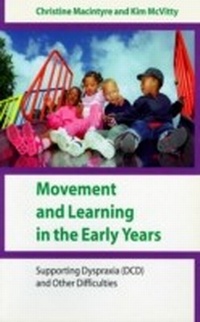
Movement and Learning in the Early Years
Supporting Dyspraxia (DCD) and Other Difficulties
1st Edition
Published on 21. May 2004
160 pages
978-1-4462-3310-8 (ISBN)
Description

`This book achieves what it sets out to do - provide clear guidance to parents and professionals on key aspects of movement in the early years. The book however does more than that - it emphasises that movement in the early years is not the territory of experts, but through the use of this book, the assessment of movement development of activities and programmes are within the range of all - class teachers and parents. I strongly recommend that this book is available in every school' - Educational Review
`This book provides a good overview of issues in movement and development and learning, and will stimulate the interested reader to explore this topic further' - Early Years
`This book will be a useful addition to any primary staff room bookshelf. It is a practical book based on sound theory. It will provide ideas for the non-specialist teacher and for parents anxious to help. The suggestions will provide a good framework for the staged assessment and support for young children for whom there is a cause for concern' - Support for Learning
`For anyone involved in the development of any young child, this should be essential reading. The book is very informative and readable by parents, teachers and students and is simply illustrated with case studies' - Dyslexia Contact
`As a behaviour advisory teacher I will certainly be influenced by reading this, and I know our local occupational therapists would be overjoyed if she knew all teachers read books like this' - Special Children
`It is always good to be able to welcome a book on such a key factor as movement in early childhood development, and this text has been written to support parents and practitioners who wish to understand how movement contributes to all aspects of learning -intellectual, social and emotional, as well as physical' - Marian Whitehead, Nursery World
`This book is an excellent introduction for anybody trying to understand how movement affects child development. It clearly explains the importance movement has on how young children learn and feel. The information and insights in this book can be found elsewhere but I have yet to find such breadth and depth of information on supporting children with movement difficulties as clearly written and accessible as this book' - Spare-Chair
`The book is very informative and readable by parents, teachers and students and amply illustrated with case studies' - Judith Stansfield, SEN ICT Consultant
Movement is a key factor in young children's development and it can affect how they learn and how they feel. Do you work with young children who have difficulties in this area?
This book shows you how to observe a child as they move to allow for early identification of any problem and then tells you how to help. Dyspraxia (DCD) is on the increase in young children and less confident and easy movement can play a part in other specific learning difficulties such as dyslexia, attention deficit disorder (ADD) and with hyperactivity (ADHD).
Included is advice on:
} observing, analyzing and assessing movement development
} building confidence
} helping with handwriting
} supporting mathematical development
Why not ask the child to pop bubble paper as one way of promoting finger awareness? Carefully taught activities can be easy to plan and fun to carry out and there are lots of suggested activities set out in the book.
Early years practitioners in nurseries, schools, playgroups and EYDCPs will find this book clear and useful; it also offers advice to parents.
Christine Macintyre was formerly Senior Lecturer at Edinburgh University and is now a freelance consultant. Kim McVitty is a nursery school teacher.
`This book provides a good overview of issues in movement and development and learning, and will stimulate the interested reader to explore this topic further' - Early Years
`This book will be a useful addition to any primary staff room bookshelf. It is a practical book based on sound theory. It will provide ideas for the non-specialist teacher and for parents anxious to help. The suggestions will provide a good framework for the staged assessment and support for young children for whom there is a cause for concern' - Support for Learning
`For anyone involved in the development of any young child, this should be essential reading. The book is very informative and readable by parents, teachers and students and is simply illustrated with case studies' - Dyslexia Contact
`As a behaviour advisory teacher I will certainly be influenced by reading this, and I know our local occupational therapists would be overjoyed if she knew all teachers read books like this' - Special Children
`It is always good to be able to welcome a book on such a key factor as movement in early childhood development, and this text has been written to support parents and practitioners who wish to understand how movement contributes to all aspects of learning -intellectual, social and emotional, as well as physical' - Marian Whitehead, Nursery World
`This book is an excellent introduction for anybody trying to understand how movement affects child development. It clearly explains the importance movement has on how young children learn and feel. The information and insights in this book can be found elsewhere but I have yet to find such breadth and depth of information on supporting children with movement difficulties as clearly written and accessible as this book' - Spare-Chair
`The book is very informative and readable by parents, teachers and students and amply illustrated with case studies' - Judith Stansfield, SEN ICT Consultant
Movement is a key factor in young children's development and it can affect how they learn and how they feel. Do you work with young children who have difficulties in this area?
This book shows you how to observe a child as they move to allow for early identification of any problem and then tells you how to help. Dyspraxia (DCD) is on the increase in young children and less confident and easy movement can play a part in other specific learning difficulties such as dyslexia, attention deficit disorder (ADD) and with hyperactivity (ADHD).
Included is advice on:
} observing, analyzing and assessing movement development
} building confidence
} helping with handwriting
} supporting mathematical development
Why not ask the child to pop bubble paper as one way of promoting finger awareness? Carefully taught activities can be easy to plan and fun to carry out and there are lots of suggested activities set out in the book.
Early years practitioners in nurseries, schools, playgroups and EYDCPs will find this book clear and useful; it also offers advice to parents.
Christine Macintyre was formerly Senior Lecturer at Edinburgh University and is now a freelance consultant. Kim McVitty is a nursery school teacher.
Reviews / Votes
`It is always good to be able to welcome a book on such a key factor as movement in early childhood development, and this text has been written to support parents and practitioners who wish to understand how movement contributes to all aspects of learning -intellectual, social and emotional, as well as physical' - Marian Whitehead, Nursery WorldAll prices
More details
Edition
First Edition
Language
English
Place of publication
London
United Kingdom
Target group
Professional and scholarly
Product notice
Reflowable
ISBN-13
978-1-4462-3310-8 (9781446233108)
Copyright in bibliographic data and cover images is held by Nielsen Book Services Limited or by the publishers or by their respective licensors: all rights reserved.
Schweitzer Classification
Other editions
Additional editions
Christine Macintyre | Kim McVitty
Movement and Learning in the Early Years
Supporting Dyspraxia (DCD) and Other Difficulties
Book
05/2004
1st Edition
SAGE Publications Inc
€231.76
Shipment within 10-20 days
Christine Macintyre | Kim McVitty
Movement and Learning in the Early Years
Supporting Dyspraxia (DCD) and Other Difficulties
Book
05/2004
1st Edition
SAGE Publications Inc
€96.80
Shipment within 10-20 days
Persons
Christine Macintyre was formerly Senior Lecturer at Edinburgh University and is now a freelance consultant.
Content
EARLY INTERVENTION IN MOVEMENT AND LEARNING
Part One: Making the Case
Development of the Brain
Self-Esteem
Being Bullied
Part Two: Movement and Learning
The ABC of Learning - Attention. Balance and Control
Differences in Movement Ability
The Importance of Movement Ability
The Size of the Problem
Ways to Help
ANALYSING, OBSERVING AND ASSESSING MOVEMENT
Part One: Analysing Movement
Factors for Analysis
Movement Abilities
Open and Closed Skills
Part Two: Observing and Assessing Movement
Assessment
Observation
Examples of the Process of Assessments
Other Factors in Assessment
LEARNING AND PERCEPTION
Part One: Learning and Movement
Constructivism
The Pace of New Learning
Matching Teaching and Learning Styles
Critical Learning Periods
Part Two: Perception
The Vestibular Sense
The Auditory Sense
The Tactile Sense
The Visual Sense
The Senses of Taste and Smell
The Proprioceptive Sense
The Kinaesthetic Sense
Some Questions for Parents to Consider
HANDWRITING AND MATHEMATICS - A MOVEMENT PERSPECTIVE
Part One: Handwriting
A Sense of Hand Preference/Dominance
Ability to Recognise/Visualise/Remember the Pattern of the Letter or Word
The Strength and Control in Their Shoulder, Arm and Hand
The Necessary Movement Abilities
Enough Spatial/Kinaesthetic Competence
The Correct Resources
Enough Space on the Desktop
Left-Handed Writers
Part Two: Mathematics
Conservation
Visual Perception
Sequencing Difficulties
Counting on the Number Rack
Spatial Understanding in Different Algorithms
Mental Maths
The Confusing Language of Mathematics
PROGRAMMES OF ACTIVITIES FOR PERCEPTUAL-MOVEMENT PROGRAMMES
Introduction
Six Golden Rules
Fun Ways of Teaching
Planning and Organising Movement
The Importance of Practice
APPENDICES
Norms of Development
Competences from the Curriculum Guidance Documents
The Underlying Factors Influencing Movement
A Brief Outline of Specific Learning Difficulties
Part One: Making the Case
Development of the Brain
Self-Esteem
Being Bullied
Part Two: Movement and Learning
The ABC of Learning - Attention. Balance and Control
Differences in Movement Ability
The Importance of Movement Ability
The Size of the Problem
Ways to Help
ANALYSING, OBSERVING AND ASSESSING MOVEMENT
Part One: Analysing Movement
Factors for Analysis
Movement Abilities
Open and Closed Skills
Part Two: Observing and Assessing Movement
Assessment
Observation
Examples of the Process of Assessments
Other Factors in Assessment
LEARNING AND PERCEPTION
Part One: Learning and Movement
Constructivism
The Pace of New Learning
Matching Teaching and Learning Styles
Critical Learning Periods
Part Two: Perception
The Vestibular Sense
The Auditory Sense
The Tactile Sense
The Visual Sense
The Senses of Taste and Smell
The Proprioceptive Sense
The Kinaesthetic Sense
Some Questions for Parents to Consider
HANDWRITING AND MATHEMATICS - A MOVEMENT PERSPECTIVE
Part One: Handwriting
A Sense of Hand Preference/Dominance
Ability to Recognise/Visualise/Remember the Pattern of the Letter or Word
The Strength and Control in Their Shoulder, Arm and Hand
The Necessary Movement Abilities
Enough Spatial/Kinaesthetic Competence
The Correct Resources
Enough Space on the Desktop
Left-Handed Writers
Part Two: Mathematics
Conservation
Visual Perception
Sequencing Difficulties
Counting on the Number Rack
Spatial Understanding in Different Algorithms
Mental Maths
The Confusing Language of Mathematics
PROGRAMMES OF ACTIVITIES FOR PERCEPTUAL-MOVEMENT PROGRAMMES
Introduction
Six Golden Rules
Fun Ways of Teaching
Planning and Organising Movement
The Importance of Practice
APPENDICES
Norms of Development
Competences from the Curriculum Guidance Documents
The Underlying Factors Influencing Movement
A Brief Outline of Specific Learning Difficulties
